
Search Colleges, Exams, Schools & more


Login
Transport of Carbon Dioxide MCQ - Practice Questions with Answers
Edited By admin | Updated on Sep 18, 2023 18:34 AM | #NEET
Quick Facts
-

19 Questions around this concept.
Solve by difficulty
 EASY
EASYThe bulk of carbon dioxide $\mathrm{CO}_2$ released from body tissues into the blood is present as
Concepts Covered - 1
Transport of Carbon Dioxide
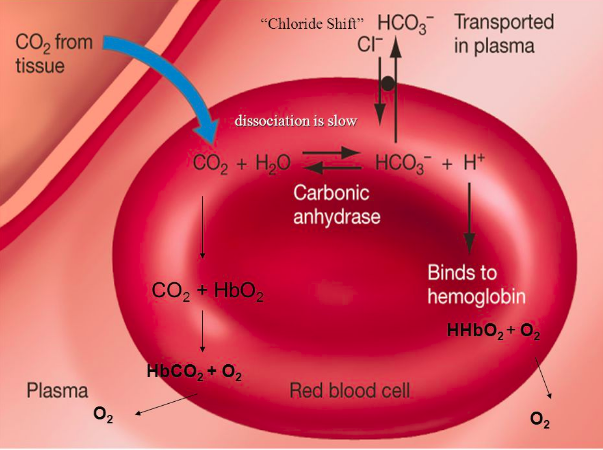
1) Nearly 20-25 percent of CO2 is transported by RBCs:
- The carbon dioxide that enters the RBCs forms a reversible compound with an amino group (NH2) of the globin part of haemoglobin.
- The compound so formed is called carbaminohemoglobin.
2) 70 percent of it is carried as bicarbonate:
- In the RBCs, a zinc enzyme carbonic anhydrase speeds up the formation of carbonic acid.
- Carbonic acid is a weak acid and quickly dissociates into hydrogen and bicarbonate ions.
- The hydrogen ions are buffered by the haemoglobin to form the haemoglobinic acid.
- As bicarbonate ions accumulate in the RBCs, some of them diffuse out into the plasma to prevent the formation of CO2 in the RBCs.
- In order to maintain the ionic balance of blood plasma, the chloride ions diffuse into the RBCs.
- This phenomenon is called the chloride shift or Hamburger Phenomenon
- The bicarbonate ions in the plasma combine with sodium ions to form sodium bicarbonate. These form an important buffering system.
- The chloride ions combine with potassium ions to form potassium chloride.

3) About 7 percent of CO2 is carried in a dissolved state through plasma:
- Some amount of carbon dioxide forms carbonic acid in the plasma.
Study it with Videos
"Stay in the loop. Receive exam news, study resources, and expert advice!"