


Lab Technician Course after 10th - Eligibility Criteria, Top Institutes, Duration
Lab Technician courses after 10th offer a practical career path for those interested in healthcare and science. These courses focus on developing skills in laboratory testing, sample analysis, and handling medical equipment. It is a preferred option for those who want to work in hospitals or diagnostic labs without pursuing an MBBS.
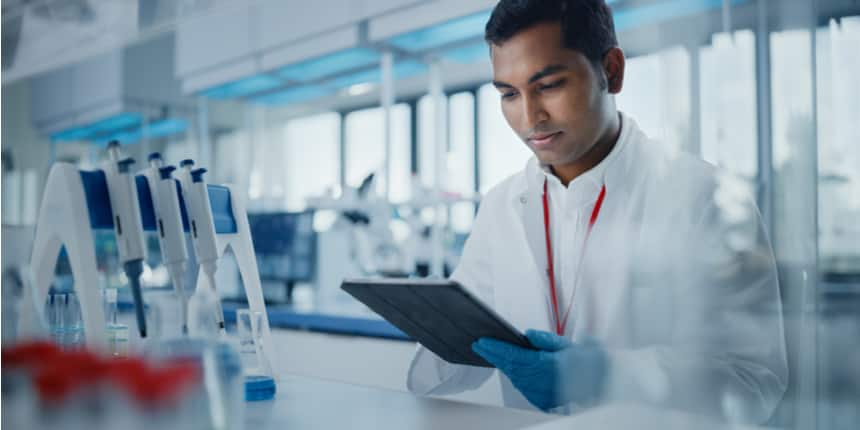
Medical Laboratory Technology is essential in modern healthcare. Lab technicians help detect infections, monitor diseases, and ensure accurate test results that support treatment decisions. Their work forms the foundation for diagnosis and medical planning, highlighting their importance in the healthcare system across hospitals, clinics, research labs, and diagnostic centres.
Also Read: Nursing Courses After 12th
Lab Technician Course after 10th
Medical Lab Technician courses after 10th are popular paramedical options for those interested in the healthcare field. These courses focus on diagnostic testing, lab equipment usage, and medical technology. Here are some of the top courses in lab technology that can help build a strong career in the medical field.
| Course | Eligibility | Duration |
|---|---|---|
Diploma in Medical Lab Technology (DMLT) | Completed class 10 or 12 with a minimum of 50 per cent with PCB as subjects | 2-3 Years |
Diploma in Radio Therapy | Pass class 12th with a minimum of 50 per cent marks in Physics, Chemistry, and Biology. | 2-3 Years |
Bachelor of Medical Lab Technology (BMLT) | Class 12th with a minimum of 50 per cent marks in Physics, Chemistry, and Biology | 4 Years |
Bachelor of Science in Medical Lab Technology (BSc MLT) | 10+2 with a minimum of 50 per cent in the science stream with Biology as the main subject | 3 Years |
BSc Medical Imaging Technology | Completed class 12th with a 50 per cent in Physics, Chemistry, and Biology | 3-4 Years |
Detailed Overview of Lab Technician Courses After 10th
In this section, we provide a detailed overview of each lab technician course mentioned above. These courses provide students with the necessary skills to work in various medical environments, from diagnostic labs to hospitals. Each course focuses on specific aspects of medical technology, ensuring students are well-prepared to contribute to the healthcare industry.
DMLT- Lab Technician Courses After 10th
The Diploma in Medical Laboratory Technology or DMLT course focuses on improving healthcare quality by teaching students how to use various lab techniques and equipment. Students gain skills in identifying and testing cells and body fluids, contributing to disease detection and prevention.
The DMLT course offers in-depth knowledge and practical skills in biochemistry, pathology, microbiology, and haematology. It also trains students to operate advanced lab equipment, conduct precise tests, and work effectively as laboratory technicians. DMLT-trained professionals play an important role in providing physicians with crucial diagnostic information for accurate treatment.
DMLT Colleges:
| Top Colleges | Fees |
|---|---|
Rs. 70,000 | |
Rs. 76,500 | |
Rs. 2.31 lakhs | |
Rs. 58,800 | |
Rs. 1.50 lakhs |
Diploma in Radio Therapy – Lab Technician Courses After 10th
The Diploma in Radio Therapy trains students to assist in cancer treatment by operating radiotherapy equipment. It includes practical and theoretical learning in radiation physics, oncology, and patient care. Students also gain skills in radiation safety and preparing patients for therapy sessions.
This course prepares students for careers in oncology departments, hospitals, and cancer treatment centres. Graduates play an essential role in delivering radiation therapy, contributing to the effective treatment of cancer patients. With this diploma, students can pursue opportunities in various healthcare environments, specialising in radiation therapy and patient care.
Diploma in Radio Therapy Colleges:
| Top Colleges | Fees |
|---|---|
Rs. 1.10 lakhs | |
- | |
Rs. 1.40 lakhs | |
Rs. 40,000 | |
Rs. 76,500 |
BMLT- Lab Technician Course After 10th
The Bachelor of Medical Laboratory Technology or BMLT course provides in-depth training on advanced laboratory diagnostic techniques, focusing on running tests that aid in disease diagnosis and patient treatment. Students gain skills in handling complex lab equipment, ensuring accuracy in their analysis and contributing to the healthcare system’s efficiency.
This course provides students with the skills to perform medical lab tests, enabling them to assist doctors in diagnosing diseases. Upon completion, they can work in hospitals, diagnostic centres, and research institutions, playing an important role in healthcare delivery by ensuring accurate test results for accurate patient care.
BMLT Colleges:
| Top Colleges | Fees |
|---|---|
Rs. 2.05 lakhs | |
- | |
Rs. 1.51 lakhs | |
Rs. 4.59 lakhs | |
Bhavan's Tripura College of Science and Technology, Agartala | Rs. 2.02 lakhs |
BSc MLT- Lab Technician Course After 10th
The BSc Medical Laboratory Technology (MLT) course after 10th, focuses on the operational aspects of healthcare facilities such as clinics, hospitals, and blood banks. Students will learn to prepare medical reports, assist doctors in diagnoses, and perform tests on human fluids to determine health conditions.
This course provides essential practical knowledge to become a skilled laboratory technician, with career opportunities in India and abroad. Graduates of this programme play an important role in healthcare, supporting accurate diagnosis and treatment by conducting tests and assisting medical professionals in providing the best care for patients.
BSc MLT Colleges:
| Top Colleges | Fees |
|---|---|
Rs. 1.95 lakhs | |
Rs. 5.09 lakhs | |
- | |
Jaipur National University | Rs. 3.13 lakhs |
Rs. 1.98 lakhs |
BSc Medical Imaging Technology- Lab Technician Course After 10th
BSc Medical Imaging Technology is a specialised MLT course after the 10th, which focuses on diagnosing diseases through imaging techniques. It helps create visual representations of internal body parts, which are not visible externally. Students will learn how to use equipment like X-rays, CT scans, MRIs, and sonography.
This course plays an important role in healthcare, helping doctors in diagnosing fractures, joint issues, and internal organ conditions. Graduates work with cutting-edge medical technology to produce crucial images that help in accurate diagnosis and treatment, providing essential support in hospitals, diagnostic centres, and healthcare facilities.
BSc Medical Imaging Technology College:
| Top Colleges | Fees |
|---|---|
- | |
Rs. 3,080 | |
Rs. 5.73 lakhs | |
CAM Institute of Allied Health Sciences and Technology, Karamsad | Rs. 2 lakhs |
- |
Career Opportunities and Scope for Lab Technicians
After completing an MLT course, graduates can explore various career opportunities in healthcare, research, and diagnostics. The growing demand for skilled lab technicians ensures ample job prospects in hospitals, clinics, and laboratories. Here are some of the top job roles with their average salary potential in this field.
| Job Roles | Description | Average Salary (LPA) |
|---|---|---|
A medical lab technician conducts tests on patient samples to diagnose diseases. He or she ensures test accuracy and assists doctors in providing appropriate treatments. | Rs. 2.7 LPA | |
Lab Manager | A lab manager is responsible for overseeing daily laboratory operations, ensuring proper equipment maintenance and adherence to safety standards. He or she coordinates the work of lab technicians and maintains the smooth functioning of the lab. | Rs. 8 LPA |
Clinical Research Associate | This professional supports clinical trials by collecting data, analysing results, and contributing to research studies aimed at new drug development or treatment options. He or she can work closely with research teams in healthcare environments. | Rs. 4.5 LPA |
Radiology Technician | A radiology technician operates imaging machines such as X-ray, MRI, and CT scanners to help diagnose medical conditions. He or she ensures accurate imaging while following safety protocols and assisting radiologists in interpreting results. | Rs. 2.6 LPA |
Source: AmbitionBox
Lab Technician courses after 10th offer a solid foundation for a healthcare career without pursuing a medical degree. These programmes develop essential diagnostic skills, opening job opportunities in hospitals, diagnostic centres, and research labs. With the rising demand for medical testing, skilled lab technicians play a crucial role in the healthcare system.
Frequently Asked Questions (FAQs)
DMLT stands for Diploma in Medical Lab Technology and it is a two to three-year-long course.
These courses cover a range of subjects including biochemistry, pathology, microbiology, haematology, medical imaging technology, and other related areas in healthcare and diagnostics.
BMLT (Bachelor’s in Medical Laboratory Technology) is of four years duration.
MLT stands for Medical Lab Technology and these courses are provided at various levels.
Yes, lab technicians are in demand globally, and with the increasing importance of diagnostics in healthcare, there is a continuous need for skilled professionals in this field.
Hospitals (public and private), clinics, labs, research institutions, colleges, blood banks, trauma centres, pharmaceuticals, crime investigation laboratories, and other sectors provide placement opportunities for MLT students.
A minimum of 50 per cent marks in class 10, and in some institutes, a minimum of 50% marks in class 12, in PCB, is required for this DMLT course after 10th.
Moolchand, Fortis, MAX, Phoenix, Asian Heart Institute.
Any medical treatment may only begin after a thorough examination and precise identification of the illness. Doctors recommend treatments or perform procedures as needed based on the findings of these tests, making the MLT course after 10th incredibly important.
Working as a supervisor, advisor, manager, health care administrator, or hospital outreach coordinator are all options.

Top Ranked Medicine and Allied Sciences Colleges
Browse Medicine Colleges by State