


Light-Harvesting Complex MCQ - Practice Questions with Answers
Quick Facts
-

12 Questions around this concept.
Solve by difficulty
 MEDIUM
In which of the following wavelength, photosystem I is inactive ?
Photosystem usually involved in both cyclic and non-cyclic photophosphorylation is
PS- I comprised of
- p - 680, chlorophyll a - 695, p -700, chlorophyll - b and carotenoids
- Chlorophyll a - 670, chlorophyll a - 690, chlorophyll b and phycobilin
The light-dependent reactions of photosynthesis take place in the __________.
Choose the incorrect statement regarding the photosystem II.
Directions: In the following questions, a statement of Assertion (A) is followed by a statement of reason (R).
Assertion: The transport of electrons from excited PS - I to the first electron acceptor is an uphill process.
Reason: Electron goes downhill while transferring from first e-acceptor to cytochrome.
Mark the correct choice as:
Energy required for ATP synthesis in PS II comes from
At the light compensation point, the ratio of the rate of uptake of CO2 in photosynthesis and release of CO2 during respiration is equal to
In photosynthesis, oxygen is produced by
Which of the following is/are the product(s) of cyclic photophosphorylation?
(a) Both NADPH and H+
(b) NADPH
(c) ATP
(d) Both ATP and NADPH
Concepts Covered - 1
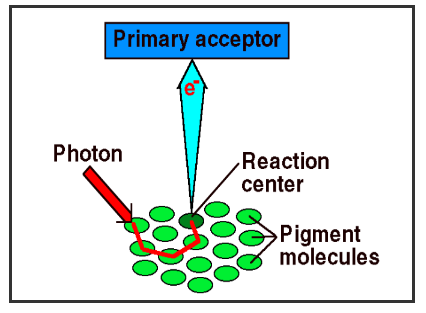
- The smallest group of pigment molecules which take part in the conversion of light energy to chemical energy is called the photosystem.
- It has a reaction centre that is fed by 200 harvesting pigment molecules.
- The harvesting molecules form a protein-based complex called the light-harvesting complex.
- In the light-harvesting complex, there are two types of molecules: Antenna molecules and core molecules.
- Antenna molecules absorb light of various wavelengths but shorter than that of the reaction centre.
- On absorption of the photons, the antenna molecules get excited and electrons are pushed in the outer orbitals.
- The excited antenna molecules hand over their energy to core molecules by resonance and come to the ground state.
- The energy picked up by the core molecules is supplied to the reaction centre.
- On absorption of energy, the photo centre gets excited and extrudes an electron after which it comes to the ground state to repeat the cycle.
- The frequency of excitation of the reaction centre is very high. It cannot be met by its direct absorption and it cannot absorb a shorter wavelength.
- Therefore, the reaction centre needs the help of harvesting molecules in the absorption of light energy.

Study it with Videos
"Stay in the loop. Receive exam news, study resources, and expert advice!"