


Phylum Echinodermata MCQ - Practice Questions with Answers
Quick Facts
-

33 Questions around this concept.
Solve by difficulty
 EASY
EASYWater - Vascular system is found in
The adults are radially symmetrical, but larvae exhibit bilateral symmetry in
Enterocoelom appeared first during the course of evolution in
Which of the following traits is not a characteristic of echinoderms?
An unsegmented body with globular star-like , spherical and discoidal shape is the characteristic feature
The water vascular system is a trait of Echinoderms and functions as a system of
Water canal system: Sponges:: Water vascular system:_______
Exclusively marine animals are found in phyla
In echinoderms, the nervous system is
Echinoderms are
Concepts Covered - 2
- The term ‘Echinodermata’ is obtained from the Greek words 'echinos' meaning spiny and 'derma' meaning skin
- This phylum includes sea stars, sea cucumbers, sea urchins, sand dollars, and brittle stars
- These are exclusively marine
- These are triploblastic with a true coelom
- They bear resemblance to chordates as both are Deuterostomes (Mouth develops last) and both show Enterocoelomic development (body development is through gut)
- Examples: Asterias (Star fish), Echinus (Sea urchin), Antedon (Sea lily), Cucumaria (Sea cucumber) and Ophiura (Brittle star).
Body Plan and Water Vascular System of Echinoderms:
- Adult Echinoderms are pentaradially symmetrical while larvae are bilaterally symmetrical
- Their endoskeleton is made up of calcareous ossicles
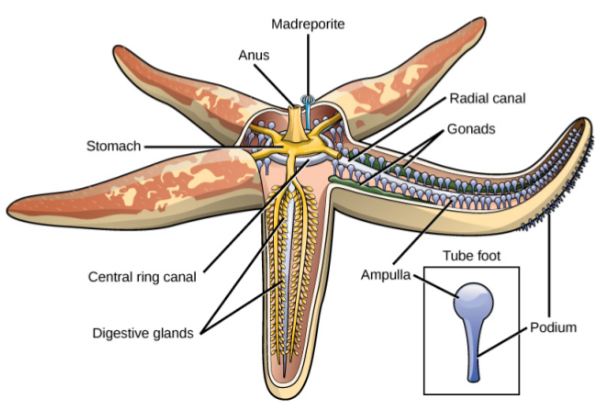
- The coelom is modified to form the characteristic ambulacral or water vascular system
- It consists of a central ring canal and radial canals that stretch along each arm
- The tube-feet project from the holes. The tube-feet show contraction and expansion
- The flow of water in water vascular system can be depicted as:
Water enters through madreporite ⟶ stone canal ⟶ ring canal ⟶ radial canals ⟶ ampulla ⟶ tube feet
- It is used in locomotion, capture of prey, transfer of food and respiration.
Digestion in Echinoderms:
- They have a complete digestive system with mouth located on the ventral side and anus on the dorsal side
Nervous System in Echinoderms:
- They have a simple nervous system with a central nerve ring and five radial rings. There is no grouping of nerves, so brain-like structure is absent
Reproduction and Development in Echinoderms:
- They are dioecious animals. Sexes are separate
- Usually external fertilization takes place
- Development is indirect with the formation of free-swimming larvae
- They also show high capacity of regeneration
Study it with Videos
"Stay in the loop. Receive exam news, study resources, and expert advice!"