
Search Colleges, Exams, Schools & more


Login
AMRU HP BSc Nursing Previous Year Question Papers - PDF Download
Solving previous year question papers is one of the most reliable ways to prepare for the AMRU HP BSc nursing entrance exam, and it matters more here than for many other entrance tests. The exam syllabus is based on the NCERT Class 11 and 12 curriculum rather than a specialised entrance-specific syllabus. Candidates who have already studied Physics, Chemistry, and biology at the higher secondary level can use previous year papers to quickly identify how AMRU frames familiar textbook concepts into AMRU B.Sc. nursing entrance questions. This article covers the exam pattern previous year papers reflect, why they are worth practising, how questions are distributed across subjects, and how to use them for better preparation. A combined PDF eBook with previous years' papers and solutions is available to download below.
This Story also Contains
- Download AMRU HP BSc Nursing Previous Year Question Papers PDF
- AMRU HP BSc Nursing Exam Pattern: What the Previous Year Papers Reflect
- Why Previous Year Question Papers Matter for AMRU BSc Nursing Preparation
- Subject-wise Distribution in AMRU HP BSc Nursing Previous Year Papers
- Difficulty Level and Question Trends of AMRU HP BSc Nursing in Recent Years
- How to Use the AMRU HP BSc Nursing Previous Year Question Paper PDF Effectively
Download AMRU HP BSc Nursing Previous Year Question Papers PDF
A combined PDF eBook covering previous years' AMRU HP BSc Nursing question papers, along with detailed solutions for every question, is available to download below:
Resource | Details | Link |
AMRU HP BSc Nursing Previous Year Question Papers (Combined eBook with Solutions) | Includes previous years' papers with correct options and explanations. |
Confused About College Admissions?
Get expert advice on college selection, admission chances, and career path in a personalized counselling session.
Book a Counselling Slot
Select Date
Pick a Slot
AMRU HP BSc Nursing Exam Pattern: What the Previous Year Papers Reflect
The Atal Medical and Research University, Himachal Pradesh (AMRU), formerly known as the Himachal Pradesh University of Health Sciences, conducts the HP BSc Nursing Entrance Test as the sole gateway for admission to the four-year BSc Nursing programme across government and private nursing colleges affiliated with the university in Himachal Pradesh. The exam is open only to female candidates, a fixed eligibility rule that AMRU applies uniformly across all categories and college quotas.
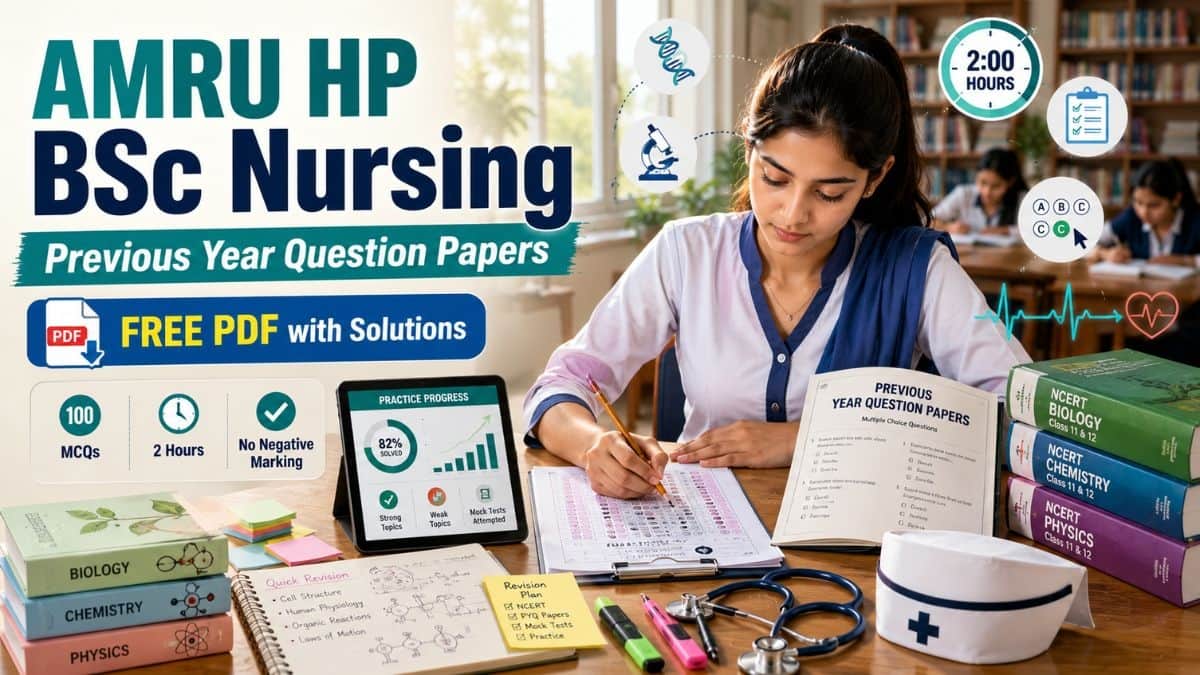
The test itself is an offline, OMR-based examination consisting of 100 objective-type multiple-choice questions, to be completed in two hours. There is no negative marking, so candidates are free to attempt every question without the risk of losing marks for an incorrect response. Every previous year paper released so far has followed this same 100-question, two-hour, no-negative-marking format, which makes older papers a dependable rehearsal for the actual test-day experience rather than just a topic-revision tool.
Why Previous Year Question Papers Matter for AMRU BSc Nursing Preparation
Because the AMRU BSc Nursing syllabus is drawn directly from the Class 11 and 12 NCERT textbooks (aligned with the Himachal Pradesh Board of School Education's 10+2 curriculum), the entrance test does not introduce unfamiliar content so much as it tests how well a candidate can recall and apply what she has already studied under exam conditions. Previous year papers are useful precisely because they show how AMRU converts standard textbook material, such as a chapter on plant physiology or organic chemistry reactions, into a quick, single-best-answer MCQ format.
Working through actual past papers also helps candidates in three concrete ways: it builds familiarity with the phrasing AMRU tends to use, it exposes recurring high-frequency topics across subjects, and it trains time management, since 100 questions in 120 minutes leaves an average of a little over a minute per question. Candidates who have reviewed a stretch of previous years' papers tend to move through the actual exam with noticeably less hesitation on question format, leaving more time for subjects that genuinely need extra thought.
Subject-wise Distribution in AMRU HP BSc Nursing Previous Year Papers
Every previous year paper has followed a consistent, evenly split subject-wise structure. Rather than weighting any one subject more heavily, AMRU distributes questions equally across five sections:
Subject | Number of Questions |
Physics | 20 |
Chemistry | 20 |
Biology | 20 |
English | 20 |
Nursing Aptitude | 20 |
Total | 100 |
This even 20-20-20-20-20 split has held steady across the previous year papers available, which makes it reasonable for candidates to plan their revision time proportionally across all five sections rather than assuming any single subject will dominate the paper.
Difficulty Level and Question Trends of AMRU HP BSc Nursing in Recent Years
Feedback from candidates who appeared for the AMRU BSc Nursing exam in recent cycles has generally described the paper as being on the easier side, with questions drawing on fairly standard, direct concepts from the NCERT syllabus rather than unusually twisted or application-heavy framing. Biology and Chemistry questions have tended to test direct recall of textbook definitions and classifications, such as genetics terminology or basic organic chemistry reactions, while Physics questions have generally stayed close to standard numerical and conceptual problems from the Class 11 and 12 syllabus. The Nursing Aptitude section, unique to this exam among general science entrance tests, has consistently focused on general awareness, reasoning, and basic aptitude rather than specialised nursing knowledge, which means it can be prepared for using standard aptitude practice material rather than nursing textbooks.
Because the overall pattern, question count, and subject-wise split have stayed unchanged across recent years, the most useful takeaway from studying multiple years' papers side by side is not a dramatic shift in difficulty but rather a consistent sense of which chapters within each NCERT subject repeat most often, which is exactly the kind of pattern that becomes visible only after solving several years' worth of papers together.
How to Use the AMRU HP BSc Nursing Previous Year Question Paper PDF Effectively
Simply reading through old papers is far less effective than solving them under timed, exam-like conditions. A more effective approach is to attempt each paper within the actual two-hour limit, without pausing to look up answers midway, and only review solutions once the attempt is complete. This helps candidates get an honest sense of their pacing across 100 questions and identify which of the five sections is consuming disproportionate time.
Once a paper has been attempted, it is worth going through every question, including the ones answered correctly, since previous year papers with detailed solutions often clarify why a particular option is correct in a way that plain textbook reading does not. Reviewing mistakes chapter-wise, rather than only noting the final score, also helps in mapping recurring weak areas back to specific NCERT chapters that may need another revision pass before the next attempt.
Frequently Asked Questions (FAQs)
Q: How many questions are asked in the AMRU HP BSc Nursing entrance exam, based on previous year papers?
A:
Based on previous year question papers, the AMRU HP BSc Nursing entrance exam consists of 100 multiple-choice questions, divided equally into 20 questions each from Physics, Chemistry, Biology, English, and Nursing Aptitude, to be completed within two hours.
Q: Is there negative marking in the AMRU HP BSc Nursing exam?
A:
No. Previous year papers and the exam pattern confirm that there is no negative marking in the AMRU HP BSc Nursing entrance exam, so candidates can attempt all 100 questions without the risk of losing marks for incorrect answers.
Q: Are AMRU HP BSc Nursing previous year question papers enough for exam preparation?
A:
Previous year question papers are a valuable and highly recommended preparation resource, since they reflect the exam's real question format and recurring topics, but they work best alongside a thorough revision of the NCERT Class 11 and 12 syllabus, since all exam questions are drawn directly from this coursework rather than from outside material.
Articles
Related Stories
|
Upcoming Medicine Exams

Certifications By Top Providers
Explore Top Universities Across Globe
Popular Courses and Specializations
List of colleges accepting AMRU HP BSc Nursing

Applications for Admissions are open.
Ranked #19 by NIRF, NAAC A++ Accredited | Recognized by dental council of India
Krishnadevaraya College of Dental Sciences and Hospital, Bangalore
ApplyRanked among the top Dental Colleges for 7 consecutive years by India Today poll
AMRU HP BSc Nursing Notifications
Never miss AMRU HP BSc Nursing update
Get timely AMRU HP BSc Nursing updates directly to your inbox. Stay informed!