NEET PG College Predictor
NEET PG All India & State College Predictor with Admission Process Guide


Most repeated Biology diagrams and data-based questions in NEET hold great significance for NEET 2027 aspirants. NEET Biology carries 360 marks under the existing pattern. Thus, Biology holds great importance from the point of view of improving the overall score in NEET.
This Story also Contains
.jpg)
NCERT Biology diagrams, labelling, flowcharts, pedigree charts, Punnett square, graphs, and experimental data hold great value for practice. Revising such visually based concepts along with NCERT theory and previous year NEET question papers is important for NEET exam aspirants. Even though past trends serve as guiding factors for preparation, none of the diagrams or questions is guaranteed to be repeated in NEET 2027.
This article presents important Biology diagrams for NEET 2027, practice questions with answer keys, and data-based MCQs.
Diagram-based questions can be expected in NEET Biology since questions may be asked based on the identification, labelling, function or process represented in the diagram. NEET exam recent trends reveal the recurrence of topics like Genetics, Biotechnology, Cell Biology, reproduction, plant morphology and human physiology.
The following is the list of the most important biology diagrams and visual concepts students need to go through for revision from NCERT:
Chapters | Diagram based on Topics/Concepts |
|---|---|
Structure of Nephron, Filtration, and reabsorption areas | |
Role of repressor protein, structural gene, Central Dogma | |
Monohybrid and dihybrid cross, Pedigree Charts, Punnett square | |
Spermatogenesis, Oogenesis, structure of sperm | |
Fruit, Seed, Position of floral parts, labeling of anther, stigma, ovary, ovule | |
Pollination | |
Types of muscles, epithelial, and connective tissues | |
Selectable markers in cloning vector pBR322, Bioreactor, plasmid |
When revising quickly, concentrate on the diagrams in Genetics & Molecular Biology, Biotechnology, Cell Biology, Human Reproduction, Plant Reproduction and Human Physiology. It is not only about the labels, but also about the function of those parts and the process shown in the diagram.
Key diagrams to revise include:
DNA structure and replication
Central dogma and lac operon
Mitosis and meiosis
Monohybrid and dihybrid crosses
Pedigree charts and Punnett squares
Nephron
Human reproductive system
Spermatogenesis and oogenesis
Flower, ovule and embryo sac
pBR322 and recombinant DNA technology
Cell organelles
Heart and neuron
The NEET previous year paper includes a variety of diagram-based questions that require a different approach for preparation. The main types of frequently asked diagram-based questions in NEET are given below.
Part-labelling questions – In these types of questions, students have to choose the correctly labelled part of a diagram, such as a monocot or a dicot seed.
Diagram identification- Candidates must recognise the image and what it depicts, such as tissue types or the stage of mitosis.
Function-based questions - Diagrams are used to ask about the function of a specific part, like guard cells in stomata.
Flow chart diagram questions - These involve the flow charts of spermatogenesis, photosynthesis, & questions are asked based on the flow charts.
The previous year's paper analysis makes students familiar with the types of questions asked by the NTA. NEET biology diagram-based questions, along with the solutions, are provided below. By going through these, aspirants can identify the mistakes and learn the correct way to answer the questions. They also have to revise the NEET biology syllabus to gain clarity on all these topics before the exam.
Question 1: Which part of the fruit, labelled in the given figure, makes it a false fruit?
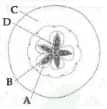
B: Endocarp
C: Thalamus
D: Seed
A: Mesocarp
Ranked #19 by NIRF, NAAC A++ Accredited | Recognized by dental council of India
Special Scholarship for Students from Goa (Get an exclusive scholarship of ₹20,000 if you're a Goa-based student) | Bringing Parul Education Trust's 30-year Education Legacy to Goa
Answer: The correct answer is option (2) Thalamus.
Explanation: In a false fruit like an apple, the thalamus contributes to fruit formation along with the ovary. Hence, it is called a false fruit because it develops from parts other than the ovary.
Question 2: Which one of the following symbols represents mating between relatives in human pedigree analysis?


Answer: The correct answer is option (1).
Explanation: The symbol in option (1) shows a double horizontal line between the male and female, which denotes mating between relatives in pedigree charts.
Question 3: In the given figure, which component has thin outer walls and highly thickened inner walls?
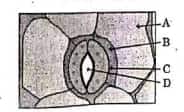
C
D
A
B
Answer: The correct answer is option (1).
Explanation: The component labelled C has thin outer walls and highly thickened inner walls, a structure characteristic of cells that provide mechanical support due to thickened secondary walls.
Question 4: Identify the part of the seed from the given figure that is destined to form a root when the seed germinates.
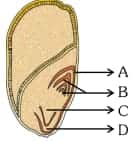
A
B
C
D
Answer: The correct answer is option (3).
Explanation: The part marked C is the radicle, the embryonic structure that gives rise to the primary root when the seed germinates. It is located below the hypocotyl and is the first to emerge during seed germination.
Question 5: With the help of the given pedigree, find out the probability for the birth of a child having no disease and being a carrier (has the disease mutation in one allele of the gene) in the F3 generation.
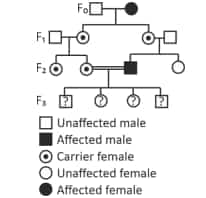
Zero
¼
½
⅛
Answer: The correct answer is option (2) ¼.
Explanation: The cross between a carrier female (XᴬXᵃ) and an unaffected male (XᴬY) produces a 25% probability of a child being unaffected and a carrier (XᴬXᵃ), as the disease gene is recessive and linked to the X chromosome.
Qualifying for the NEET exam requires a clear understanding of visual concepts and their applications. Focusing on the most repeated biology diagrams in NEET helps aspirants identify the important topics. A few useful tips for studying important biology diagrams for NEET are provided below. Students can incorporate these strategies into their NEET study plans for effective results.
Study the pedigree chart, seed, flower, animal tissues, and human reproduction, which are among the most repeated biology diagrams in NEET.
Assess the NEET question papers to identify the frequently asked diagram-based questions in NEET.
Use the colour-coding technique to label each part of the NEET biology diagram-based questions.
To clearly understand the difference between similar diagrams like monocot and dicot seeds, to avoid confusion.
Use flashcards for the important biology diagrams for NEET, and shuffle cards every week to strengthen knowledge.
Data-based questions in NEET Biology assess the capability of a student to understand and use NCERT concepts through information rather than just rote learning. Data-based questions could be based on tabulated data, graphs, observations from experiments, crosses, probabilities, processes in biotechnology or any numerical/factual data.
Important topics to practice NCERT-based biology MCQs include Genetics, Molecular Basis of Inheritance, Biotechnology and plant physiology. Analysis of NEET Biology paper also reveals repeated questions from Genetics, Biotechnology and molecular biology concepts.
During the process of solving data-based questions, identify the given information, relate it to the NCERT concept and then proceed to eliminate the wrong options.
Ques: In a plant, black seed colour (BB/Bb) is dominant over white seed colour (bb). In order to find out the genotype of the black seed plant, with which of the following genotypes will you cross it?
Option 1) BB
Option 2) bb
Option 3) Bb
Option 4) BB/Bb
Answer: In a test cross, an organism with an unknown genotype is mated to an organism with a known genotype in order to ascertain the genotype of the unknown organism. The test cross is said to have been created by Gregor Mendel. To determine the genotype of a black seed colour at F2, the black seed from F2 is crossed with the white seed colour. This is called a test cross. To determine the genotype of (BB/Bb) black seed, we need to cross it with white seed (bb)
Hence, the correct answer is Option (2) bb
Ques: Plasmid pBR322 has a PstI restriction enzyme site within gene ampR that confers ampicillin resistance. If this enzyme is used for inserting a gene β galactoside production and the recombinant plasmid is inserted in an E.coli strain.
Option 1) It will not be able to confer ampicillin resistance to the host cell.
Option 2) The transformed cells will have the ability to resist ampicillin as well as produce β galactoside.
Option 3) It will lead to lysis of the host cell.
Option 4) It will be able to produce a novel protein with a dual ability.
Answer: A gene called ampR found on the plasmid pBR322 renders E. coli resistant to the antibiotic ampicillin. This gene contains a unique location that can be cut by the restriction enzyme PstI.
The ampR gene will be broken if a new gene, such as the gene for galactoside synthesis, is inserted using PstI. At that point, the plasmid can no longer provide ampicillin resistance to the cell.
E. Coli carrying this recombinant plasmid will therefore not be able to thrive on plates containing ampicillin. Scientists can determine whether or not the plasmid has the new gene in this way.
Hence, the correct answer is option 1)It will not be able to confer ampicillin resistance to the host cell.
Analyse the data, graph, table, or cross before analysing the options.
Determine which NCERT topic is tested.
Note the genotype, ratio, sequence, or relationship if needed.
Compare the data with the NCERT topic.
Exclude those options which contradict the given data.
Solve NEET PYQs & NCERT-based MCQs.
Frequently Asked Questions (FAQs)
They are direct NCERT‑based, predictable, and scoring, helping aspirants secure marks quickly in NEET 2027 Biology.
They test analytical skills and application of NCERT concepts, often using tables, charts, or experimental data from chapters like photosynthesis, inheritance, and biotechnology.
Yes. They are generally short, direct, and predictable, making them faster to solve than lengthy theoretical questions.


NEET PG All India & State College Predictor with Admission Process Guide
End-to-End NEET PG Admission Guidance | One-to-One Counselling | College Predictors | Regular Updates | E-books
Ranked #19 by NIRF, NAAC A++ Accredited | Recognized by dental council of India
Special Scholarship for Students from Goa (Get an exclusive scholarship of ₹20,000 if you're a Goa-based student) | Bringing Parul Education Trust's 30-year Education Legacy to Goa
Ranked among the top Dental Colleges for 7 consecutive years by India Today poll