SRM Kattankulathur Dental College and Hospital, Kattankulathur
Ranked #19 by NIRF, NAAC A++ Accredited | Recognized by dental council of India


RUHS BSc Nursing Question Papers PDF (2020–2026) with Answers & Solutions: Solving RUHS BSc Nursing previous-year question papers helps you understand the entrance exam pattern, key topics, and difficulty level. By solving the RUHS BSc Nursing previous-year question papers, candidates will get an idea of the type of questions asked, and their solving speed and accuracy will improve.
Download Now: RUHS CUET Question Paper 2026 PDF with Answer Key, Solutions & Analysis
This Story also Contains
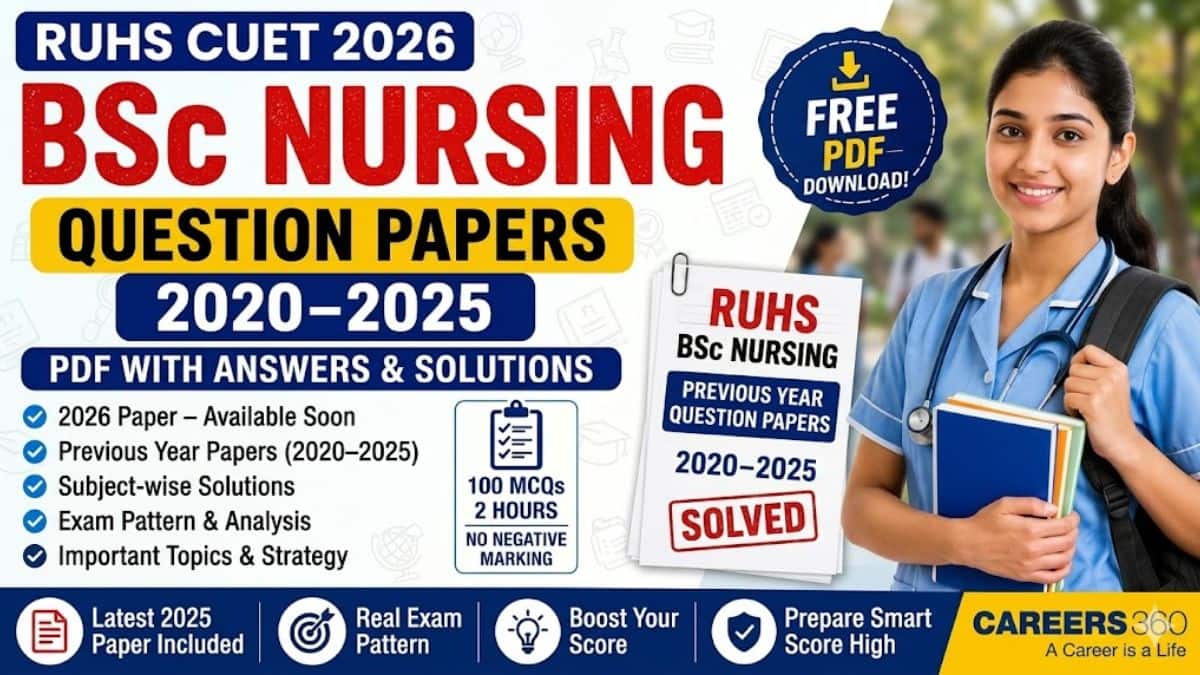
Candidates will find RUHS CUET BSc Nursing question papers PDF from 2020 to 2025 with solutions here. Aspirants who are preparing for the RUHS BSc Nursing 2027 Entrance Exam can download the RUHS BSc Nursing question papers and solve Physics, Chemistry and Biology questions. The RUHS BSc Nursing 2027 exam dates have not been announced yet.
RUHS BSc Nursing Entrance Exam Question Paper 2027 will be helpful for the aspirants who are preparing for the upcoming entrance exam. The official notification for 2027 has not yet been issued by RUHS. According to the available expected timetable, the notification is likely to be issued in March 2027, followed by applications starting in April and exams being held in May 2027.
Ranked #19 by NIRF, NAAC A++ Accredited | Recognized by dental council of India
Special Scholarship for Students from Goa (Get an exclusive scholarship of ₹20,000 if you're a Goa-based student) | Bringing Parul Education Trust's 30-year Education Legacy to Goa
These are expected dates only and shall not be considered as finalised until the official notification is issued.
Get expert advice on college selection, admission chances, and career path in a personalized counselling session.
The RUHS CUET BSc Nursing 2026 question paper PDF, official answer key, memory-based solutions, and detailed subject-wise exam analysis are available now.
RUHS CUET 2026 Question Paper - Download Here
Download RUHS CUET question paper 2025, 2024 and 2023 PDF, along with other previous-year papers provided in the table below. Practising these papers helps candidates to get an idea of the RUHS BSc Nursing Exam preparation and important topics.
Download Here - RUHS CUET Nursing Question Paper with solution PDF (2020-2025)
Candidates can refer to the RUHS BSc Nursing previous years' papers with answer keys and solutions for revision and practice.
Candidates must ensure to verify the source of the question paper prior to practising. RUHS doesn't offer direct download options for all previous years' question papers on its website. The academic platform offers papers which could be the official paper or questions as remembered by candidates.
The memory-based papers are compiled on the basis of questions remembered by candidates post-exam. The phrasing or arrangement of questions might vary from the actual question paper.
Students who wish to obtain an RUHS BSc Nursing question paper in Hindi must ensure the language is mentioned along with the paper.
Understanding the exam pattern is important before solving previous year papers.
Parameter | Details |
Total Questions | 100 |
Total Marks | 100 |
Physics | 33 questions |
Chemistry | 33 questions |
Biology | 34 questions |
Duration | 120 minutes |
Negative Marking | No |
RUHS BSc Nursing entrance exam negative marking and duration should be known by the candidates before beginning preparation. Candidates must also cross-check the latest exam notification regarding the same.
There is a difference between the sources regarding the mode of the examination. It needs to be verified from the latest RUHS information bulletin how the 2027 exam will be held, whether online or offline OMR mode.
Current Electricity
Optics
Laws of Motion
Modern Physics
Thermodynamics
Chemical Bonding
Acids, Bases & pH
Organic Basics
Periodic Table
Biomolecules
Ranked among the top Dental Colleges for 7 consecutive years by India Today poll
Cell Cycle
Genetics
Human Reproduction
Evolution
Ecology
The questions asked in RUHS BSc exam are mentioned here, subject-wise:
Question 1:
The SI unit of electric charge is:
A) Ampere
B) Coulomb
C) Volt
D) Ohm
Correct Answer: (B)
Explanation:
SI unit of charge is Coulomb, defined as 1C=1A⋅s.
Question 2:
A body is thrown vertically upward with a velocity 2m/s. The maximum height reached is: (g=10m/s2)
A) 10m
B) 0.20m
C) 40m
D) 5m
Correct Answer: (B)
Explanation:
Using $h=\frac{u^2}{2g}$:
$h=\frac{2^2}{2\times9.8}\approx0.20$ m.
So the correct maximum height is 0.20 m
Question 3:
Which type of mirror is used in a vehicle's rear-view mirror?
A) Concave
B) Plane
C) Convex
D) Bifocal
Correct Answer: (C)
Explanation:
A convex mirror gives a wider field of view and forms a diminished image.
Question 4:
The phenomenon of total internal reflection is used in:
A) Periscope
B) Optical fibre
C) Microscope
D) Telescope
Correct Answer: (B)
Explanation:
Optical fibre works on total internal reflection when θi>θc.
Question 5:
The unit of power is:
A) Joule
B) Newton
C) Watt
D) Pascal
Correct Answer: (C)
Explanation:
1W=1Js.
Question 1:
Which of the following vitamins is water-soluble?
Options:
A. Vitamin A
B. Vitamin D
C. Vitamin K
D. Vitamin C
Correct Answer: D) Vitamin C
Explanation:
Vitamins are categorised into two types based on their solubility: fat-soluble and water-soluble.
Fat-soluble vitamins include A, D, E, and K, which are stored in the body’s fatty tissues and liver.
Water-soluble vitamins, such as Vitamin C and B-complex vitamins, dissolve in water and are not stored in the body, meaning they need to be consumed more regularly.
Vitamin C (ascorbic acid) is a classic water-soluble vitamin, essential for tissue repair, the enzymatic production of certain neurotransmitters, and immune function.
Question 2:
The pH of pure water at 25∘C is:
A) 0
B) 7
C) 14
D) 5
Correct Answer: (B)
Explanation:
[H+]=10−7, so pH=−log[H+]=7.
Question 3:
Which gas is produced when zinc reacts with dilute sulphuric acid?
A) Oxygen
B) Sulphur dioxide
C) Hydrogen
D) Carbon dioxide
Correct Answer: (C)
Explanation:
Zn+H2SO4→ZnSO4+H2↑
Question 4:
The atomic number of Carbon is:
A) 8
B) 10
C) 6
D) 12
Correct Answer: (C)
Explanation:
Atomic number Z=6.
Question 5:
Bleaching powder is used as a disinfectant because it releases:
A) Oxygen
B) Hydrogen
C) Chlorine
D) Nitrogen
Correct Answer: (C)
Explanation:
Bleaching powder releases Cl2, which acts as a disinfectant.
Question 1:
Histone proteins are rich in:
(A) Aspartic acid and glutamic acid
(B) Alanine and isoleucine
(C) Proline and valine
(D) Lysine and arginine
Correct Option: (D) Lysine and arginine
Explanation:
Histone proteins are positively charged due to a high content of basic amino acids like lysine and arginine. This positive charge allows histones to bind tightly to the negatively charged phosphate backbone of DNA, facilitating DNA packaging in the nucleus into structures called nucleosomes. This interaction is essential for chromatin structure and gene regulation.
Question 2:
The DNA sequence that provides the binding site for RNA polymerase is called:
(A) Promoter site
(B) Operator site
(C) Terminator site
(D) Structural site
Correct Option: (A) Promoter site
Explanation:
The promoter site is a specific DNA sequence where RNA polymerase binds to initiate transcription. It is located upstream of the coding region of a gene and contains specific motifs like the TATA box in eukaryotes. This region ensures that RNA polymerase starts transcription at the correct location. Other sites, like the operator, regulate transcription (especially in prokaryotes), the terminator signals transcription to stop, and the structural site refers to the actual coding region of the gene.
Question 3:
Which cell is responsible for androgen secretion?
(A) Sertoli cells
(B) Interstitial cells
(C) Leydig cells
(D) Sperm
Correct Option: (C) Leydig cells
Explanation:
Leydig cells, also known as interstitial cells, are located in the spaces between the seminiferous tubules of the testes. These cells are responsible for the production and secretion of androgens, primarily testosterone. This process is regulated by luteinizing hormone (LH) from the anterior pituitary gland. The testosterone secreted by Leydig cells plays a vital role in the development of male secondary sexual characteristics and the maintenance of spermatogenesis.
Question 4:
Embryological support for evolution was proposed by:
(A) Alfred Wallace
(B) Ernst Haeckel
(C) Charles Darwin
(D) Ugo de Vries
Correct Option: (B) Ernst Haeckel
Explanation:
Ernst Haeckel proposed the idea that embryological development in different species shows similarities that reflect their evolutionary ancestry. He formulated the “biogenetic law,” often summarised as "ontogeny recapitulates phylogeny," which suggested that the development of an organism (ontogeny) retraces the evolutionary history (phylogeny) of its species. While the strict interpretation of this idea has been discredited, comparative embryology remains an important line of evidence for common descent.
Question 5:
DNA replication occurs during which phase of the cell cycle?
A) G1 phase
B) S phase
C) G2 phase
D) M phase
Correct Answer: (B)
Explanation:
DNA synthesis occurs in S phase of interphase.
1. Real Exam Familiarity: Previous papers provide the closest simulation of actual RUHS exam standards.
2. Identify High-Weightage Chapters: Repeated chapters often dominate RUHS papers.
3. Speed & Accuracy Improvement: Timed practice significantly boosts performance.
4. Subject-Wise Trend Analysis: Students can pinpoint:
Physics numericals
Chemistry NCERT concepts
Biology factual dominance
5. Better Score Prediction: Mock practice with PYQs improves realistic performance evaluation.
Solve 2026 + 2025 papers
Identify weak areas
Build formula sheets
Solve 2024 + 2023 papers
Time-bound practice
Analyse mistakes
Solve 2022 + 2021 papers
Focus revision
Full mock simulations
Simply downloading RUHS BSc Nursing previous year question papers is not enough. Candidates should follow a structured approach to maximise their preparation and improve their chances of securing a good score in the entrance examination.
Start With the Latest Question Paper
Students should begin with the most recent RUHS BSc Nursing question paper, as it reflects the latest exam pattern, subject distribution and question style. Solving the latest paper helps candidates understand current trends and identify important topics.
Solve Papers in a Timed Environment
Attempt previous year papers within the actual exam duration to improve speed and accuracy. This practice helps students develop effective time-management skills and build confidence before the examination.
Analyse Mistakes Carefully
After completing a paper, review incorrect answers and identify weak areas. Maintaining an error notebook can help candidates avoid repeating similar mistakes during the actual examination.
Focus on Frequently Asked Topics
Several topics are repeatedly tested in RUHS BSc Nursing entrance examinations. Candidates should pay special attention to high-weightage chapters from Physics, Chemistry and Biology while revising previous year questions.
Track Progress Regularly
Students should compare their performance across multiple papers and monitor improvements in accuracy, speed and subject-wise scores. Consistent practice with previous year question papers can significantly enhance overall exam readiness.
Ignoring Biology weightage
Skipping previous papers
Not reviewing mistakes
Over-focusing on theory only
Poor time management
Students who thoroughly practise RUHS BSc Nursing question papers from 2020–2026 gain a significant strategic advantage.
Frequently Asked Questions (FAQs)
RUHS BSc Nursing 2027 exam will be held tentatively in May 2027. The exact date will be declared by RUHS notification.
Yes, there might be resources for question papers in Hindi/English language if applicable. Candidates must verify the language of every question paper available.
There can be some resources which are official copies of the question papers and there can be memory based questions which have been compiled by students feedback. Candidates must verify the source first before using them.


Ranked #19 by NIRF, NAAC A++ Accredited | Recognized by dental council of India
Special Scholarship for Students from Goa (Get an exclusive scholarship of ₹20,000 if you're a Goa-based student) | Bringing Parul Education Trust's 30-year Education Legacy to Goa
Ranked among the top Dental Colleges for 7 consecutive years by India Today poll