NEET PG College Predictor
NEET PG All India & State College Predictor with Admission Process Guide


Human Reproduction NEET questions with solutions are helpful for practising one of the significant Class 12 Biology chapters for NEET 2027. The chapter deals with male and female reproductive systems, spermatogenesis, oogenesis, menstrual cycle, fertilisation, implantation, pregnancy, parturition, and lactation.
This Story also Contains
The previous years' NEET Biology papers have revealed that Human Reproduction has been a consistent chapter every year, and the frequency of questions in the chapter has been variable every year. Thus, the chapter of Human Reproduction is a valuable chapter to revise in NEET 2027, but past weightage is just an indicative value only.
Practice of Human Reproduction Questions for NEET 2027 helps the candidates in recognising the frequently asked concepts, practising various types of questions, and revising NCERT facts, diagrams, processes, and hormonal regulation. The NEET exam questions may be asked based on reproductive organs, gametogenesis, menstrual cycle, fertilisation, implantation, pregnancy, parturition, and lactation.
Check some of the most important human reproduction NEET previous year questions:
Question 1: Which of the following is not a component of the Fallopian tube?
Uterine fundus
Isthmus
Infundibulum
Ampulla
Solution: The correct answer is option (1), as the uterine fundus is the upper, dome-shaped part of the uterus above the opening of the fallopian tubes.
Option (2) is incorrect as the isthmus is the last and narrow part of the oviduct that links to the uterus.
Option (3) is incorrect, as the infundibulum is the part of the oviduct that is closer to the ovary.
Option (4) is incorrect as the ampulla is the wider part of the oviduct.
Hence, the correct answer is option 1) Uterine fundus.
Question 2: Given below are two statements: One is labelled as Assertion A, and the other is labelled as Reason R:
Assertion A: FSH acts upon ovarian follicles in females and Leydig cells in males.
Reason R: Growing ovarian follicles secrete estrogen in females, while interstitial cells secrete androgen in male human beings.
In the light of the above statements, choose the correct answer from the options given below:
Both A and R are true, and R is the correct explanation of A
Both A and R are true, but R is NOT the correct explanation of A
A is true, but R is false
A is false, but R is true
Ranked #19 by NIRF, NAAC A++ Accredited | Recognized by dental council of India
Established in 1993, with a focus on Homoeopathy and Health Sciences | Offers programmes in Homoeopathy and allied health-related disciplines
Solution: The assertion that FSH influences the ovarian follicles in females but LH affects the Leydig cells in males is correct. While FSH increases the growth of ovarian follicles and secretion of estrogen, it is LH that stimulates the androgen production in Leydig cells in males. Thus, the assertion is incorrect, and the reason is true.
Hence, the correct answer is option 4) A is false, but R is true.
Question 3: Given below are two statements:
Statement I: The presence or absence of the hymen is not a reliable indicator of virginity.
Statement II: The hymen is torn during the first coitus only.
In the light of the above statements, choose the correct answer from the options given below:
Both Statement I and Statement II are true
Both Statement I and Statement II are false
Statement I is true, but Statement II is false
Statement I is false, but Statement II is true
Solution: The presence or absence of a hymen is not a reliable indicator of virginity because the hymen can also be broken by a sudden jolt, insertion of a vaginal tampon,
Active participation in some sports, and for some women, the hymen persists even after coitus.
Hence, the correct option is 3) Statement I is true, but Statement II is false.
Question 4: Given below are two statements: One is labelled as Assertion A, and the other is labelled as Reason R:
Assertion A: Breastfeeding during the initial period of infant growth is recommended by doctors for bringing a healthy baby.
Reason R: Colostrum contains several antibodies essential to developing resistance for the newborn baby.
In the light of the above statements, choose the most appropriate answer from the options given below:
Both A and R are correct, and R is the correct explanation of A
Both A and R are correct, but R is NOT the correct explanation of A
A is correct, but R is not correct
A is not correct, but R is correct
Solution: Health professionals greatly recommend breastfeeding the infant to be fed in the earliest period of child growth. After birth, babies produce colostrum-containing antibodies, an essential factor involved in the early development of immune systems. For the protection and general health care of infants before infections set off, early nutrition during the early time of a child's life is the most important starting point.
Hence, the correct answer is option 1) Both A and R are correct, and R is the correct explanation of A.
Question 5: Identify the correct option (A), (B), (C), (D) concerning spermatogenesis.
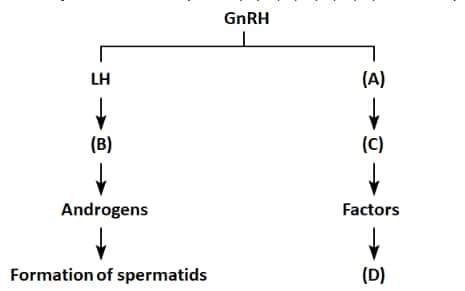
FSH, Leydig cells, Sertoli cells, spermiogenesis.
ICSH, Interstitial cells, Leydig cells, spermiogenesis.
FSH, Sertoli cells, Leydig cells, spermatogenesis.
ICSH, Leydig cells, Sertoli cells, spermatogenesis.
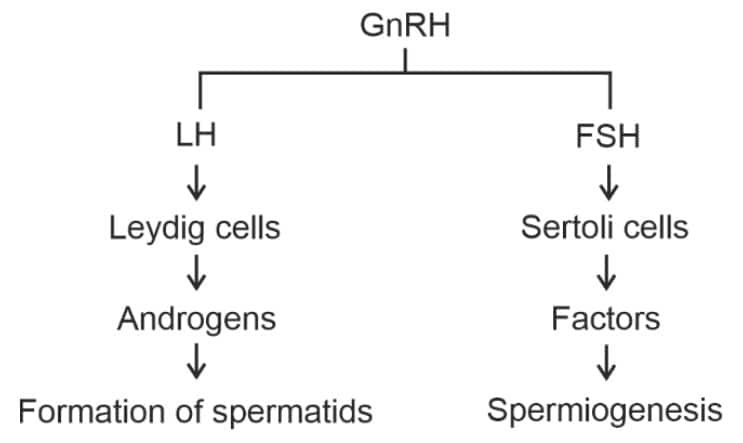
Solution:
(A) FSH, which is a pituitary hormone.
(B) Leydig cells, which are found in the interstitial space outside of the seminiferous tubules.
(C) Sertoli cells are found inside the seminiferous tubules.
(D) Spermiogenesis, which is a process that helps in the transformation of spermatids into spermatozoa.
Hence, the correct answer is option 1) as FSH, Leydig cells, Sertoli cells, and spermiogenesis.
Question 6: Given below are two statements:
Statement I: The Vas deferens receive a duct from the seminal vesicle and opens into the urethra as the ejaculatory duct.
Statement II: The cavity of the cervix is called the cervical canal which along with the vagina' forms the birth canal.
In the light of the above statements, choose the correct answer from the options given below: (NEET 2023)
Both Statement I and Statement II are true.
Both Statement I and Statement II are false.
Statement I is correct, but Statement II is false.
Statement I is incorrect, but Statement II is true.
Solution:
Statement I: The vas deferens is a tube that receives a duct from the seminal vesicle and carries sperm from the epididymis to the urethra. It is a part of the male reproductive system and is involved in the transportation of sperm during ejaculation.
Statement II: The cervix is the lower part of the uterus that connects the uterus to the vagina. It contains a cavity called the cervical canal, which is a passageway for sperm to enter the uterus and for menstrual blood to exit the uterus during menstruation. The cervix, along with the vagina, forms the birth canal through which a baby passes during childbirth.
Both statements accurately describe anatomical structures and their functions in the male and female reproductive systems, respectively.
Hence, the correct answer is option 1) Both Statement I and Statement II are true.
Question 7: Which of the following statements are correct regarding the female reproductive cycle?
A. In non-primate mammals, cyclical changes during reproduction are called the oestrus cycle.
B. The first menstrual cycle begins at puberty and is called menopause.
C. Lack of menstruation may be indicative of pregnancy.
D. Cyclic menstruation extends between menarche and menopause. (NEET 2023)
Choose the most appropriate answer from the options given below:-
A and D only
A and B only
A, B and C only
A, C and D only
Solution: A. In non-primate mammals, cyclical changes during reproduction are indeed called the estrus cycle, not the menstrual cycle. The estrus cycle is characterised by the presence of an estrus phase, during which the female is sexually receptive.
B. The first menstrual cycle in females begins at puberty, marking the onset of reproductive capability. Menopause, on the other hand, refers to the cessation of menstrual cycles and reproductive function in women, typically occurring around the age of 45-55.
C. Lack of menstruation can be indicative of pregnancy. During pregnancy, menstruation ceases due to the hormonal changes that sustain the pregnancy.
D. Cyclic menstruation extends between menarche (the onset of the first menstrual cycle) and menopause (the cessation of menstrual cycles).
Hence, the correct answer is option 4) A, C, and D only.
Question 8: Given below are two statements: one is labelled as Assertion A, and the other is labelled as Reason R.
Assertion A: The Endometrium is necessary for the implantation of a blastocyst.
Reason R: In the absence of fertilisation, the corpus luteum degenerates, which causes the disintegration of the endometrium.
In the light of the above statements, choose the correct answer from the options given below: (NEET 2023)
Both A and R are true, and R is the correct explanation of A.
Both A and R are true, and R is NOT the correct explanation of A.
A is true, but R is false.
A is true, but R is true.
Solution: The assertion (A) that the endometrium is necessary for implantation of the blastocyst is true. The endometrium provides the necessary environment for the embryo to attach and establish a connection with the maternal blood supply.
The reason (R) provided, stating that the degeneration of the corpus luteum causes the disintegration of the endometrium, is not the correct explanation for the necessity of the endometrium. The degeneration of the corpus luteum and the subsequent decrease in hormone levels contribute to the shedding of the endometrium during menstruation but do not directly explain the requirement of the endometrium for blastocyst implantation.
Hence, the correct answer is option 2) Both A and R are true, and R is NOT the correct explanation of A.
Analysis of the NEET question paper indicates that Human Reproduction is an important chapter that is frequently asked in the NEET Biology paper. The questions are usually related to the concepts, diagrams, reproduction process, and hormonal control taught in NCERT. Good command of the above topics will assist candidates in scoring marks from this chapter.
From the NEET 2021–2026 question paper pattern, the Human Reproduction chapter has had around 3-7 questions in the NEET exam, but it varies from time to time. Important questions of NEET on this topic include conceptual clarity, diagrams, biological processes, and NCERT facts. Practice of Human Reproduction NEET PYQs is important in identifying common concepts and patterns of questions asked in NEET 2027.
Based on the NEET 2021–2025 trend, the chapter contributes 3–7 questions per year, with an average weightage of around 4.62% in the Biology paper. Human reproduction in NEET PYQ covered topics such as the male and female reproductive systems, gametogenesis, menstrual cycle, fertilisation, implantation, pregnancy, and lactation, along with diagram-based and assertion–reason questions.
Year-wise NEET Question Trend
| Year | Number of Questions |
|---|---|
| 2026 | 5 |
| 2025 | 7 |
| 2024 | 4 |
| 2023 | 3 |
| 2022 | 4 |
| 2021 | 3 |
The six-year trend shows that Human Reproduction has consistently appeared in the NEET Biology paper, although its annual question count has varied. Students should therefore complete the entire chapter instead of studying only the topics that appeared frequently in previous papers.
Human Reproduction is a do-or-die biology chapter in the NEET 2027 syllabus, and many questions are directly based on NCERT concepts and diagrams. Check these important topics included in Human Reproduction in NEET PYQ.
| Subtopic | What to study |
|---|---|
| Male & Female Reproductive Systems | Structure and functions of reproductive organs, parts of the oviduct, uterus layers, and labelling NCERT diagrams. |
| Microscopic Anatomy of Testis & Ovary | Structure of seminiferous tubules, roles of Sertoli cells and Leydig cells, ovarian follicles, and corpus luteum. |
| Gametogenesis (Spermatogenesis & Oogenesis) | Stages of gamete formation, hormonal control (FSH, LH), and differences between spermatogenesis and oogenesis. |
| Menstrual Cycle & Hormonal Regulation | Phases of the menstrual cycle, LH surge and ovulation, roles of estrogen and progesterone. |
| Fertilisation & Early Embryonic Development | Site of fertilisation, acrosome reaction, cleavage, blastocyst formation, and implantation. |
| Pregnancy, Placenta, Parturition & Lactation | Placental functions, hormones during pregnancy, the role of oxytocin in parturition, and the importance of colostrum in lactation. |
Based on the NEET PYQ trend analysis, some common mistakes in most scoring NEET concepts of the human reproduction chapter that students shouldn't make:
Ignoring hormonal regulation: Failure to focus on hormones such as FSH, LH, estrogen, and progesterone, which are often included in NEET questions.
Mixing up gametogenesis: Students mix up spermatogenesis and oogenesis, including their steps and outcomes.
Not practising the NCERT biology important diagrams: Human reproduction in NEET PYQ includes Diagram-based questions. Hence, students must practice diagram labelling for the reproductive system from the NCERT textbooks.
Poor understanding of menstrual cycle phases: It is important to understand the various phases of the menstrual cycle.
Human Reproduction PYQs are essential but not sufficient on their own. Previous-year questions help students understand the type and level of questions asked, but NEET 2027 can test the same NCERT concept in a different format.
For better preparation, combine:
NCERT Biology
Human Reproduction PYQs
Chapter-wise MCQs
NCERT diagrams and tables
Full-length Biology mock tests
Error analysis and repeated revision
The latest Careers360 Biology analysis continues to show the importance of NCERT-based preparation and PYQ practice across high-yield Biology chapters.
Frequently Asked Questions (FAQs)
Usually, 3-4 questions are asked from the Human Reproduction chapter in NEET. In some years, the number may increase depending on the exam pattern, making it an important scoring topic in the Biology section.
Yes, NCERT Class 12 Biology is the most important source for this chapter. Many NEET questions are directly based on NCERT concepts, diagrams, and factual statements, so students should revise the textbook thoroughly.
Yes, NEET often includes diagram-based questions, especially from the male and female reproductive systems. Practising NCERT diagrams and labelling important parts can help students answer such questions accurately.
Usually, 3-4 questions are asked from the Human Reproduction chapter in NEET. In some years, the number may increase depending on the exam pattern, making it an important scoring topic in the Biology section.
Yes, NCERT Class 12 Biology is the most important source for this chapter. Many NEET questions are directly based on NCERT concepts, diagrams, and factual statements, so students should revise the textbook thoroughly.
Yes, NEET often includes diagram-based questions, especially from the male and female reproductive systems. Practising NCERT diagrams and labelling important parts can help students answer such questions accurately.


NEET PG All India & State College Predictor with Admission Process Guide
End-to-End NEET PG Admission Guidance | One-to-One Counselling | College Predictors | Regular Updates | E-books
Ranked #19 by NIRF, NAAC A++ Accredited | Recognized by dental council of India
Established in 1993, with a focus on Homoeopathy and Health Sciences | Offers programmes in Homoeopathy and allied health-related disciplines
Special Scholarship for Students from Goa (Get an exclusive scholarship of ₹20,000 if you're a Goa-based student) | Bringing Parul Education Trust's 30-year Education Legacy to Goa
Ranked among the top Dental Colleges for 7 consecutive years by India Today poll