JSS University Mysore Allied Sciences 2026
NAAC A+ Accredited| Ranked #21 in University Category by NIRF | Applications open for multiple UG & PG Programs


NEET Formula Sheet 2027 is an important revision material for the candidates appearing for the NEET UG exam. The sheet includes formulas for NEET Physics and Chemistry for chapters like Kinematics, Laws of Motion, Work, Energy and Power, Electrostatics, Current Electricity, Some Basic Concepts of Chemistry, Chemical Thermodynamics and Equilibrium. Candidates can make use of the NEET Formula Sheet PDF to revise important formulas and equations in order to enhance their speed in solving problems.
This Story also Contains

Formula revision becomes an important aspect of NEET preparation, especially while solving numerical-based questions in Physics and Physical Chemistry. A good NEET 2027 Formula Sheet can assist candidates in remembering formulas of various chapters without revising the entire chapter in theory. Formula revision along with concept-based practice and NEET previous year questions will surely help candidates increase their speed of calculations.
This article has NEET Physics and Chemistry formulas chapter-wise as per the latest officially available NEET exam syllabus. Candidates can make use of formulas in order to revise and solve numerical questions for NEET preparation. In case the official NEET 2027 syllabus is updated by the concerned authority, candidates must follow the new NEET syllabus.
The important physics formulas for NEET based on the NEET exam trends observed in the previous years are provided here. The table consists of the highest-scoring concepts in the last 5 years, the number of times they appeared in NEET, and the years in which questions were based on these concepts. The physics NEET 2027 formula sheet is based on these high-scoring concepts.
|
|
|
Get expert advice on college selection, admission chances, and career path in a personalized counselling session.
|
|
|
|
|
|
|
|
|
|
|
|
|
|
|
|
|
|
|
|
|
|
|
|
|
|
|
|
|
|
|
|
|
|
|
|
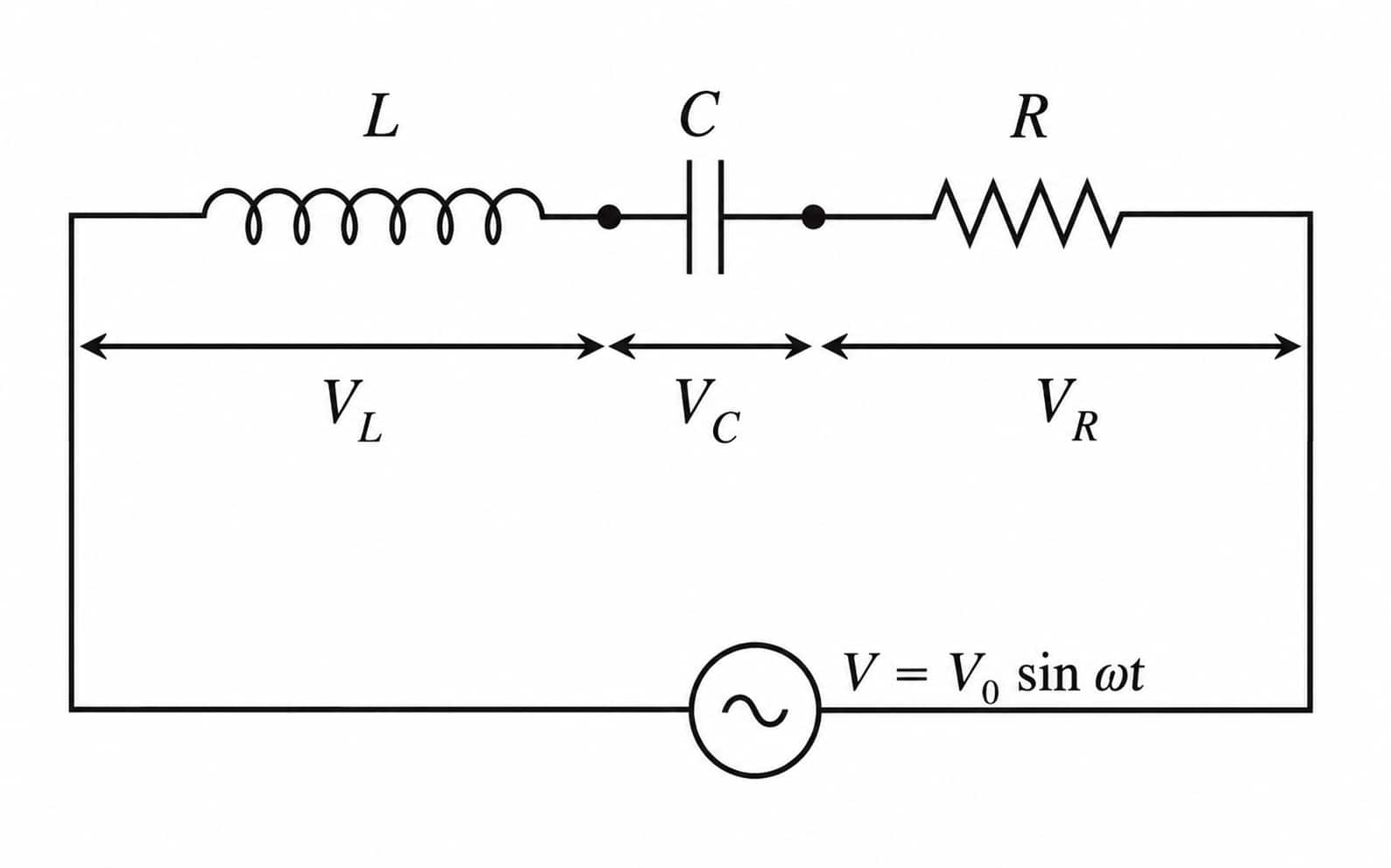
Let $i$ be the amount of current in the circuit at any time, and let $V_L$, $V_C$, and $V_R$ be the potential drops across $L$, $C$, and $R$, respectively.
$V_R = iR$ $\Rightarrow$ Voltage is in phase with $i$.
$V_L = i\omega L$ $\Rightarrow$ Voltage leads $i$ by $90^\circ$.
$V_C = \frac{i}{\omega C}$ $\Rightarrow$ Voltage lags $i$ by $90^\circ$.
By all these, we can draw a phasor diagram as shown below
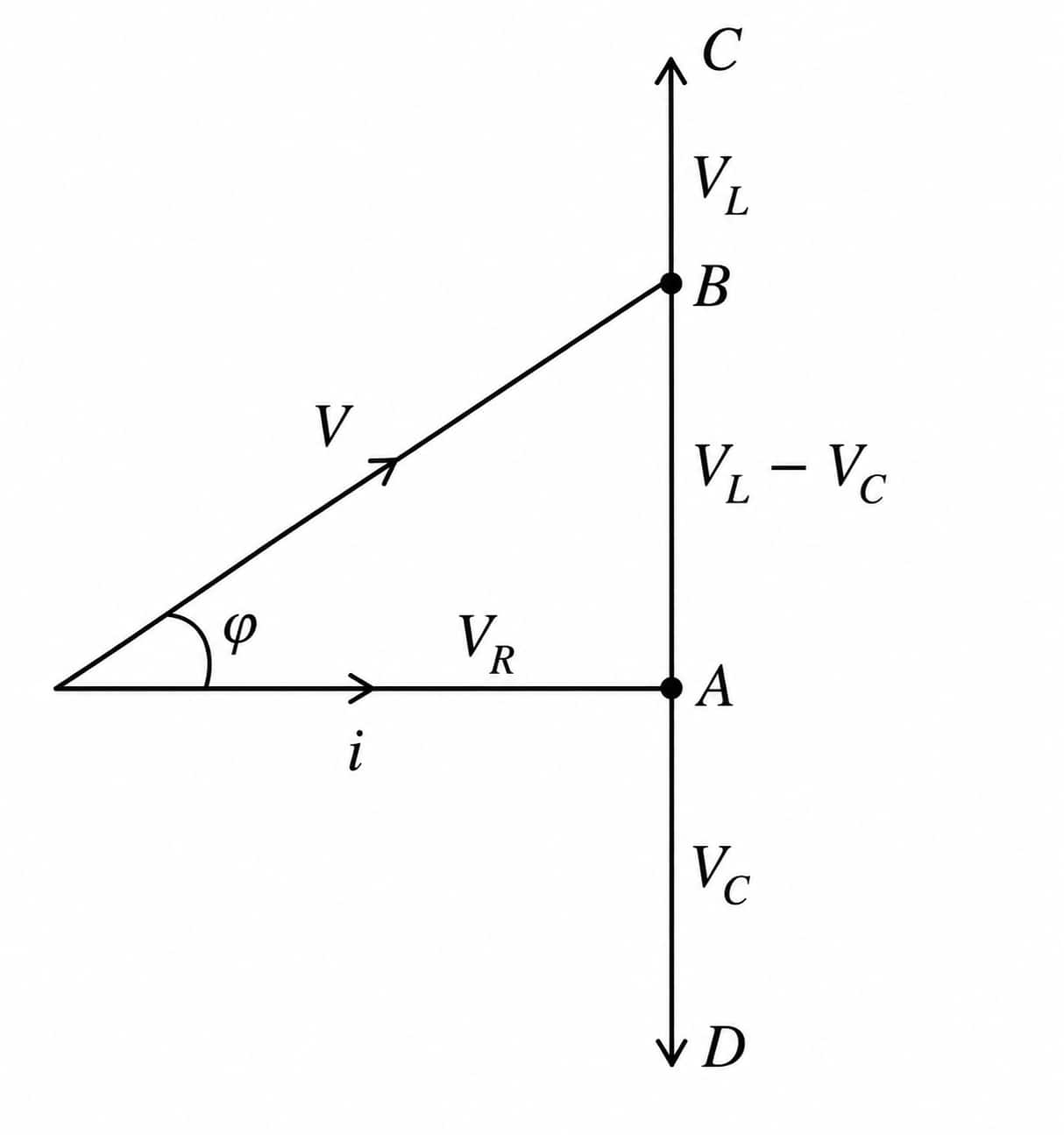
So, from the above phasor diagram, $V$ will represent the resultant of vectors $V_R$ and $(V_L - V_C)$.
So, the equation becomes:
$V = \sqrt{V_R^2 + (V_L - V_C)^2}$
$= \sqrt{(iR)^2 + (X_L - X_C)^2}$
$= \sqrt{(iR)^2 + \left(\omega L - \frac{1}{\omega C}\right)^2}$
$= iZ$
where
$Z = \sqrt{R^2 + \left(\omega L - \frac{1}{\omega C}\right)^2}$
is called the impedance of the circuit.
Also,
$\tan\phi = \frac{V_L - V_C}{V_R}$
$= \frac{X_L - X_C}{R}$
$= \frac{\omega L - \frac{1}{\omega C}}{R}$.
As we know,
$a = -\omega^2 x$
General equation of SHM
1. For Displacement:
$x = A\sin(\omega t + \phi)$
where $\phi$ is the initial phase and $(\omega t + \phi)$ is called the phase.
Various displacement equations:
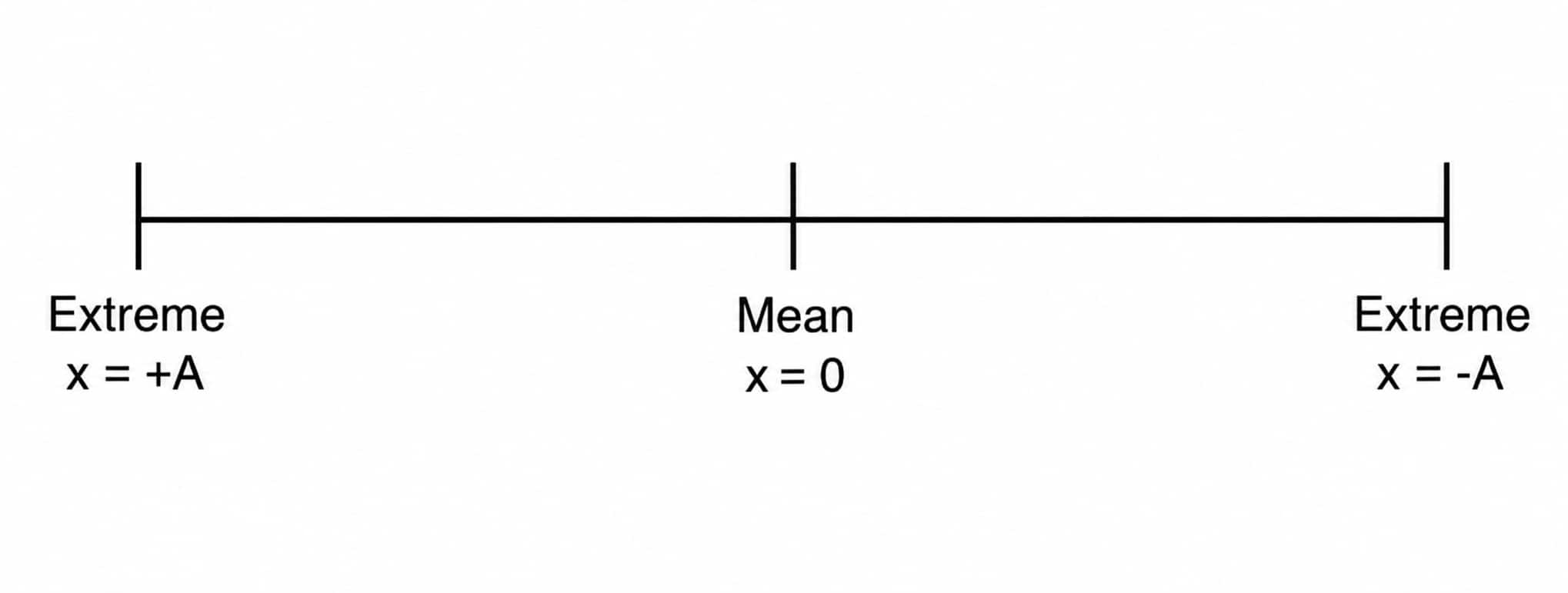
(1) $x = A\sin\omega t$ $\Rightarrow$ when the particle starts from the mean position towards right.
(2) $x = -A\sin\omega t$ $\Rightarrow$ when the particle starts from the mean position towards left.
(3) $x = A\cos\omega t$ $\Rightarrow$ when the particle starts from the right extreme position towards the mean position.
(4) $x = -A\cos\omega t$ $\Rightarrow$ when the particle starts from the left extreme position towards the mean position.
2. For Velocity ($v$):
$x = A\sin(\omega t + \phi)$
$\Rightarrow v = \frac{dx}{dt} = A\omega\cos(\omega t + \phi)$
$= A\omega\sin\left(\omega t + \phi + \frac{\pi}{2}\right)$
3. For Acceleration ($a$):
$x = A\sin(\omega t + \phi)$
$\Rightarrow v = \frac{dx}{dt} = A\omega\cos(\omega t + \phi)$
$= A\omega\sin\left(\omega t + \phi + \frac{\pi}{2}\right)$
$\Rightarrow a = \frac{dv}{dt} = -A\omega^2\sin(\omega t + \phi)$
$= A\omega^2\sin(\omega t + \phi + \pi)$
$= -\omega^2x$
So, the phase difference between $x$ and $v$ is $\frac{\pi}{2}$.
Similarly, the phase difference between $v$ and $a$ is $\frac{\pi}{2}$.
And, the phase difference between $a$ and $x$ is $\pi$.
Differential Equation of SHM:
$\frac{dv}{dt} = -\omega^2x$
$\Rightarrow \frac{d}{dt}\left(\frac{dx}{dt}\right) = -\omega^2x$
$\Rightarrow \frac{d^2x}{dt^2} + \omega^2x = 0$
If the motion of any particle satisfies this equation, then that particle performs Simple Harmonic Motion (SHM).
Based on the NEET 2027 exam pattern seen over the previous five years, we have assembled the important chemistry formulas for the NEET exam. The concepts that have scored the highest over the past five years, along with the number of times they have appeared and the years in which questions based on them have been asked, are listed in the table below. The NEET chemistry formula listed below is based on these high-scoring concepts:
|
|
|
|
|
|
|
|
|
|
|
|
|
|
|
|
|
|
|
|
|
|
|
|
Aspirants can download the important NEET chemistry formula from the table given below:
|
|
|
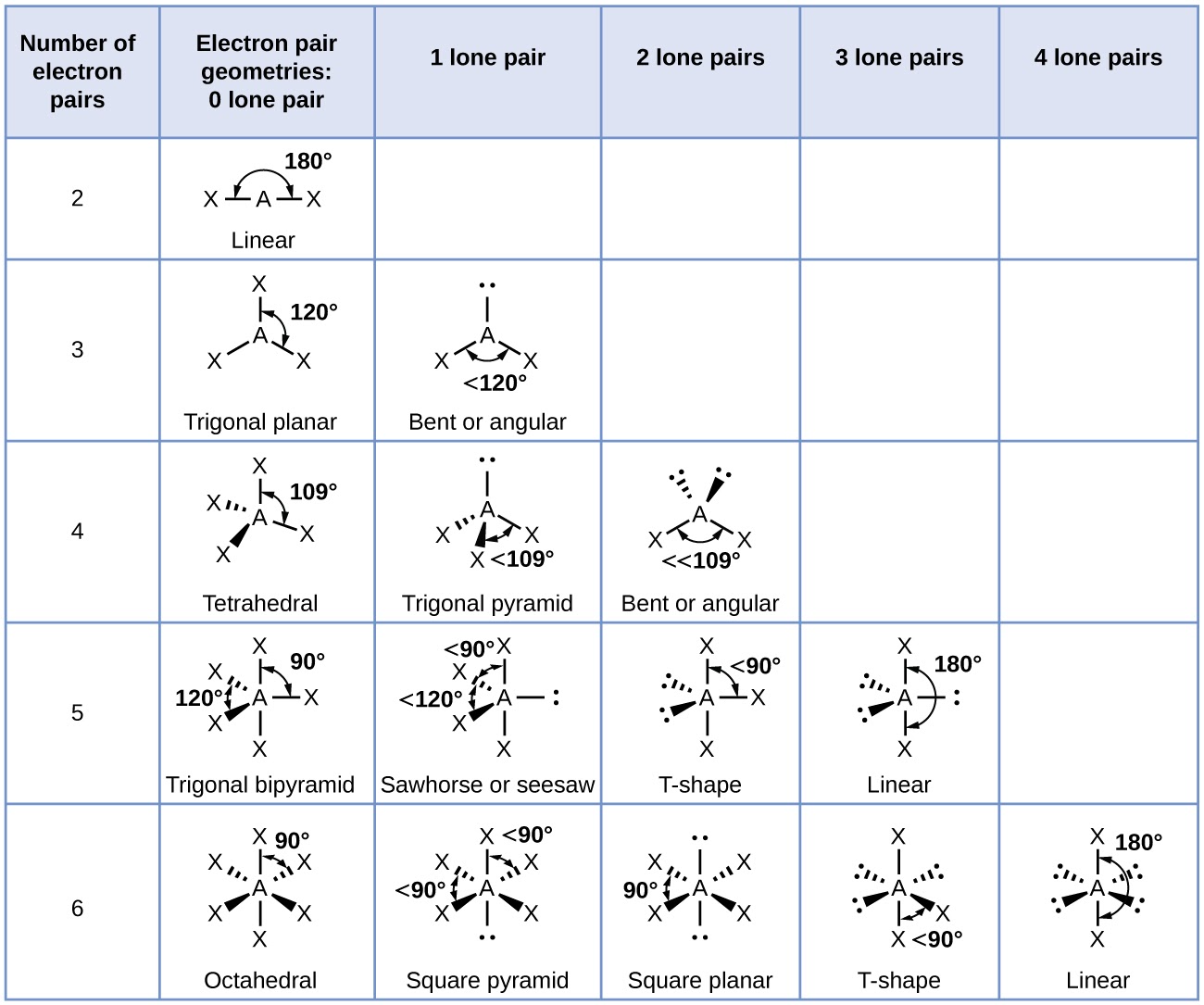
The ideal shapes of molecules, which are predicted based on electron pairs and lone pairs of electrons, are mentioned in the table below:
General Representation:
$A_xB_y \rightleftharpoons xA^+ + yB^-$
$K_{sp} = [A^+]^x[B^-]^y$
Relation between Solubility ($s$) and Solubility Product ($K_{sp}$):
$A_xB_y \rightleftharpoons xA^+ + yB^-$
If solubility is $s$, then $[A^+] = xs$ and $[B^-] = ys$.
Thus,
$K_{sp} = (xs)^x(ys)^y$
$= x^x y^y s^{x+y}$
The Gas Laws — Boyle’s Law (Pressure–Volume Relationship):
$P \propto \frac{1}{V}$
$\Rightarrow PV = k$ (at constant $T$)
Frequently Asked Questions (FAQs)
A NEET formula sheet helps candidates revise important Physics and Chemistry formulas quickly before the exam. It also saves time during revision and improves problem-solving speed.
Yes, these formulas will be helpful for the NEET 2027 exam as well. Since NEET 2027 follows the same NEET syllabus and exam pattern, the important Physics and Chemistry formulas remain relevant for preparation, revision, and practice.
Students should use the NEET formula sheet for daily revision, last-minute preparation, and quick recap before mock tests. It is also helpful for identifying frequently used formulas from high-weightage chapters.
Formulas are mainly important for Physics and Chemistry in NEET, especially for numerical and application-based questions. Biology has fewer direct formulas but includes important ratios, laws, and concepts in topics such as Genetics and Ecology.

On Question asked by student community
Hello, you can pursue BPT in Kerala without NEET UG. Admission is generally based on the LBS Centre rank list and the applicable admission process. You can check BPT colleges in Kerala and their details here: https://medicine.careers360.com/colleges/list-of-bpt-in-physiotherapy-colleges-in-kerala
Hello Student,
If you are looking for information about NEET PG 2025 DNB seat allotment and the fees payable at the allotted college or hospital, DNB seats are allotted through the respective counselling process based on your rank, category, choice of speciality, and seat availability.
For the 2025 session, the
Dear Student, with a NEET PG 2026 rank of 6,600 in the EWS category, your options should be assessed using the relevant counselling year's college-wise closing ranks, category-wise seats and counselling round. Please also confirm whether you are applying through the applicable All India counselling route or another quota. That
Hello
If you mean whether a school/college will be strict about attendance when you are preparing for NEET UG, it depends on the institution’s rules. NEET preparation itself is generally not a reason to ignore regular attendance.
For example, CBSE requires 75% attendance for board-exam eligibility, with limited relaxation for
Hello Student,
Aapke NEET marks 372 aur AIR 3,51,532 hain. Lekin 3rd round mein MBBS seat ke liye counselling karani chahiye ya nahi, iska sahi answer dene ke liye mujhe aapki category, domicile state, aur aap AIQ se counselling kar rahe hain ya state quota se—ye details chahiye.
In details
the product 'P' will be ,


| Column A | Column B |
| A |
a) Organisation of cellular contents and further cell growth. |
| B |
b) Leads to formation of two daughter cells. |
| C |
c) Cell grows physically and increase volume proteins,organells. |
| D |
d) synthesis and replication of DNA. |
Match the correct option as per the process shown in the
0.16 g of dibasic acid required 25 ml of decinormal solution for complete neutralisation. The modecular weight of the acid will be
32
64
128
256
0xone is

Know possible Govt/Private MBBS/BDS Colleges based on your NEET rank
College Predictors Webinars One to One Counselling Regular Updates Medical Almanac
Highest Package: ₹32 LPA | Placement Rate: 90% students placed | 5000+ Students Placed 900+ Placements Recruiters | Scholarships Available
33.5 LPA-Highest Package | Up to 100% scholarship worth 30 CR
Get Job Ready in Healthcare | Employability-Focused Programs
Get Started With Your Healthcare Career. 2026 Admissions open.