
Search Colleges, Exams, Schools & more


Login
Comparison between Simple Squamous Epithelium and Stratified Squamous Epithelium MCQ - Practice Questions with Answers
Edited By admin | Updated on Sep 18, 2023 18:34 AM | #NEET
Quick Facts
-

16 Questions around this concept.
Solve by difficulty
 EASY
EASYMatch the following and choose the correct option
|
|
|
|
|
|
|
|
Options
The cells lining the blood vessels belong to the category of
Concepts Covered - 1
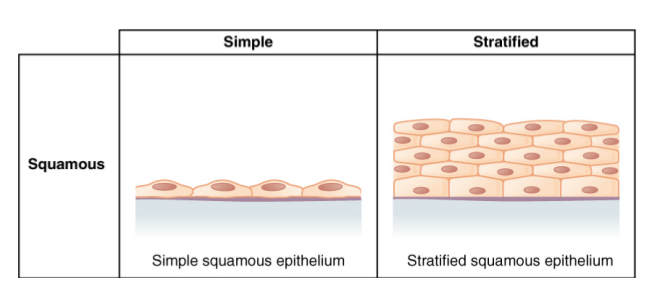
Simple Squamous Epithelium and Stratified Squamous Epithelium
Simple squamous epithelium
Structure
- Squamous epithelium is composed of large, polygonal flat cells whose edges fit closely together. Hence, it is also called pavement epithelium.
- The nuclei of these cells are flattened and lie at the centre of cells.
- The cells of squamous epithelium lie on a thin basement membrane
- Location
- This type of epithelium is found in the terminal bronchioles and alveoli of the lungs, the wall of the Bowman's capsule and descending limb of the loop of Henle, membranous labyrinth ( internal ear), blood vessels, lymph vessels, heart, coelomic cavities and rete testis of the testis.
- In blood vessels, lymph vessels and heart, it is called the endothelium. In coelom, it is referred to as the mesothelium.
- The skin castings of frog are cast odd in single layers and are termed a squamous epithelium.
Function:
- The functions of squamous epithelium are protection, excretion, gas exchange and secretion of coelomic fluid. They form the diffusion boundaries.
Stratified Squamous Epithelium
- The cells in the deepest layer are columnar or cuboidal and have oval nuclei. This layer is called stratum germinativum.
- The cells of this layer mitotically divide and give rise to new cells which shifts outward to form intermediate layers.
- The superficial layers which are named squamous layer possess flat cells with transversely elongated nuclei.
- Squamous layers can be of the following types:
- Keratinized stratified epithelium- The cells replace their cytoplasm with a water-impermeable protein called keratin in a process called keratinisation. These dead cells are called stratum corneum or horny layer. This layer is shed at intervals. It is found in the epidermis of skin of land vertebrates to check the water loss.
- Non- keratinized stratified squamous epithelium- The cells of this epithelium does not have keratin and are unable to check water loss. It is present in the oral cavity, tongue, pharynx, oesophagus, lower parts of the urethra, vocal cords, vagina, cervix, the inner surface of the eyelids and cornea of the eye.
Study it with Videos
"Stay in the loop. Receive exam news, study resources, and expert advice!"
Get Answer to all your questions

Begin a career in Medical and Allied Sciences. Admissions Open for
Ranked as India’s #1 Not for profit pvt. University by India Today
KCDSH- Krishnadevaraya Dental College & Sciences Admis 2026
ApplyRanked among the top Dental Colleges for 7 consecutive years by India Today poll
Emversity Allied Health Programs
ApplyGet Job Ready in Healthcare | Employability-Focused Programs
Virohan Allied & Healthcare Programs
ApplyAllied & Healthcare programs | 20+ Partner Universities & Institutes | 98% placement record
SCSVMV Deemed to be University | AHA Admissions 2026
ApplyAlied Health Sciences at SCSVMV | NAAC 'A' Grade | AICTE & UGC Aproved | 100% Placement Support | Merit-based Scholarships
JSS University Mysore Allied Sciences 2026
ApplyNAAC A+ Accredited| Ranked #21 in University Category by NIRF | Applications open for multiple UG & PG Programs