
Search Colleges, Exams, Schools & more


Login
Cuboidal Epithelium and Stratified Cuboidal Epithelium MCQ - Practice Questions with Answers
Edited By admin | Updated on Sep 18, 2023 18:34 AM | #NEET
Quick Facts
-

13 Questions around this concept.
Solve by difficulty
 EASY
EASYWhen the cells of epithelial tissue are arranged in a single layer with a cubical shape, they are called
Simple cuboidal epithelium lines all the following structures except the
Concepts Covered - 1
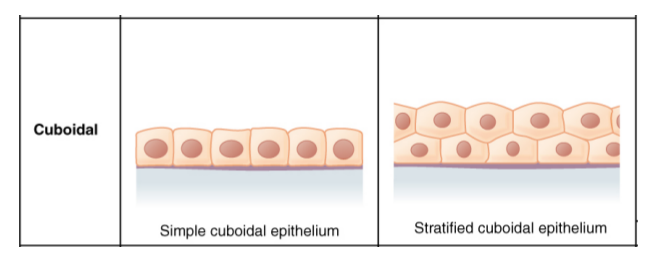
Cuboidal Epithelium and Stratified Cuboidal Epithelium
Simple Cuboidal Epithelium
Structure
- The cells of cuboidal epithelium are cubical and more or less square in shape.
- The nuclei are rounded and lie in the centre of the cells.
- These cells often form microvilli on their free surface giving a brush-like appearance to their free border called brush bordered cuboidal epithelium.
- The function of microvilli increases the absorptive surface area.
- Location
- The cuboidal epithelium is present in the small salivary and pancreatic ducts, thyroid follicles, parts of the membranous labyrinth, proximal and distal convoluted tubules of the nephron, ovaries, seminiferous tubules, ciliary body, choroid and iris of eyes.
- These are also found on the inner surface of the lens, the pigment cell layer of the retina and sweat glands
Function:
- The functions of cuboidal epithelium include protection, secretion, absorption, excretion and gamete formation in germinal epithelium.
Stratified Cuboidal Epithelium
- The outer layers have cuboidal cells and basal layer of columnar cells.
- It forms the epidermis of fishes, amphibians, salamanders etc.
- It also lines the sweat gland ducts and larger salivary and pancreatic ducts.
Study it with Videos
"Stay in the loop. Receive exam news, study resources, and expert advice!"
Get Answer to all your questions

Begin a career in Medical and Allied Sciences. Admissions Open for
Enrol for Aakash Re-NEET 2026 Victory Batch at Rs. 99 only. Batch start 16th May.
KCDSH- Krishnadevaraya Dental College & Sciences Admis 2026
ApplyRanked among the top Dental Colleges for 7 consecutive years by India Today poll
Emversity Allied Health Programs
ApplyGet Job Ready in Healthcare | Employability-Focused Programs
Virohan Allied & Healthcare Programs
ApplyAllied & Healthcare programs | 20+ Partner Universities & Institutes | 98% placement record
Amity University Noida | Allied Health Sciences Admissions
ApplyRanked as India’s #1 Not for profit pvt. University by India Today
SCSVMV Deemed to be University | AHA Admissions 2026
ApplyAlied Health Sciences at SCSVMV | NAAC 'A' Grade | AICTE & UGC Aproved | 100% Placement Support | Merit-based Scholarships