
Search Colleges, Exams, Schools & more


Login
Muscular tissues MCQ - Practice Questions with Answers
Edited By admin | Updated on Sep 18, 2023 18:34 AM | #NEET
Quick Facts
-

16 Questions around this concept.
Solve by difficulty
 EASY
EASYFind mismatch pair from the following:
What property of muscular tissue allows it to respond to electrical stimuli?
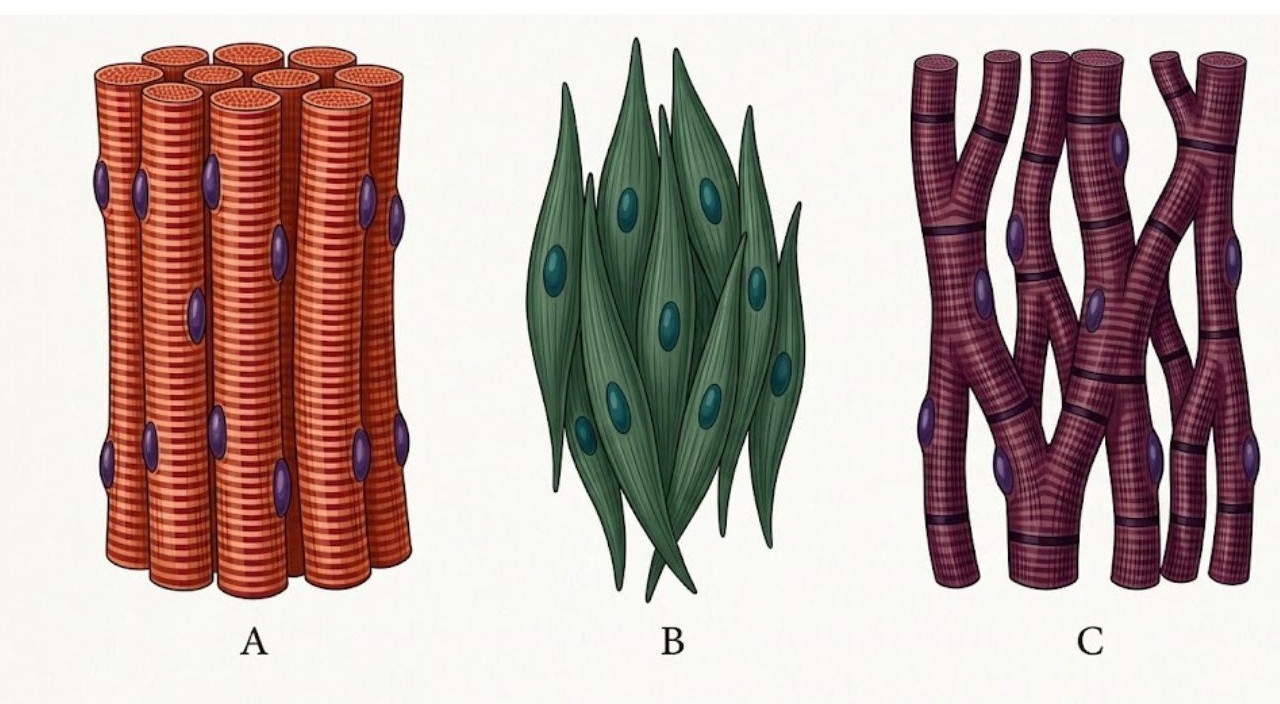
Identify the figures A, B, and C showing different types of muscle and select the correct option.
Concepts Covered - 1
Muscular tissues
- Muscular tissue includes all the muscles of the body
- Muscles are made up of cells that are in the form of contractile muscle fibres. This muscle fibre consists of fine myofibrils in their cytoplasm called sarcoplasm.
- These muscle fibres are bound to each other by means of connective tissue.
- Muscle cells are called myocytes while the cells which give rise to myocytes are called myoblasts.
Origin-
Muscular tissue originates from the mesoderm of the embryo.
Features of Muscles:
- Muscular tissue is contractile. It means its cells can undergo contraction and relaxation causing movements.
- Muscles show electrical excitability also because of the presence of electric potential difference across its plasma membrane.
Types of muscles:
The muscles are of three types
- Striped or striated or skeletal or voluntary muscle
- Unstriped or non-striated or visceral or smooth or involuntary muscle
- Cardiac muscle
Functions of muscular tissue:
- Muscles cause movement and locomotion in animals.
- Muscles support the bones and other structures.
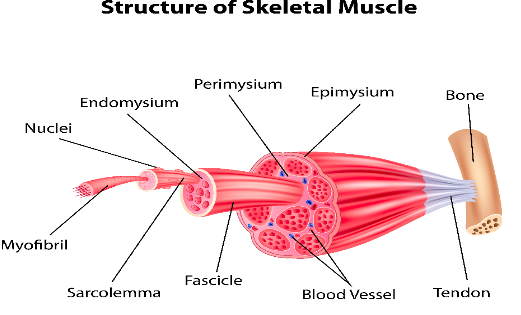
Structure of skeletal muscle:
- On the outer side, a muscle is covered by a sheath of connective tissue which is called epimysium.
- Inner to epimysium, a muscle consists of bundles of muscle fibres called fasciculi
- Each fascicle is covered by a perimysium.
- Each muscle fibre of a fascicle is surrounded by endomysium.
Study it with Videos
"Stay in the loop. Receive exam news, study resources, and expert advice!"