
Search Colleges, Exams, Schools & more


Login
Rotational Equilibrium MCQ - Practice Questions with Answers
Edited By admin | Updated on Sep 25, 2023 25:23 PM | #NEET
Quick Facts
-

7 Questions around this concept.
Solve by difficulty
 MEDIUM
An L-shaped object, made of thin rods of uniform mass density, is suspended with a string as shown in the figure. If $A B=B C$, and the angle made by AB with the downward vertical is $\theta$, then:

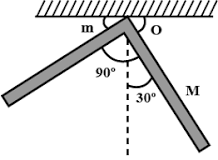
Two uniform rods of equal length but different masses are rigidly joined to form an L-shaped body, which is then pivoted about as shown in the figure. If in equilibrium the body is in the shown configuration, ratio
will be.

Two uniform rods of equal length but different masses are rigidly joined to form an L-shaped body, which is then pivoted about O as shown in the figure. If in equilibrium the body is in the shown in configuration, ratio of M and m will be
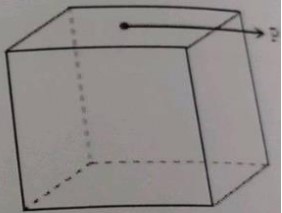
A solid cube is placed on a horizontal on a horizontal surface. The coefficient of friction between them is μ where μ<1/2. A variable horizontal on the cube's upper face, perpendicular to one edge and passing through the the mid-point of edge, as shown in figure. The maximum acceleration with which it can move without toppling is
A uniform rod of mass 20 kg and length 5 m leans against a smooth vertical wall making an angle of $60^{\circ}$ with it. The other end rests on a rough horizontal floor. The friction force that the floor exerts on the rod is (take $\mathrm{g}=10 \mathrm{~m} / \mathrm{s}^2$ )
Concepts Covered - 1
Rotational Equilibrium
For Translational equilibrium $\sum \vec{F}=0$
And For Rotational equilibrium $\sum \vec{\tau}=0$Í
-
- For rotational equilibrium of the system the resultant torque acting on it must be zero.
$$
\text { i.e., } \sum \tau=0
$$- Various cases of equilibrium
$
\text { 1. } \sum \vec{F}=0 \text { and } \sum \vec{\tau}=0
$
Forces are equal and act along the same line.Body will be in both Translational and Rotational equilibrium.
i.e., It will remain stationary if initially it was at rest.$
\text { 2. } \sum \vec{F}=0 \text { and } \sum \tau \neq 0
$
Forces are equal and do not act along the same line.Rotation of the body will happen i.e. spinning of the body.
$
\text { 3. } \sum F \neq 0 \text { and } \sum \vec{\tau}=0
$
Forces are unequal and act along the same line.
Body will be in Translational motion.
i.e., slipping of body
$
\text { 4. } \sum F \neq 0 \text { and } \sum \tau \neq 0
$
Forces are unequal and do not act along the same line.
Body will be in both Rotation and translation motion.
i.e. rolling of a body.
-
Couple Force-
1. A couple is defined as a combination of two equal and oppositely directed forces but not acting along the same line.
$$
\text { i.e., } \sum \vec{F}=0 \text { and } \sum \tau \neq 0
$$
2. A torque by a couple is given by
$$
\vec{\tau}=\vec{r} \times \vec{F}
$$
3. In the case of a couple both the forces are externally applied.
4. Work done by torque in twisting the wire is given by
$$
W=\frac{1}{2} C \cdot \theta^2
$$
Where C is the coefficient of twisting
Study it with Videos
"Stay in the loop. Receive exam news, study resources, and expert advice!"
Get Answer to all your questions

Begin a career in Medical and Allied Sciences. Admissions Open for
Enrol for Aakash Re-NEET 2026 Victory Batch at Rs. 99 only. Batch start 16th May.
KCDSH- Krishnadevaraya Dental College & Sciences Admis 2026
ApplyRanked among the top Dental Colleges for 7 consecutive years by India Today poll
Emversity Allied Health Programs
ApplyGet Job Ready in Healthcare | Employability-Focused Programs
Virohan Allied & Healthcare Programs
ApplyAllied & Healthcare programs | 20+ Partner Universities & Institutes | 98% placement record
Amity University Noida | Allied Health Sciences Admissions
ApplyRanked as India’s #1 Not for profit pvt. University by India Today
SCSVMV Deemed to be University | AHA Admissions 2026
ApplyAlied Health Sciences at SCSVMV | NAAC 'A' Grade | AICTE & UGC Aproved | 100% Placement Support | Merit-based Scholarships