SRM Kattankulathur Dental College and Hospital, Kattankulathur
Ranked #19 by NIRF, NAAC A++ Accredited | Recognized by dental council of India


NEET 2027 Negative Marking: Every wrong answer in NEET doesn’t just cost you 1 mark — it actually costs you 5 marks in total. You lose 1 mark for the incorrect attempt and miss out on the +4 you could have gained. Now imagine getting just 10 questions wrong. That’s a 50-mark drop, which can be the difference between securing a government MBBS seat and missing the cutoff. This is why understanding NEET 2027 negative marking is not just important but a critical scoring strategy.
This Story also Contains
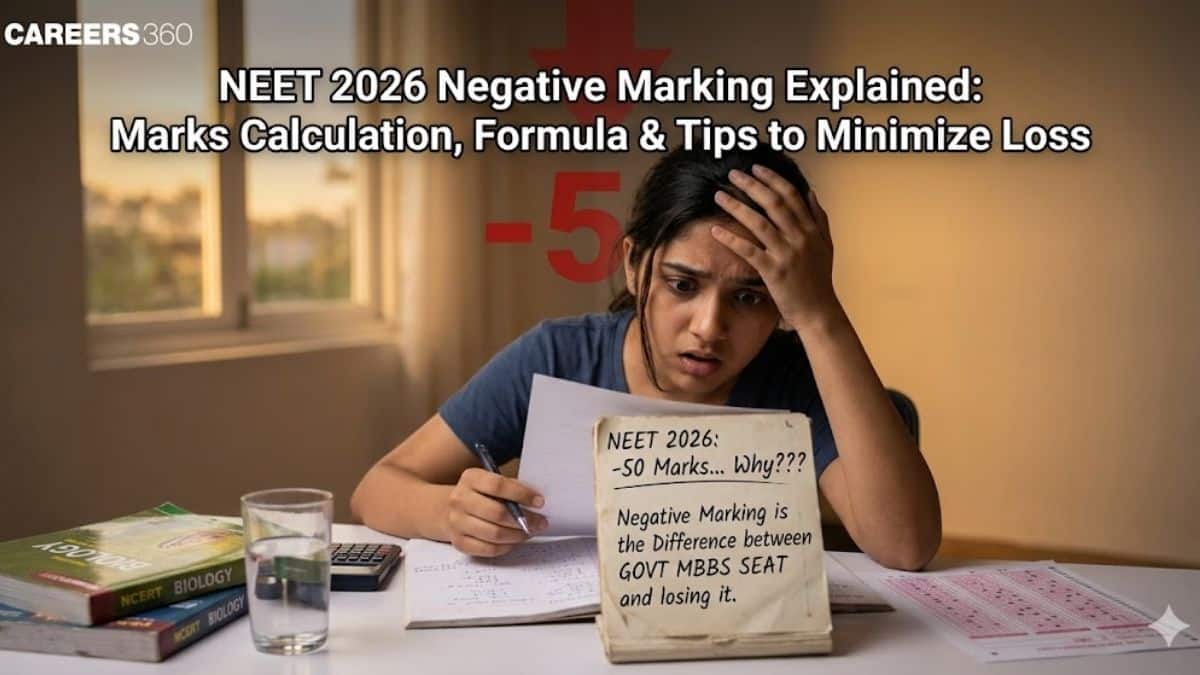
The NEET marking scheme 2027 follows a strict pattern where each correct answer carries +4 marks, while every incorrect answer results in a -1 penalty. Many aspirants lose marks not due to lack of preparation but because of avoidable mistakes like guesswork, OMR errors, and misreading questions. In this article, you’ll learn how the NEET marks calculation works, how to apply the correct formula, and most importantly, how to minimise negative marking in NEET 2027 using proven strategies. If you want to improve your NEET exam score without studying extra hours, mastering this concept can give you a serious edge in the exam.
Understanding the NEET 2027 negative marking system is crucial if you want to maximise your score. In NEET, accuracy matters more than the number of attempts.
For every correct answer, you gain +4 marks, while every incorrect answer leads to a -1 mark penalty. Unanswered questions carry 0 marks, meaning there is no penalty for skipping.
This marking scheme makes one thing very clear:
Blind guessing can reduce your score significantly.
Below is the overview of the NEET 2027 negative marking:
Subject | Total Question | Total Marks | Marks for Correct Answer | Marks for Incorrect Answer | Marks for Unanswered Questions |
Physics | 45 | 180 | +4 | -1 | 0 |
Chemistry | 45 | 180 | +4 | -1 | 0 |
Biology | 90 | 360 | +4 | -1 | 0 |
Total Questions: 180
Maximum Marks: 720
1 wrong answer = –1 mark
1 missed correct answer = –4 mark opportunity
Net loss per mistake = 5 marks
Ranked #19 by NIRF, NAAC A++ Accredited | Recognized by dental council of India
Special Scholarship for Students from Goa (Get an exclusive scholarship of ₹20,000 if you're a Goa-based student) | Bringing Parul Education Trust's 30-year Education Legacy to Goa
This is why toppers focus more on accuracy than attempts.
Example: If you attempt 150 questions and make just 10 wrong attempts, you lose 10 marks directly — but also miss out on 40 potential marks. That’s a 50-mark swing, which can shift your rank by thousands.
Get expert advice on college selection, admission chances, and career path in a personalized counselling session.
To understand your performance, you must know how to calculate your score using the NEET marks calculation formula:
NEET Total Score = (Number of Correct Answers × 4) – (Number of Incorrect Answers × 1)
Example:
Correct Answers = 140 → 140 × 4 = 560
Incorrect Answers = 20 → 20 × 1 = 20
Final Score = 560 – 20 = 540
Now imagine reducing just 10 wrong answers — your score jumps by 50 marks instantly.
Negative marking doesn’t just reduce your marks — it directly impacts your All India Rank (AIR).
5 wrong answers = 25 marks lost
10 wrong answers = 50 marks lost
20 wrong answers = 100 marks lost
Ranked among the top Dental Colleges for 7 consecutive years by India Today poll
A 50–100 mark difference can shift your rank by thousands of positions.
This is why toppers focus on accuracy, not attempts.
Negative marks can reduce your chances of entering a good medical college. Knowing the pattern of the exam and applying proper strategies can prevent you from losing marks. Most students lose marks due to avoidable mistakes — not lack of knowledge.
Some aspirants randomly mark answers, hoping for luck. Probability says that guessing won’t help in the long run - they’ll end up losing marks.
Some aspirants fill in the wrong option in the OMR sheet, but this mistake is fixable. They mess up the question sequence, and all the hard work goes to waste.
While filling out the OMR, align the question number properly, place a finger on the number, double-check, and then carefully fill in the bubble.
This is very common, especially with statement-based, assertion-reason, and twisted NCERT line questions.
While reading questions, underline keywords like “not,” “correct,” “incorrect,” etc. Underline key terms while attempting the paper. This helps avoid misinterpretation and prevents silly mistakes.
Aspirants often get confused between “A is the correct explanation of R” and “A is not the correct explanation of R.”
The more they practice, the better their approach becomes.
Commonly, aspirants just see option A, think it's right, and mark it without checking options B, C, and D. This is a major mistake.
Use the option elimination method. Eliminate wrong options first, then choose the best one. This way, their answer are more accurate.
If aspirants don't analyse their mock tests properly, they're likely to repeat the same mistakes. So the rule is they should not attempt the next mock test until they've fully analysed the previous one.
Analyse and revise weak topics, then go for the next mock. That’s the only way to improve.
The negative marking can be improved by post-test analysis practice.
Reducing negative marking is one of the fastest ways to improve your score.
Being aware of the NEET Exam pattern allows you to use your time more effectively and prevent errors.
If you are unsure, it is better to skip than risk losing marks.
Eliminate 2 wrong options first — then decide. This increases accuracy.
Round 1: Solve easy and direct questions
Round 2: Attempt moderate questions
NEET Mock tests help you:
Improve speed
Build exam temperament
Reduce silly mistakes
Do not waste time on easy questions.
Have faith in your practice and answer confidently.
Good time management allows you not to rush and thus avoid mistakes:
Give time to each subject.
Spend the last 10 minutes checking your answers.
Write down:
Mistakes
Concepts involved
Correct logic
Reviewing this daily can significantly reduce repeat errors.
A smart strategy can save 30–70 marks without extra study.
Start with Biology (highest scoring section)
Move to Chemistry
Attempt Physics last
Do not spend more than 90 seconds per question
Keep the last 10–15 minutes for review
Accuracy + time management = higher score.
Guessing blindly
Ignoring mock tests
Poor time management
Overthinking easy questions
Changing answers without logic
Avoiding these mistakes alone can boost your score significantly.
Frequently Asked Questions (FAQs)
Avoid negative marking in NEET by attempting only well-prepared questions, skipping doubtful ones, and using smart guessing with elimination.
In NEET, each correct answer gives +4 marks, while every wrong answer deducts -1 mark, which is how negative marking is calculated.
For every incorrect answer, 1 mark is deducted, while correct answers carry +4 marks.
No, unanswered questions carry 0 marks.
Focus on accuracy, avoid guessing, practice mock tests, and analyse mistakes regularly.

On Question asked by student community
Hello Students,
For the NEET UG 2026 Question Paper PDF with Answer Key and Solutions, refer to the article below:
https://medicine.careers360.com/articles/neet-previous-year-question-paper-with-solution
Hello Student,
You can check the resource provided below:
Download NEET Previous 10 Years Question Papers with Solutions PDF
You can also check the NEET 2026 question paper with solutions
Hope this helps!
Hello Chetan,
Here are the links you asked for. I hope they serve your purpose.
Hello Suma,
Here are the links you asked for. I hope they serve your purpose.
Hello Bhanuday,
Here are the links you requested. I hope you find them helpful.
the product 'P' will be ,


| Column A | Column B |
| A |
a) Organisation of cellular contents and further cell growth. |
| B |
b) Leads to formation of two daughter cells. |
| C |
c) Cell grows physically and increase volume proteins,organells. |
| D |
d) synthesis and replication of DNA. |
Match the correct option as per the process shown in the
0.16 g of dibasic acid required 25 ml of decinormal solution for complete neutralisation. The modecular weight of the acid will be
32
64
128
256
0xone is

Ranked #19 by NIRF, NAAC A++ Accredited | Recognized by dental council of India
Special Scholarship for Students from Goa (Get an exclusive scholarship of ₹20,000 if you're a Goa-based student) | Bringing Parul Education Trust's 30-year Education Legacy to Goa
Ranked among the top Dental Colleges for 7 consecutive years by India Today poll