Emversity Allied Health Programs
Get Job Ready in Healthcare | Employability-Focused Programs


Solving Kinematics questions from NEET previous-year question papers will help aspirants to understand how the topics of equations of motion, velocity, acceleration, vectors, graphs of motion, projectile motion, and relative velocity are asked in the Physics section. Instead of rote learning of formulae, students should identify the physical situation and apply the right formula or graphical method accordingly.
This Story also Contains
Practising Kinematics NEET physics previous year questions is highly beneficial for NEET 2027 preparation in enhancing conceptual clarity, problem-solving skills, and accuracy. The current syllabus of NEET Physics includes motion along a straight line, graphs of position vs time, graphs of velocity vs time, uniformly accelerated motion, vectors, relative velocity, motion in a plane, projectile motion, and uniform circular motion. This article will provide important NEET Kinematics PYQs, solutions, recent trends in NEET questions, formulas, and tips for NEET preparation.
The topics of kinematics in the NEET Physics paper test more than just the application of formulae. Some possible topics include interpretation of the motion graph, relation between velocity and acceleration, projectile motion, and equations of motion in certain scenarios. Based on the pattern of previous years, some of the topics which have been tested and which students need to practice well for NEET 2027 include equations of motion, speed and velocity, projectile motion, uniform circular motion, and Kinematics graphs.
Get Job Ready in Healthcare | Employability-Focused Programs
Motion graphs and vector-related problems are difficult if the student is not aware of what exactly the slope or the area in the graph means and how to resolve a vector. Practising Kinematics NEET PYQs will therefore help in knowing how concepts are used in the NEET Physics paper. Analysis of recent exams will thus be helpful in identifying common concepts and formats of questions.
The unit comprises the major concepts given below:
|
|
|
|
|
|
|
|
|
|
|
|
|
|
|
|
|
|
|
|
|
|
|
|
|
|
|
|
|
|
Get expert advice on college selection, admission chances, and career path in a personalized counselling session.
To help students understand the importance of Kinematics in NEET, we have compiled PYQs from 2020-2026, categorising them by sub-topic, difficulty level, and type of question.
|
|
|
|
|
|
|
|
|
|
|
|
|
|
|
|
|
|
|
|
|
|
|
|
|
|
|
|
|
|
|
|
Here are some of the most important PYQs from Kinematics, with detailed solutions.
Ques 1: If the magnitude of the sum of two vectors is equal to the magnitude of the difference of the two vectors, the angle between these vectors is:
Option 1: 0o
Option 2: 90o
Option 3: 45o
Option 4: 180o
Difficulty level: Easy
Answer:
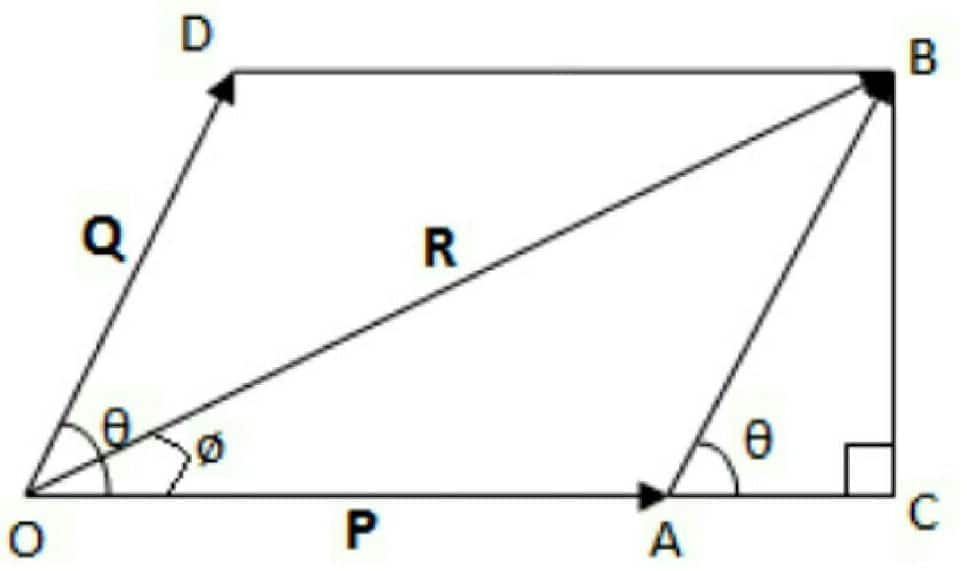
Represents the law of parallelogram vector addition:
$|\vec{A} - \vec{B}| = |\vec{A} + \vec{B}| = \sqrt{A^2 + B^2 - 2AB\cos\theta}$
Now, using the given values:
$A^2 + B^2 - 2AB\cos\theta = A^2 + B^2 + 2AB\cos(90^\circ)$
Since $\cos(90^\circ) = 0$, we get:
$2AB\cos(90^\circ) = 0$
Therefore,
$|\vec{A} - \vec{B}| = \sqrt{A^2 + B^2}$
Hence, the vectors are perpendicular:
$\angle AB = 90^\circ$
Hence, the answer is option (2).
Ques 2: A particle of mass 10 g moves along a circle of radius 6.4 cm with a constant tangential acceleration. What is the magnitude of this acceleration if the kinetic energy of the particle becomes equal to 8 x 10⁻⁴ J by the end of the second revolution after the beginning of the motion?
Option 1: 0.1 m/s2
Option 2: 0.15 m/s2
Option 3: 0.18 m/s2
Option 4: 0.2 m/s2
Difficulty level: Medium
Answer:
Given:
Mass of particle, $m = 10\,\text{g} = 10 \times 10^{-3}\,\text{kg}$
Radius of circle, $r = 6.4\,\text{cm} = 6.4 \times 10^{-2}\,\text{m}$
Kinetic energy after 2 revolutions, $KE = 8 \times 10^{-4}\,\text{J}$
Let the constant tangential acceleration be $a_t$.
Step 1: Total distance travelled in 2 revolutions
$s = 2 \times 2\pi r = 4\pi r$
$s = 4 \times 3.14 \times 6.4 \times 10^{-2} = 8.0384\,\text{m}$
Step 2: Using the equation of motion
$v^2 = 2a_t s$
Using
$\frac{1}{2}mv^2 = \frac{1}{2}m(2a_t s) = KE$
Therefore,
$KE = ma_t s$
$\Rightarrow a_t = \frac{KE}{ms}$
$a_t = \frac{8 \times 10^{-4}}{(10 \times 10^{-3}) \times 8.0384}$
$= \frac{8 \times 10^{-4}}{8.0384 \times 10^{-2}}$
$\approx 0.0995 \approx 0.1\,\text{m/s}^2$
Final Answer: Option 1) $0.1\,\text{m/s}^2$
Alternate verification
Given,
$KE = \frac{1}{2}mV^2 = 8 \times 10^{-4}\,\text{J}$
Then,
$V^2 = \frac{2 \times KE}{m}$
$= \frac{2 \times 8 \times 10^{-4}}{10 \times 10^{-3}} = 0.16$
Now, using
$V^2 = 2a_t s$
$\Rightarrow a_t = \frac{V^2}{2s}$
$= \frac{0.16}{2 \times 8.0384}$
$\approx 0.1\,\text{m/s}^2$
Hence, the answer is option 1.
Ques 3: A ball is thrown vertically downward with a velocity of 20 m/s from the top of a tower. It hits the ground after some time with a velocity of 80 m/s. The height of the tower is: (g = 10 m/s)
Option 1: 360 m
Option 2: 340 m
Option 3: 320 m
Option 4: 300 m
Difficulty level: Medium
Answer:
Given:
Initial velocity, $u = 20\,\text{m/s}$ (downward)
Final velocity, $v = 80\,\text{m/s}$
Acceleration due to gravity, $g = 10\,\text{m/s}^2$
Let the height of the tower be $h$.
Using the kinematic equation
$v^2 = u^2 + 2gh$
Substitute the values
$(80)^2 = (20)^2 + 2 \cdot 10 \cdot h$
$\Rightarrow 6400 = 400 + 20h$
$\Rightarrow 20h = 6000$
$\Rightarrow h = \frac{6000}{20} = 300\,\text{m}$
Final Answer: Option 4) $300\,\text{m}$
Alternate method
$v^2 - u^2 = 2as$
$(80)^2 - (20)^2 = 2 \times 10 \times h$
$h = \frac{6400 - 400}{20}$
$= \frac{6000}{20} = 300\,\text{m}$
Hence, the answer is option 4.
Ques 4: A small block slides down on a smooth inclined plane, starting from rest at time t=0. Let Sn be the distance travelled by the block in the interval t=n-1 to t=n.
Then, the ratio $S_n/S_{n+1}$ is
A) $\frac{2n-1}{2n}$
B) $\frac{2n-1}{2n+1}$
C) $\frac{2n+1}{2n-1}$
D) $\frac{2n}{2n-1}$
Difficulty level: Medium
Answer: 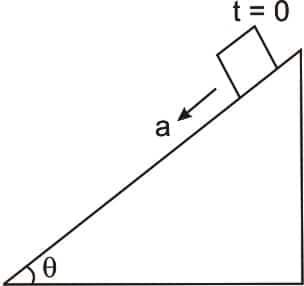
From $t = 0$ to $t = n - 1$,
$S_1 = 0 + \frac{1}{2}a(n - 1)^2$
From $t = 0$ to $t = n$,
$S_2 = 0 + \frac{1}{2}an^2$
From $t = 0$ to $t = n + 1$,
$S_3 = 0 + \frac{1}{2}a(n + 1)^2$
Therefore,
$S_n = S_2 - S_1$
$= \frac{1}{2}a\left[n^2 - (n^2 - 2n + 1)\right]$
$= \frac{1}{2}a(2n - 1)$
Similarly,
$S_{n+1} = S_3 - S_2$
$= \frac{1}{2}a\left[n^2 + 2n + 1 - n^2\right]$
$= \frac{1}{2}a(2n + 1)$
Hence,
$\frac{S_n}{S_{n+1}} = \frac{\frac{1}{2}a(2n - 1)}{\frac{1}{2}a(2n + 1)}$
$\therefore \frac{S_n}{S_{n+1}} = \frac{2n - 1}{2n + 1}$
Hence, the answer is option (2).
Ques 5: A particle moving in a circle of radius R with a uniform speed takes a time T to complete one revolution.
If this particle were projected with the same speed at an angle ′θ′ to the horizontal, the maximum height attained by it equals 4 R . The angle of projection,θ, is then given by :
Option 1: $\theta = \cos^{-1}\left(\frac{gT^2\pi}{2R}\right)$
Option 2: $\theta = \cos^{-1}\left(\frac{\pi^2 R g T^2}{2}\right)$
Option 3: $\theta = \sin^{-1}\left(\pi^2 R g T^2\right)$
Option 4: $\theta = \sin^{-1}\left(\frac{2gT^2\pi}{2R}\right)$
Difficulty level: Medium
Given:
$T = \frac{2\pi R}{V}$
and
$V = \frac{2\pi R}{T}$
Range:
$R = \frac{u^2\sin 2\theta}{g}$
$\Rightarrow u^2 = \frac{Rg}{\sin 2\theta}$
Height:
$H = \frac{V^2\sin^2\theta}{2g}$
Substituting $V = \frac{2\pi R}{T}$,
$H = \frac{\left(\frac{2\pi R}{T}\right)^2\sin^2\theta}{2g}$
Therefore,
$\sin^2\theta = \frac{2gHT^2}{4\pi^2R^2}$
$\Rightarrow \sin\theta = \sqrt{\frac{2gHT^2}{4\pi^2R^2}}$
Hence,
$\theta = \sin^{-1}\left(\sqrt{\frac{2gHT^2}{4\pi^2R^2}}\right)$
Ques 6: The ratio of the distances travelled by a freely falling body in the 1st, 2nd, 3rd and 4th second :
Option 1: 1: 4: 9: 16
Option 2: 1: 3: 5: 7
Option 3: 1: 1: 1: 1
Option 4: 1: 2: 3: 4
Difficulty level: Medium
Answer:
The initial speed of the body is zero, i.e. $u = 0$.
Distance travelled in the $n^\text{th}$ second is given by
$S_n = u + \frac{a}{2}(2n - 1)$
Since $u = 0$,
$S_n = \frac{a}{2}(2n - 1)$
Distance travelled in the 1st second
$S_1 = \frac{a}{2}(2 \times 1 - 1) = \frac{a}{2}$
Distance travelled in the 2nd second
$S_2 = \frac{a}{2}(2 \times 2 - 1) = \frac{3a}{2}$
Distance travelled in the 3rd second
$S_3 = \frac{a}{2}(2 \times 3 - 1) = \frac{5a}{2}$
Distance travelled in the 4th second
$S_4 = \frac{a}{2}(2 \times 4 - 1) = \frac{7a}{2}$
Therefore,
$S_1 : S_2 : S_3 : S_4 = 1 : 3 : 5 : 7$
Hence, according to Galileo's law, the distances travelled by a freely falling body in successive seconds are in the ratio of odd numbers
$1 : 3 : 5 : 7$
Hence, the answer is option (2).
Ques 7: A ball is projected with a velocity of $10\,\text{m/s}$ at an angle of $60^\circ$ with the vertical direction. Its speed at the highest point of its trajectory will be
Option 1: $5\sqrt{3}\,\text{m/s}$
Option 2: $5\,\text{m/s}$
Option 3: $10\,\text{m/s}$
Option 4: Zero
Difficulty level: Medium
Answer:
The ball is projected at an angle of $60^\circ$ with the vertical. Therefore, its angle with the horizontal is
$\theta = 90^\circ - 60^\circ = 30^\circ$
At the highest point of the trajectory, the vertical component of velocity becomes zero, while the horizontal component remains unchanged.
Therefore, the speed at the highest point is
$v = u\cos\theta$
$= 10\cos30^\circ$
$= 10 \times \frac{\sqrt{3}}{2}$
$= 5\sqrt{3}\,\text{m/s}$
Hence, the correct answer is Option 1: $5\sqrt{3}\,\text{m/s}$.
Here are some important Physics Formulas which serve as a base for Kinematics:
$v = u + at$
$s = ut + \frac{1}{2}at^2$
$v^2 = u^2 + 2as$
Time of flight: $T = \frac{2u\sin\theta}{g}$
Maximum height: $H = \frac{u^2\sin^2\theta}{2g}$
Range: $R = \frac{u^2\sin 2\theta}{g}$
Graphical Analysis:
The slope of a position-time graph gives velocity.
The slope of a velocity-time graph is acceleration.
Practice position-time, velocity-time, and acceleration-time graphs.
Learn vectors
Revise vector components and relative velocity for projectiles and motions.
Be careful with calculations
Verify units, signs, and directions before finalising your answer.
Solve PYQs
Solve recent PYQs of Kinematics in NEET, including NEET 2026.
Take mock tests
Take NEET mock tests to increase your accuracy.
Maintain notes
Keep a small list of formulas and mistakes for revision.
In NEET 2027, develop conceptual understanding and PYQ/mock test-solving skills for accurate and fast solutions to Kinematics problems.
Why Solve Kinematics Previous Year Questions for NEET 2027?
Solving Kinematics NEET PYQs will help students in:
Frequently Asked Questions (FAQs)
Focus on equations of motion, displacement‑time and velocity‑time graphs, projectile motion, and relative velocity problems.
Start with NCERT solved examples, then practice PYQs year‑wise, and finally attempt mock tests for speed and accuracy.
On average, 2–3 questions appear every year, mostly numerical and graph‑based, directly from NCERT Class 11 Physics.
Kinematics can include both numerical and conceptual questions. Graph interpretation, vector relationships and motion under gravity can also be tested. Students should therefore practise both numerical and conceptual MCQs

On Question asked by student community
Hello Savi
Please check the link below:
Hope it helps.
Hello, for AP NEET PG Category C seats, NRI documents are generally required if you are applying under the NRI quota, and eligibility depends on the applicable counselling rules. The fee payment currency and procedure should be confirmed from the current Dr. NTRUHS notification at its official website drntr.uhsap.in.
Hello, the NEET PG stipend at Parul University depends on the postgraduate course, academic year and applicable university policies.
Hello, some B.Sc Nursing colleges may offer admission without NEET, but the admission process depends on the college and its eligibility rules. You can find colleges offering B.Sc Nursing admission without NEET here: https://medicine.careers360.com/articles/bsc-nursing-admission-without-neet
Hello, you can pursue BPT in Kerala without NEET UG. Admission is generally based on the LBS Centre rank list and the applicable admission process. You can check BPT colleges in Kerala and their details here: https://medicine.careers360.com/colleges/list-of-bpt-in-physiotherapy-colleges-in-kerala
the product 'P' will be ,


| Column A | Column B |
| A |
a) Organisation of cellular contents and further cell growth. |
| B |
b) Leads to formation of two daughter cells. |
| C |
c) Cell grows physically and increase volume proteins,organells. |
| D |
d) synthesis and replication of DNA. |
Match the correct option as per the process shown in the
0.16 g of dibasic acid required 25 ml of decinormal solution for complete neutralisation. The modecular weight of the acid will be
32
64
128
256
0xone is

Know possible Govt/Private MBBS/BDS Colleges based on your NEET rank
College Predictors Webinars One to One Counselling Regular Updates Medical Almanac
Get Job Ready in Healthcare | Employability-Focused Programs
Ranked among the top Dental Colleges for 7 consecutive years by India Today poll
Ranked #19 by NIRF, NAAC A++ Accredited | Recognized by dental council of India