
Search Colleges, Exams, Schools & more


Login
NEET: How 16 Students with ranks as high as 22,26,607 Secured MBBS Seats in Government Medical Colleges
Switch to

Switch to
Something very unusual is happening with NEET medical admissions in India. A shocking fact has recently come to light—at least 16 students who didn’t even qualify in the NEET UG exam in 2024, but still managed to get MBBS seats, and some of them were admitted to government medical colleges. This has caused a lot of anger and confusion among students, parents, and teachers. Now, many people are seriously questioning whether the NEET exam is truly fair, whether the admission process is transparent, and whether the rules set by the National Medical Commission (NMC) are being properly followed.
This Story also Contains
- The NEET Minimum Eligibility Norms
- Qualified vs Available Seats: The Bigger Gap
- List of MBBS Colleges which Allotted MBBS Seats (As per NMC Data)
- Case Example: Admission at Bhima Bhoi Medical College, Balangir
- Admission Granted with 10% NEET Score at Prafulla Chandra Sen Government Medical College
- NEET Qualification Mandatory Even for Central Pool Seats: Official Clarification
- This Isn’t Just About 16 Students — It’s About the Future
The NEET Minimum Eligibility Norms
To be eligible for admission into any MBBS program in India, a candidate must meet minimum qualification criteria defined by the National Medical Commission (NMC). Students must secure the NEET UG cutoff marks to be eligible for the admission.
Category | Cut-off Percentile | Qualifying Marks (2024) | Qualifying Marks (2025) |
General / UR | 50th | 162 | 144 |
OBC | 40th | 127 | 113 |
SC | 40th | 127 | 113 |
ST | 40th | 127 | 113 |
General-PH / UR-PwBD | 45th | 144 | 127 |
Any candidate scoring below these thresholds is officially deemed ineligible for MBBS admission as per the NEET UG rules and the Supreme Court guidelines.
Confused About College Admissions?
Get expert advice on college selection, admission chances, and career path in a personalized counselling session.
Book a Counselling Slot
Select Date
Pick a Slot
Qualified vs Available Seats: The Bigger Gap
The NEET UG examination continues to highlight a glaring gap between the number of qualified candidates and the availability of MBBS seats in India.
According to official data:
NEET UG 2024 | NEET UG 2025 | ||||
Registered | Appeared | Qualified | Registered | Appeared | Qualified |
24,06,079 | 23,33,162 | 13,15,853 | 22,76,069 | 22,09,318 | 12,36,531 |
Despite over 13.15 lakh students qualifying in 2024, the total number of MBBS seats available was only 1,09,145—creating a steep shortfall of over 12 lakh candidates who cleared NEET but had no seats to compete for. This makes it clear that only around 1 in every 12 qualified candidates could realistically secure admission.
The trend continues in 2025, where 12.36 lakh students qualified, while seat numbers have not significantly increased, deepening the competition further.
This massive mismatch not only creates pressure on students but also raises urgent concerns about the credibility of the admission process, especially in light of reports that even non-qualified candidates were granted MBBS seats, many in government colleges, bypassing the very merit-based framework that NEET was designed to uphold.
List of MBBS Colleges which Allotted MBBS Seats (As per NMC Data)
Below is the list of 16 colleges who admitted students who did not qualify NEET UG 2024 — many are government medical colleges — according to official NMC counselling data:
Sl. No. | State | College Name | Merit No. | Ownership | Type of Institute |
1 | West Bengal | 15,37,570 | Public | Other - Public | |
2 | Gujarat | 16,24,953 | Public | Other - Public | |
3 | Karnataka | 16,35,033 | Public | Other - Public | |
4 | Arunachal Pradesh | Tomo Riba Institute of Health & Medical Sciences, Naharlagun | 18,05,926 | Public | Other - Public |
5 | Gujarat | 18,25,706 | Private | Other - Private | |
6 | Maharashtra | Dr. Panjabrao Alias Bhausaheb Deshmukh Memorial Medical College, Amravati | 18,65,485 | Private | Other - Private |
7 | Maharashtra | 18,99,141 | Public | Other - Public | |
8 | West Bengal | 19,44,367 | Public | Other - Public | |
9 | Karnataka | 20,44,936 | Private | Other - Private | |
10 | Odisha | Government Medical College & Hospital (Bhima Bhoi Medical College), Balangir | 20,50,495 | Public | Other - Public |
11 | West Bengal | 20,73,481 | Public | Other - Public | |
12 | Maharashtra | 20,81,954 | Public | Other - Public | |
13 | Tamil Nadu | 20,84,217 | Public | Other - Public | |
14 | Karnataka | 21,06,407 | Private | Other - Private | |
15 | West Bengal | 21,57,526 | Public | Other - Public | |
16 | Chhattisgarh | Late Shri Baliram Kashyap Memorial NDMC Govt. Medical College, Jagdalpur | 22,26,607 | Public | Other - Public |
A growing list of students with ranks beyond 22 lakh and scores as low as 52 out of 720 (just over 7%) have been admitted to MBBS programs, many in state-run government colleges.
Case Example: Admission at Bhima Bhoi Medical College, Balangir
One of the clearest pieces of evidence supporting the claim of NEET-unqualified students securing MBBS seats comes from Government Medical College & Hospital, Balangir (renamed as Bhima Bhoi Medical College & Hospital).
As per official admission data released by the college:
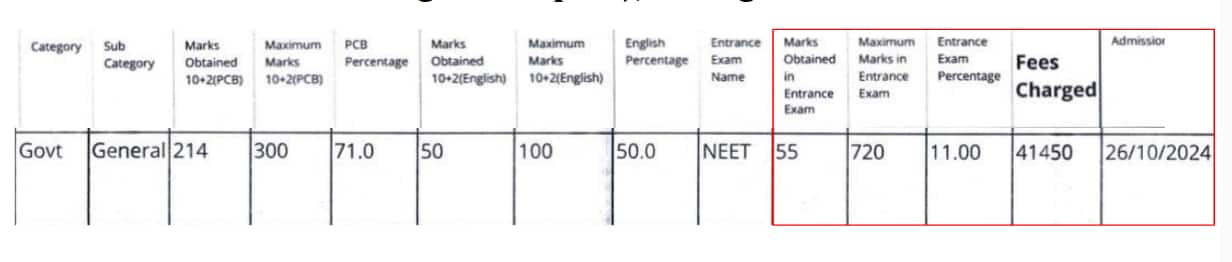
General category student was granted an MBBS seat in 2024 despite scoring only 55 out of 720 in NEET—equivalent to 11%, far below the qualifying cut-off of 162 marks for the General category.
The student was admitted on 26 October 2024, and paid a fee of 41,450. According to NEET UG 2024 norms set by the National Medical Commission (NMC), such a low score renders the candidate ineligible for admission.
This case raises serious concerns over the transparency and fairness of the NEET counselling and admission process, especially in government medical colleges where merit is expected to be strictly upheld.
NEET Syllabus: Subjects & Chapters
Select your preferred subject to view the chapters
Admission Granted with 10% NEET Score at Prafulla Chandra Sen Government Medical College
An official admission record from Prafulla Chandra Sen Government Medical College & Hospital, West Bengal, shows that a student from the OBC (NCL) category was admitted to the MBBS program in 2024 with a NEET score of just 52 out of 720, equivalent to only 10%.
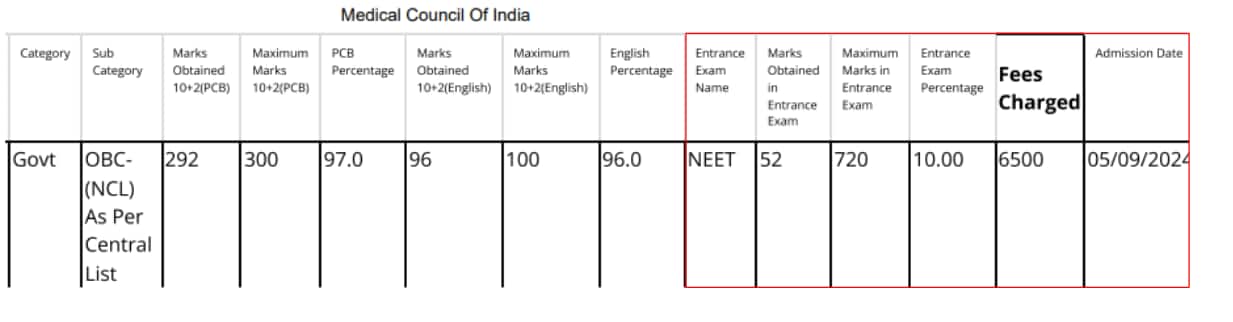
According to the NEET UG 2024 eligibility criteria, OBC-NCL candidates must secure at least the 40th percentile, which equated to 127 marks in 2024. The student in this case scored well below the required cutoff, making them officially ineligible for admission.
This incident adds to the growing list of documented cases where NEET-unqualified candidates were allegedly admitted to MBBS programs, undermining the fairness and transparency of the national medical admission framework.
NEET Qualification Mandatory Even for Central Pool Seats: Official Clarification
In light of the recent controversy surrounding admissions of NEET-unqualified candidates, an official memorandum from the Ministry of Health & Family Welfare, dated 12th August 2024, clarifies that Central Pool MBBS/BDS seats are not exempt from NEET eligibility criteria.
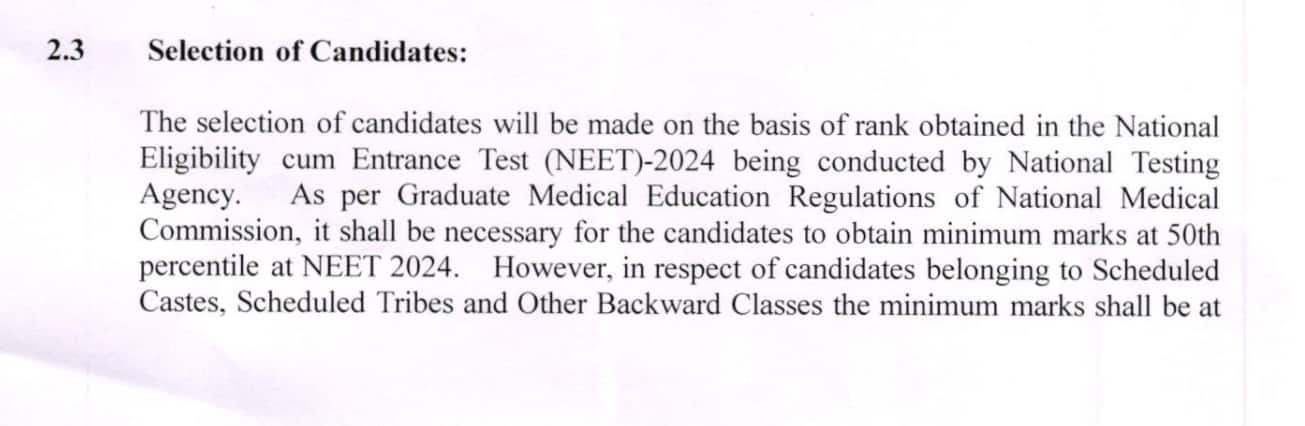
This makes it explicitly clear that NEET qualification remains mandatory, even for those selected under Central Pool nominations. Therefore, candidates scoring below the qualifying percentiles (162 marks for General, 127 for OBC/SC/ST in 2024) are not eligible for admission, irrespective of quota or category.
This official guideline further contradicts and questions the legitimacy of several documented admissions where students with NEET scores as low as 10%–11% were granted MBBS seats in government medical colleges. If these admissions were processed under Central Pool claims, they too appear to be in direct violation of NMC regulations.
This Isn’t Just About 16 Students — It’s About the Future
The NEET UG exam was introduced to ensure merit-based, transparent, and equal opportunity admissions to medical colleges across India. But the shocking evidence of students with ranks beyond 22 lakh and scores as low as 10% getting MBBS seats—many in government institutions—shows a serious breakdown in the system.
This is not just about 16 students. It’s about the trust of lakhs of deserving candidates who followed the rules, worked hard, and still didn’t get a seat. When unqualified students bypass the system, it destroys the very purpose of NEET and damages the future of India’s healthcare system.
Despite repeated guidelines from the NMC and the Ministry of Health, basic rules are being ignored. If qualifying in NEET is not mandatory anymore, then why conduct the exam at all?
It’s time for authorities to give clear answers. Students and parents deserve to know:
Who allowed these admissions?
Under what quota or authority?
And most importantly, will any action be taken?
Until that happens, this issue must be called what it is—a national-level medical admission scandal that needs urgent investigation, accountability, and reform.
Articles
Related Stories
|
Upcoming Medicine Exams

Certifications By Top Providers
Explore Top Universities Across Globe
Popular Courses and Specializations
List of colleges accepting NEET
Browse Medicine Colleges by State
Questions related to NEET
On Question asked by student community
Have a question related to NEET ?
Hello Savi
Please check the link below:
- https://medicine.careers360.com/articles/neet-previous-year-question-paper-with-solution
- https://www.careers360.com/download/neet-sample-papers-previous-years
Hope it helps.
Hello, for AP NEET PG Category C seats, NRI documents are generally required if you are applying under the NRI quota, and eligibility depends on the applicable counselling rules. The fee payment currency and procedure should be confirmed from the current Dr. NTRUHS notification at its official website drntr.uhsap.in.
Hello, the NEET PG stipend at Parul University depends on the postgraduate course, academic year and applicable university policies.
Hello, some B.Sc Nursing colleges may offer admission without NEET, but the admission process depends on the college and its eligibility rules. You can find colleges offering B.Sc Nursing admission without NEET here: https://medicine.careers360.com/articles/bsc-nursing-admission-without-neet
Hello, you can pursue BPT in Kerala without NEET UG. Admission is generally based on the LBS Centre rank list and the applicable admission process. You can check BPT colleges in Kerala and their details here: https://medicine.careers360.com/colleges/list-of-bpt-in-physiotherapy-colleges-in-kerala
Popular NEET Questions
the product 'P' will be ,
Option: 1

Option: 2

Option: 3
Option: 4


| Column A | Column B |
| A |
a) Organisation of cellular contents and further cell growth. |
| B |
b) Leads to formation of two daughter cells. |
| C |
c) Cell grows physically and increase volume proteins,organells. |
| D |
d) synthesis and replication of DNA. |
Match the correct option as per the process shown in the
0.16 g of dibasic acid required 25 ml of decinormal solution for complete neutralisation. The modecular weight of the acid will be
Option: 1
32
Option: 2
64
Option: 3
128
Option: 4
256
0xone is
Option: 1
Option: 2
Option: 3
Option: 4

Study Resources, Applications and Opportunities
Know possible Govt/Private MBBS/BDS Colleges based on your NEET rank
NEET 1-to-1 Counseling Guidance
ApplyCollege Predictors Webinars One to One Counselling Regular Updates Medical Almanac
Emversity Allied Health Programs
ApplyGet Job Ready in Healthcare | Employability-Focused Programs
KCDSH- Krishnadevaraya Dental College & Sciences Admis 2026
ApplyRanked among the top Dental Colleges for 7 consecutive years by India Today poll
SRM Kattankulathur Dental College Admissions 2026
ApplyRanked #19 by NIRF, NAAC A++ Accredited | Recognized by dental council of India
NEET Notifications
Never miss NEET update
Get timely NEET updates directly to your inbox. Stay informed!