NEET PG College Predictor
NEET PG All India & State College Predictor with Admission Process Guide


10 Common Mistakes First-Time NORCET Aspirants Make in Stage 1: Every year, thousands of nursing students give the AIIMS NORCET Stage 1 test; however, many of them end up losing marks owing to NORCET Stage 1 errors that can be avoided. There is a very rigid sectional pattern in Stage 1 with 100 questions which need to be answered in 90 minutes, with five sections containing 20 questions in each section and 18 minutes allotted to each section.
This Story also Contains
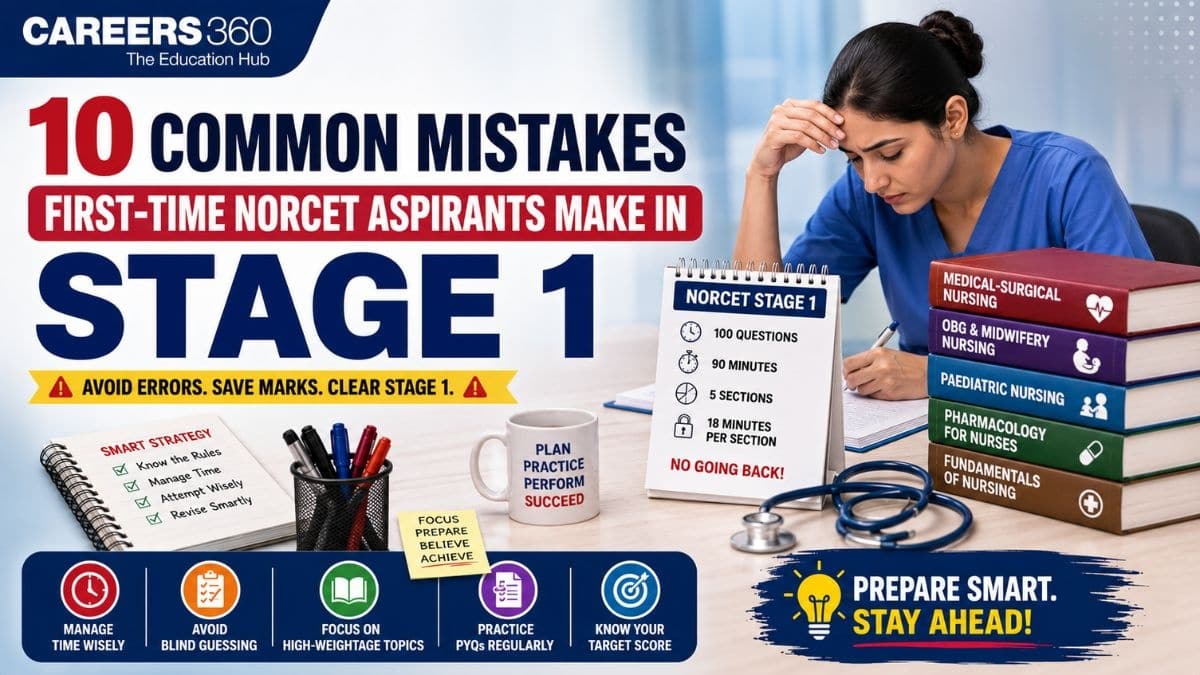
Candidates appearing for AIIMS NORCET for the first time may have prepared very well academically; however, they may face problems owing to their lack of familiarity with the rigid format of the exam. Problems of poor time management, random guessing, late practice of mock tests, and improper revision may result in reduced performance.
This article lists ten mistakes specific to how NORCET Stage 1 is actually structured, based on the exam's sectional format, marking scheme, and qualifying nature. A short list of general exam-day mistakes follows at the end, for anyone preparing for their first attempt.
Practising NORCET using a 90-minute timer is one of the most common errors made by candidates when preparing for NORCET.
The real exam is broken down into five parts, each part containing 20 questions and having a time limit of 18 minutes. Once the time expires, you cannot access the part again. Therefore, candidates must train themselves to answer, check and amend answers in 18 minutes.
It is good to practice full-length mocks, but the training must also be complemented with sectional mocks according to NORCET’s actual timing.
In Stage 1, there are 20 questions of General Knowledge and Aptitude out of 100, and the remaining 80 questions are from the nursing syllabus.
Some candidates who aspire to be nurses tend to concentrate mainly on the subjects related to nursing but leave GK and Aptitude for later. This may lead to a lower score at the qualifying stage.
Hence, students need to consider preparing for GK and Aptitude as well, along with other topics.
A wrong answer costs one-third of a mark, and an unattempted question costs nothing. Aspirants who practise sample papers without negative marking sometimes carry the same guessing habit into the NORCET exam, especially in the final minutes of a closing section. Four random guesses, with three wrong and one right, net out to zero. An educated guess, where at least one option can be ruled out, is a different calculation. A blind guess, made under time pressure, usually isn't worth the risk.
NORCET's nursing subjects do not carry equal weight. Medical-surgical nursing and OBG typically make up a much larger weightage of the paper than smaller subjects like Nursing Research or Microbiology. Aspirants who split study time evenly across every subject, rather than giving more time to the high-weightage topic, often under-prepare exactly the subjects that carry the most marks.
Stage 1 is qualifying only. It does not contribute to the final merit list. Prelims cutoffs are released as a percentile, not a raw score. Some first-time aspirants relax too much after a comfortable Stage 1 score. They assume the hard part of preparation is over, or panic over a Stage 1 score that looks low without checking how percentile-based qualifying actually works. Both reactions come from the same gap: not fully understanding what Stage 1 does and doesn't measure.
Previous year question papers reveal the exam's real question format and its repeated topics and information. A concept book or textbook alone cannot fully provide both. So practicing PYQs in the last few days before the exam means finding out too late which topics repeat often instead of using that pattern to guide revision from the start.
Studying several books covering the same subject. Each book's concepts are the same with slightly different tone or wording or numbers. Following multiple books adds confusion rather than depth. This is especially costly close to Stage 1, when the goal shifts from learning new material to reinforcing what's already known. A single consistent source, revised multiple times, gives more confidence against exam pressure than multiple partially read books.
Subjects or chapters covered early in preparation often fade away by exam day without revision. A single read-through of any subject, without a planned second or third pass, leaves it vulnerable to being forgotten under the different phrasing NORCET tends to use in its actual questions.
Sectional timing is a skill, not just a content check, and skills need repetition to build. Aspirants who take their first full sectional mock test in the final week are testing an untrained skill for the first time with a little time left to fix what goes wrong. Mock tests started earlier; even if scores are lower at first, leave time to correct pacing and section-specific weaknesses.
Stage 1's qualifying cutoff varies by category and by cycle. Aspirants sometimes prepare toward a single assumed "safe score" without checking how that score compares to their own category's recent trends, leading to either misplaced overconfidence or unnecessary panic. Checking recent cutoff patterns gives a more realistic target than guessing at one.
Get expert advice on college selection, admission chances, and career path in a personalized counselling session.
Beyond NORCET's specific format, a few broader exam-day habits are given below, especially on a first attempt:
Arriving at the exam centre beyond time. Being there a little earlier adds avoidable stress before the exam even starts
Spending too long on the first hard question in a section, instead of marking it and moving on
Not reading each question fully before answering, especially negatively framed ones
Letting one difficult section affect focus and confidence in the sections that follow
These are not unique to NORCET, but they tend to matter more inside a strict sectional, negatively marked format than in an exam with more flexible timing.
There is a simple way to avoid most of the unnecessary mistakes:
Practice writing the paper in the five-section pattern rather than giving open 90-minute tests only.
Always include GK & Aptitude since they have 20 marks.
Practice PYQs right from the beginning, rather than waiting till the end.
Focus on high-yield subjects in nursing but still cover all the topics.
Give timed mocks and analyse each wrong and guessed question.
Have an error notebook for your repeated mistakes and weak concepts.
Do not unnecessarily hop between sources and practice the chosen ones again.
Take negative marking very seriously and differentiate between an educated guess and a wild guess.
Monitor your accuracy and time per section, not the overall mock score.
Pay attention to the actual execution on the exam day, because knowing the answer and answering it in the limited time are two different things.
Frequently Asked Questions (FAQs)
Practising without real sectional timing is one of the most consistent issues. Many aspirants prepare with a single open timer for the whole paper and meet the actual sectional, no-going-back format for the first time on exam day.
Yes. A wrong answer costs one-third mark, while an unattempted question costs nothing. Blind guessing, especially in the last minutes of a closing section, tends to lower the overall score more than it raises it.
It can be, if it leads to under-preparing for Stage 2. Stage 1 is qualifying only and does not carry forward into the final merit list, which is decided entirely by the Mains score.

On Question asked by student community
Hello Student,
The AIIMS NORCET (Nursing Officer Recruitment Common Eligibility Test) previous year question papers are available in PDF format at the link given below:
https://medicine.careers360.com/articles/aiims-nursing-officer-previous-year-question-papers
Hello Punitha,
The NORCET (Nursing Officer Recruitment Common Eligibility Test) is conducted by the All India Institute of Medical Sciences for the recruitment of Nursing Officers in AIIMS and participating institutes.
Here are the links to the NORCET important questions and answer resources:

NEET PG All India & State College Predictor with Admission Process Guide
End-to-End NEET PG Admission Guidance | One-to-One Counselling | College Predictors | Regular Updates | E-books