


Drug Dosage Calculation Questions for NORCET: 50 Practice Problems
Drug Dosage Calculation Questions for NORCET 2026: Drug dosage calculation decides more NORCET marks than most aspirants realise. AIIMS NORCET 11 exam calculation questions don't test how much you know. They test whether you can apply a formula correctly, under time pressure, without a small arithmetic slip that can cost you the marks. Drug Dosage is also the one topic where a wrong answer usually means a wrong step, not a knowledge gap. That's what makes practice Drug Dosage Calculation Questions more effective here compared to most other NORCET subjects.
This Story also Contains
- Why Drug Dosage Calculation Questions Deserve Daily Practice
- Drug Dosage Calculation Questions:15 Practice Questions with Full Solutions
- 50 Drug Dosage Calculation Practice Problems with Solutions - Download PDF
- How to Practise Drug Dosage Calculation Daily
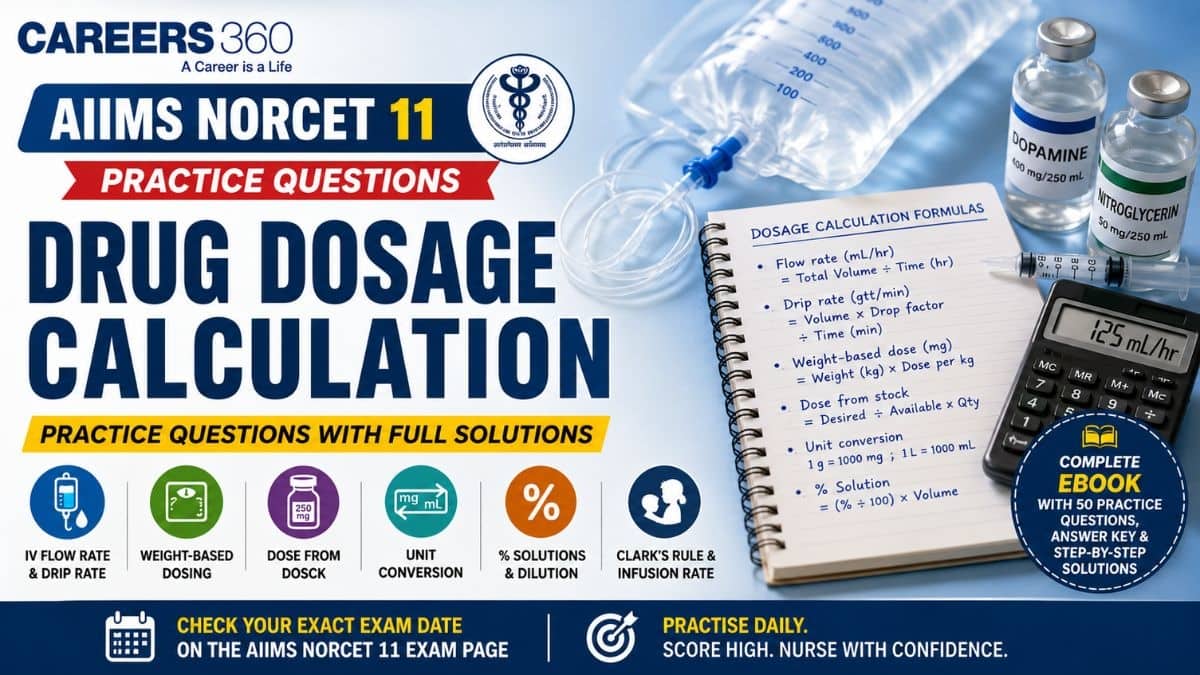
Below are 15 practice problems covering the main dosage-calculation formats: IV flow rate, drip rate, weight-based dosing, dose from stock, unit conversion, percentage solutions, Clark's Rule, and weight-based infusion rate. Each one comes with the full solution. If you're building calculation practice into your revision plan, see our AIIMS NORCET 11 subject-wise revision plan for where this fits into your weekly schedule.
Why Drug Dosage Calculation Questions Deserve Daily Practice
Dosage calculation questions follow a small set of repeating formulas. Once you know the formula, the only thing left to get wrong is the arithmetic, or a missed unit conversion. This is unlike a fact-recall question, where either you know the answer or you don't. Here, speed and accuracy come from repetition, not from reading a rule once and moving on.
Ten minutes of calculation practice, done daily, beats one long session done weekly. The goal isn't to memorise these 15 questions. It's to get fast enough at the underlying formulas that any new number, on exam day, doesn't slow you down.
Confused About College Admissions?
Get expert advice on college selection, admission chances, and career path in a personalized counselling session.
Drug Dosage Calculation Questions:15 Practice Questions with Full Solutions
IV Flow Rate (mL/hr)
Q1. A patient is prescribed 1000 mL of Normal Saline to run over 8 hours. Using an infusion pump, what flow rate (mL/hr) should the nurse set?
A. 8000 mL/hr B. 133 mL/hr C. 100 mL/hr D. 125 mL/hr
Correct answer: D. 125 mL/hr
Solution: Flow rate = Total volume ÷ Time in hours = 1000 mL ÷ 8 hr = 125 mL/hr.
Q2. A patient needs 500 mL of Ringer's Lactate infused over 4 hours. Using an infusion pump, what flow rate (mL/hr) should the nurse set?
A. 83.3 mL/hr B. 2000 mL/hr C. 125 mL/hr D. 129 mL/hr
Correct answer: C. 125 mL/hr
Solution: Flow rate = Total volume ÷ Time in hours = 500 mL ÷ 4 hr = 125 mL/hr.
IV Drip Rate (gtt/min)
Q7. 1000 mL of IV fluid is to be infused over 8 hours using a set with a drop factor of 15 gtt/mL. What is the correct drip rate in drops per minute?
A. 16 gtt/min B. 62 gtt/min C. 31 gtt/min D. 125 gtt/min
Correct answer: C. 31 gtt/min
Solution: Drip rate = (Volume × Drop factor) ÷ Time in minutes = (1000 mL × 15 gtt/mL) ÷ 480 min = 31.2, rounded to 31 gtt/min.
Q9. 1000 mL of D5W is to run over 6 hours through a set calibrated at 10 gtt/mL. What is the correct drip rate?
A. 28 gtt/min B. 14 gtt/min C. 56 gtt/min D. 167 gtt/min
Correct answer: A. 28 gtt/min
Solution: Drip rate = (1000 mL × 10 gtt/mL) ÷ 360 min = 27.8, rounded to 28 gtt/min.
Weight-Based Dosage (mg/kg)
Q15. A child weighing 20 kg is prescribed a drug at 5 mg/kg/day. What is the total dose in mg?
A. 100 mg B. 4 mg C. 50 mg D. 120 mg
Correct answer: A. 100 mg
Solution: Total dose = Weight × Dose per kg = 20 kg × 5 mg/kg = 100 mg.
Q16. A 15 kg child is ordered an antibiotic at 8 mg/kg/dose. What is the total dose?
A. 60 mg B. 120 mg C. 135 mg D. 1.9 mg
Correct answer: B. 120 mg
Solution: Total dose = 15 kg × 8 mg/kg = 120 mg.
Dose Calculation from Stock
Q23. The doctor orders 500 mg of a drug. Available tablets are 250 mg each. How much should the nurse administer?
A. 0.5 tab B. 1 tab C. 3 tab D. 2 tab
Correct answer: D. 2 tab
Solution: Dose to give = (Desired ÷ Available) × Quantity = (500 ÷ 250) × 1 tab = 2 tablets.
Q26. 250 mg of an oral suspension is ordered. Available strength is 125 mg in 5 mL. How much should the nurse administer?
A. 2.5 mL B. 5 mL C. 10 mL D. 15 mL
Correct answer: C. 10 mL
Solution: Dose to give = (250 ÷ 125) × 5 mL = 10 mL.
Unit Conversion
Q31. A drug order reads 0.5 g. How many mg is this?
A. 50 mg B. 500 mg C. 50000 mg D. 5000 mg
Correct answer: B. 500 mg
Solution: 1 g = 1000 mg, so 0.5 g = 500 mg.
Q33. A patient's IV fluid order is written as 2.5 L. The nurse must record this on the intake chart in mL. How many mL is this?
A. 2500 mL B. 25000 mL C. 250 mL D. 250000 mL
Correct answer: A. 2500 mL
Solution: 1 L = 1000 mL, so 2.5 L = 2500 mL.
Percentage Solution / Dilution
Q37. How many grams of drug are present in 100 mL of a 2% solution?
A. 4 g B. 2 g C. 1 g D. 200 g
Correct answer: B. 2 g
Solution: Grams = (% ÷ 100) × Volume = (2 ÷ 100) × 100 = 2 g.
Q39. How many grams of drug are present in 500 mL of a 5% solution?
A. 50 g B. 25 g C. 2500 g D. 12.5 g
Correct answer: B. 25 g
Solution: Grams = (5 ÷ 100) × 500 = 25 g.
Paediatric Dosing (Clark's Rule)
Q41. Using Clark's Rule, calculate a child's dose if the adult dose is 500 mg and the child weighs 30 lb (average adult weight = 150 lb).
A. 50 mg B. 2500 mg C. 100 mg D. 200 mg
Correct answer: C. 100 mg
Solution: Child's dose = (Child's weight ÷ 150) × Adult dose = (30 ÷ 150) × 500 mg = 100 mg.
Weight-Based Infusion Rate (mcg/kg/min)
Q45. A 70 kg patient is ordered a Dopamine infusion at 5 mcg/kg/min. Available solution: 400 mg in 250 mL. What infusion rate (mL/hr) should be set?
A. 26.2 mL/hr B. 13.1 mL/hr C. 23.1 mL/hr D. 6.5 mL/hr
Correct answer: B. 13.1 mL/hr
Solution: Dose/min = 70 kg × 5 mcg/kg/min = 350 mcg/min. Concentration = (400 mg × 1000) ÷ 250 mL = 1600 mcg/mL. Rate = 350 ÷ 1600 = 0.219 mL/min = 13.1 mL/hr.
Q48. A 50 kg patient is ordered a Nitroglycerin infusion at 0.1 mcg/kg/min. Available solution: 50 mg in 250 mL. What infusion rate should be set?
A. 3 mL/hr B. 0.8 mL/hr C. 1.5 mL/hr D. 11.5 mL/hr
Correct answer: C. 1.5 mL/hr
Solution: Dose/min = 50 kg × 0.1 mcg/kg/min = 5 mcg/min. Concentration = (50 mg × 1000) ÷ 250 mL = 200 mcg/mL. Rate = 5 ÷ 200 = 0.025 mL/min = 1.5 mL/hr.
50 Drug Dosage Calculation Practice Problems with Solutions - Download PDF
These 15 cover the format. The full eBook has all 50 questions, arranged by calculation type, plus a complete answer key and full step-by-step working for every single question, so you can check not just what the right answer is, but exactly how to get there.
How to Practise Drug Dosage Calculation Daily
Attempt each question cold, without looking at the formula first. Write your working on paper, the same way you would in the exam. Only check the solution after you've committed to an answer. This is slower at first. It's also the only way calculation speed actually improves, because the exam won't give you a formula sheet either.
Frequently Asked Questions (FAQs)
Mainly IV flow rate, IV drip rate, weight-based (mg/kg) dosing, dose calculation from available stock, unit conversion, and percentage solutions. Paediatric dosing using Clark's Rule and weight-based infusion rates also appear.
NORCET is a computer-based test and does not provide a physical or on-screen calculator. All dosage calculations must be done by hand, which is why manual calculation speed matters.
The number of questions asked in exam may vary by year. However, the calculation-based questions appear consistently in previous year papers, often mixed into Fundamentals of Nursing, Paediatric Nursing, and Medical-Surgical Nursing sections.
Popular Courses and Specializations
Questions related to AIIMS NORCET
On Question asked by student community
Hello Student,
The AIIMS NORCET (Nursing Officer Recruitment Common Eligibility Test) previous year question papers are available in PDF format at the link given below:
https://medicine.careers360.com/articles/aiims-nursing-officer-previous-year-question-papers
Hello Punitha,
The NORCET (Nursing Officer Recruitment Common Eligibility Test) is conducted by the All India Institute of Medical Sciences for the recruitment of Nursing Officers in AIIMS and participating institutes.
Here are the links to the NORCET important questions and answer resources: