JSS University Mysore Allied Sciences 2026
NAAC A+ Accredited| Ranked #21 in University Category by NIRF | Applications open for multiple UG & PG Programs


The National Testing Agency (NTA) affixes the NEET reservation criteria for the single largest medical entrance exam in India. The authority will release the detailed NEET 2026 reservation criteria along with the information brochure. The reservation in NEET is provided to state medical and dental colleges under the All India scheme along with central universities.
This Story also Contains
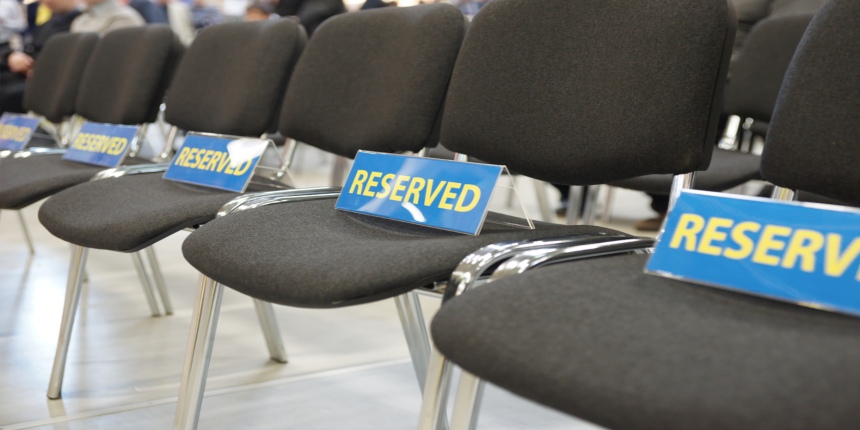
The seat reservation of NEET UG benefits nearly 1,500 OBC and 550 EWS candidates. Candidates must note that the NEET reservation criteria 2026 will be directed under the reservation guidelines of the Government of India (GOI). Besides the EWS quota and OBC quota, the reservation of 15% seats for Scheduled Caste (SC), 7.5% seats for Scheduled Tribe (ST) and 5% seats for Persons with Disability (PwD) is given. Medical aspirants must fill in their reservation criteria for NEET 2026 while registering.
In every state, 85% of seats are reserved under State Quota candidates and NEET 2026 reservation criteria for them is decided by the concerned state authorities. NEET is the single undergraduate national-level medical entrance examination. Based on the NEET result, admissions to over 1 lakh MBBS and 27,868 BDS seats, 52,720 AYUSH seats, and 603 BVSc & AH seats are offered in the medical-dental colleges of India. For more details on the reservation criteria of NEET 2026, SC ST reservation in NEET and others, candidates are advised to read the full article.
NEET 2026 reservation criteria is provided to 27% OBC and 10% EWS categories. Out of the total seats in all government MBBS/BDS colleges, 15% are reserved for All India Quota (AIQ) seats. The seats under the 15% AIQ scheme are allotted through NEET UG reservation criteria.
Earlier, the Supreme Court introduced NEET reservation to 15% seats for SC and 7.5% seats for ST categories. While the 27% OBC reservation in NEET was implemented in Central universities only. However, it was not extended to AIQ seats of state MBBS and BDS colleges. In 2021, the Government of India (GoI) decided to provide 27% OBC and 10% EWS reservation in the AIQ scheme. The OBC and EWS students from across the country can take admissions under the AIQ scheme.
The Directorate General of Health Services (DGHS) on behalf of the Medical Counselling Committee (MCC) conducts the NEET counselling for 15% of seats available for admission in all government medical and dental colleges. As per the NEET reservation criteria, there are certain percentage of seats reserved category-wise in government medical colleges in the 15% AIQ. Candidates must note that the remaining unreserved seats are filled on the basis of merit secured in NEET result 2026. The article below provides information on OBC criteria for NEET, EWS criteria for NEET, and others.
Category | Reservation |
SC | 15% |
ST | 7.5% |
NEET reservation for OBC-NCL | 27% |
GEN-EWS | 10% |
Persons with Disability (PwBD) | 5% |
*Horizontal reservation across all categories including unreserved seats.
Get expert advice on college selection, admission chances, and career path in a personalized counselling session.
The Ministry of Health and Family Welfare brought EWS quota in NEET UG admission in 2019. Under this quota, 10% of seats are reserved in the government medical colleges for candidates from financially unstable backgrounds. The candidates must hold an EWS certificate for NEET exam. The distinguishing criteria for EWS category in NEET 2026 reservations are listed below. It must be noted that those candidates whose family owns any of these will not be eligible.
Annual income of the family must not be more than ₹8,00,000
5 acres of agricultural land and above
Residential flat of 1000 sq. ft. and above
Residential plot of 100 sq. yards and above in notified municipalities
Residential plot of 200 sq. yards and above in areas others than the notified municipalities
Participating institutes in NEET EWS reservation
1. Central University/Institutes
2. National Institutes
3. State Government Medical Colleges
Given below is the list of colleges that undertake admissions through NEET EWS reservations. Also this reservation will only be available to candidates belonging to unreserved categories.
In compliance with the last year NEET reservation criteria, those candidates who have a benchmark physical disability are eligible for getting a reservation of 5%. Candidates will be getting this provision under effect of the Rights of Persons with Disability Act, 2016. Those candidates who claim to be eligible for NEET 2026 reservation criteria under the same have to submit their PwBD Certificate for NEET, issued to them by any one of the fifteen authorities approved for disability certificates.
Like previous years, the guidelines for NEET reservation criteria for the seats which are under state quota will be set by the state counselling authorities on the basis of the prevailing reservation policies. Candidates must be aware that all the states have their own reservation policies. These reservation policies are strategised for different indigenous categories that are governed under state rule.
Also, the concerned state counselling authorities govern the admission process in the government and dental colleges of the particular state. Their reservation policy might not match with NEET 2026 reservation criteria.
DGHS conducts All India Counselling for seats available in Deemed/Central universities, ESIC college and AFMS institutes and NEET reservation criteria 2026 is applied here. Directorate General of Armed Forces Medical Services, Ministry of Defence, Government of India lays down rules and regulations for admission to AFMC, Pune.
Also read: NEET Sample Papers | NEET Exam Pattern | NEET Exam Date
Frequently Asked Questions (FAQs)
As per government regulations for NEET reservation criteria, 27% seats for OBC, 10% seats for EWS, 15% seats for SC and 7.5% seats for ST are reserved in Central Universities and state medical colleges.
For admission to 15% AIQ, seats will be allotted irrespective of the domicile NEET criteria. While for 85% state quota seats, candidates need to fulfill the domicile and other eligibility conditions asked by the respective authority.
15% seats will be reserved for All India Quota seats, while 85% seats will be reserved for state quota. The seats under this reservation will be allotted as per the NEET reservation criteria 2026.
The seats left after the constitutional reservation for NEET exam will be available for general category candidates.
As per the reservation criteria, seats for SC, ST, OBC, EWS and PwD candidates will be reserved. The admission to 15% AIQ, 85% state quota and other seats will be allotted through NEET 2026 scores.

On Question asked by student community
Hello Dear Student,
You can check, find and access more information here:
Hello Dear Student,
With 460 marks and an AIR of ~150,450, a government MBBS seat is highly unlikely. However, you have very strong chances of securing a seat in Private MBBS, BDS, BAMS, or Deemed Universities.
You can check, find and access more information here:
Hello Dear Student,
With a NEET score of 118 in the SC category, securing a government MBBS seat is not possible. The cut-off for government medical colleges typically ranges between 450 and 500+ marks. However, your score makes you eligible for private medical or BDS colleges through state-level counseling.
You
Dear Aspirant,
Based on the details you have shared: NEET 2026 score 549 marks l, All India rank AIR 37,754 OBC category and Uttar Pradesh domicile:
Dear Aspirant,
The Assam NEET 2026 cutoff has not been released yet, It will be announced after the you NEET UG counselling process begin and will vary depending on factor such as the number of applicant, seat availability, reservation category, and the difficulty level of the exam.
As a rough
the product 'P' will be ,


| Column A | Column B |
| A |
a) Organisation of cellular contents and further cell growth. |
| B |
b) Leads to formation of two daughter cells. |
| C |
c) Cell grows physically and increase volume proteins,organells. |
| D |
d) synthesis and replication of DNA. |
Match the correct option as per the process shown in the
0.16 g of dibasic acid required 25 ml of decinormal solution for complete neutralisation. The modecular weight of the acid will be
32
64
128
256
0xone is

Know possible Govt/Private MBBS/BDS Colleges based on your NEET rank
College Predictors Webinars One to One Counselling Regular Updates Medical Almanac
Alied Health Sciences at SCSVMV | NAAC 'A' Grade | AICTE & UGC Aproved | 100% Placement Support | Merit-based Scholarships
5+ Crore Scholarship for Meritorious Students | 250+ Recruiters | 10,000+ Placements | 20 Lakhs Highest Package
Highest Package: ₹32 LPA | Placement Rate: 90% students placed | 5000+ Students Placed 900+ Placements Recruiters | Scholarships Available
India's youngest NAAC A++ accredited University | NIRF rank band 151-200 | 2200 Recruiters | 45.98 Lakhs Highest Package