NEET PG College Predictor
NEET PG All India & State College Predictor with Admission Process Guide


Best Books for NEET SS: NEET SS has no single fixed syllabus. NBEMS draws questions up to the PG-exit level from whichever of the 13 question paper groups you've registered for. So, a candidate sitting for the Medical Group's Cardiology super-speciality and one sitting for the Surgical Group's Urology super-speciality are, in practical terms, preparing for two different exams that happen to share a name and an exam date. A generic booklist can't serve both exams.
This Story also Contains
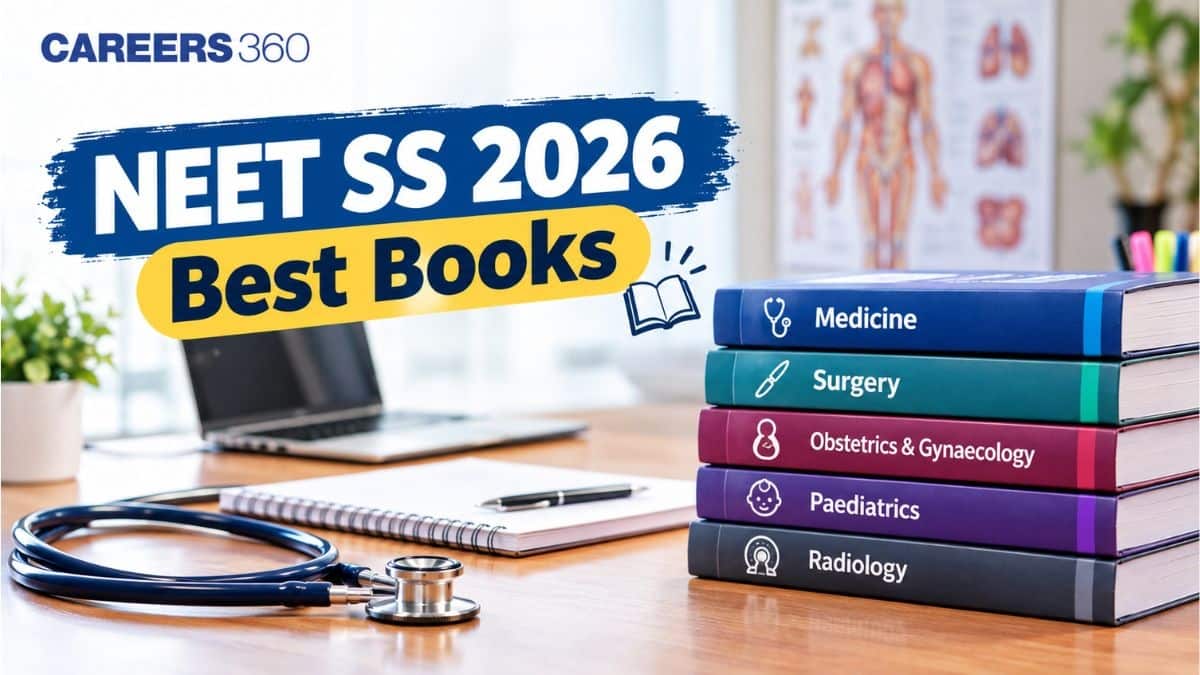
NEET SS exam actually splits candidates by question paper group and, within that, by the super-speciality you're targeting. Where a book genuinely is used across every group (an internal medicine base text, a surgery base text, a dedicated NEET SS MCQ bank), that's called out separately, since duplicating it under all 13 groups would be noise, not help. None of this is an NBEMS-prescribed list. The board doesn't publish a book list, precisely because the syllabus isn't fixed. So, what's below reflects the standard PG-exit-level reference texts used broadly across DM/MCh preparation for each speciality, not an official reading list.
Before the group-wise lists, it helps to know what you're actually being tested on. NEET SS is a 150-question, computer-based exam conducted in English only. The exam runs across two shifts on two exam days, with +4 for a correct answer and −1 for a wrong one, and zero for anything left unattempted. Because there's no fixed syllabus, the group-wise NEET SS syllabus document is the only reliable starting point for confirming which super-specialities fall under your feeder qualification before you commit time to any book list. MD General Medicine, for instance, feeds into Cardiology, Nephrology, Medical Gastroenterology, Neurology, Endocrinology, Clinical Haematology, Infectious Diseases, and several other groups, and the correct book list changes entirely depending on which of those you're targeting.
Get expert advice on college selection, admission chances, and career path in a personalized counselling session.
Candidates from an MD/DNB General Medicine background choosing a Medical Group super-speciality need a base internal medicine text plus a dedicated reference for their chosen sub-speciality. Reading only the base text and skipping the speciality-specific reference is the single most common gap at this level, since NEET SS questions in this group go well beyond general medicine depth.
Super-speciality | Base text | Speciality-specific reference |
All Medical Group specialities | Harrison's Principles of Internal Medicine | — |
Cardiology | Harrison's | Braunwald's Heart Disease |
Nephrology | Harrison's | Comprehensive Clinical Nephrology (Feehally, Floege, Johnson) |
Medical Gastroenterology / Hepatology | Harrison's | Sleisenger and Fordtran's Gastrointestinal and Liver Disease |
Neurology | Harrison's | Adams and Victor's Principles of Neurology, or Bradley's Neurology in Clinical Practice |
Endocrinology | Harrison's | Williams Textbook of Endocrinology |
Medical Oncology | Harrison's | DeVita, Hellman, and Rosenberg's Cancer: Principles & Practice of Oncology |
Clinical Haematology | Harrison's | Wintrobe's Clinical Hematology |
Infectious Diseases | Harrison's | Mandell, Douglas, and Bennett's Principles and Practice of Infectious Diseases |
Clinical Immunology & Rheumatology | Harrison's | Kelley's Textbook of Rheumatology |
Critical Care Medicine | Harrison's | Marino's The ICU Book |
The Surgical Group works the same way. Schwartz's Principles of Surgery as the shared base, with a distinct standard reference for whichever surgical super-speciality you're sitting for. Surgery Essence by Pritesh Singh is commonly used as a condensed revision companion alongside these, not as a replacement for them.
Super-speciality | Base text | Speciality-specific reference |
All Surgical Group specialities | Schwartz's Principles of Surgery | — |
Neurosurgery | Schwartz's | Youmans and Winn Neurological Surgery |
Urology | Schwartz's | Campbell-Walsh-Wein Urology |
Vascular Surgery / CTVS | Schwartz's | Rutherford's Vascular Surgery and Endovascular Therapy |
Surgical Oncology | Schwartz's | DeVita's Cancer: Principles & Practice of Oncology (shared with Medical Oncology) |
Plastic & Reconstructive Surgery | Schwartz's | Grabb and Smith's Plastic Surgery |
Paediatric Surgery | Schwartz's | Ashcraft's Pediatric Surgery |
GI Surgery | Schwartz's | Sabiston Textbook of Surgery |
These two groups are smaller in candidate volume than Medical and Surgical, which means fewer dedicated NEET SS-specific resources exist for them — making the standard international reference texts even more central to preparation rather than optional supplements.
Paediatrics Group (feeder: MD/DNB Paediatrics — Paediatric Cardiology, Neonatology, Paediatric Neurology, etc.): Nelson Textbook of Pediatrics as the base text, with Moss and Adams' Heart Disease in Infants, Children, and Adolescents for Paediatric Cardiology and Avery's Diseases of the Newborn or Fanaroff and Martin's Neonatal-Perinatal Medicine for Neonatology.
Obstetrics & Gynaecology Group (feeder: MD/MS/DNB OBG — Reproductive Medicine, Gynaecological Oncology, etc.): Williams Obstetrics and Te Linde's Operative Gynecology as base texts, Speroff's Clinical Gynecologic Endocrinology and Infertility for Reproductive Medicine, and DeVita's oncology text again for Gynaecological Oncology.
Anaesthesiology candidates need Miller's Anesthesia as the foundational text regardless of which sub-speciality they're targeting, layered with a focused reference depending on the chosen path: Kaplan's Cardiac Anesthesia for Cardiac Anaesthesia, Cottrell and Patel's Neuroanesthesia for Neuroanaesthesia, and Marino's The ICU Book again where Critical Care Medicine overlaps with an anaesthesia feeder qualification.
A small set of resources aren't tied to any single super-speciality and are used across nearly every NEET SS group:
NEET SS MCQ book by Deepak Marwah & Mudit Khanna — the most consistently cited dedicated question bank for this exam specifically, useful precisely because it's built around NEET SS's question style rather than a general PG-entrance format.
R. Kumar's Clinical Methods in Medicine — referenced across Medical Group specialities for clinical-scenario-style questions.
Guyton and Hall's Textbook of Medical Physiology — still relevant at PG-exit level for physiology-linked questions embedded inside clinical vignettes, particularly for Cardiology, Nephrology, and Critical Care.
Previous years' NEET SS question papers — solving these matters more here than for most other medical entrances, because with no fixed syllabus, actual past papers are the closest thing to a syllabus boundary you'll get.
Buying a generic "PG entrance" booklist instead of a group-specific one. A book list built for NEET PG or INI CET assumes MBBS-level breadth; NEET SS assumes PG-exit-level depth in one narrow area, so the same books don't transfer directly.
Substituting condensed revision books for the full standard reference. A condensed text like Surgery Essence works as a second-pass revision aid, not as your only source, given the exam draws from PG-exit-level knowledge that condensed books deliberately compress.
Ignoring your own residency notes and rounds experience. Because there's no fixed syllabus, your own department's case discussions and the clinical reasoning you've built during residency often cover exactly the kind of applied-knowledge question NEET SS asks — treating book study as the only preparation method undervalues that experience.
Skipping past papers because "there's no fixed syllabus anyway." This is backwards — with no fixed syllabus, previous years' papers are actually more informative about likely question style and depth than they would be for an exam with a published syllabus.
Also Read:
Frequently Asked Questions (FAQs)
No — NBEMS doesn't publish one, since NEET SS has no fixed syllabus and draws questions from your chosen group.
No, use it as the base and add a dedicated reference like Braunwald's for depth in your chosen sub-speciality.
Yes — with no fixed syllabus, past papers are your best guide to actual question style and depth.

On Question asked by student community
Good Morning
Hope you are fine
You question seems incomplete but you have tagged National Eligibility cum Entrance Test Super Specialty (NEET SS) 2022, so I am answering for this exam, as per you query 4 marks awarded for your correct answer, 1 mark deducted for incorrect response and 0
Hello,
The Directorate General of Health Services on behalf of MCC will conduct NEET SS Counseling in online mode, as of now there is no official announcement made yet regarding the commencement of counseling process, since the results are already declared the process may start by this month, however to
Hello There,
Listen, your question is Incomplete , you have not specified any thing more about the topic , I am not able to get what you exactly wanted to ask . Due to your Incomplete question I am unable to answer your concern. Try to send complete Question next
Hello,
The NEET SS exam was conducted on 10th January 2022, and the results have not been released yet. However, the results are expected to be out by today, that is, 31st January 2022. The result will be abailable for 32 specialities and at the official website which is nbe.edu
Hi
NEET UG All India counseling is expected to start soon
On January 7, the Supreme Court of India gave decision regarding the validity of OBC reservation in NEET counselling.
Counseling will be held in 4 rounds- 1st round, 2nd round, mopup round and filling of stray vacancies
The NEET

NEET PG All India & State College Predictor with Admission Process Guide
End-to-End NEET PG Admission Guidance | One-to-One Counselling | College Predictors | Regular Updates | E-books