SRM Medical College Admissions 2026
Ranked #18 by NIRF, NAAC A++ Accredited | Unmatched clinical exposure with over 7 lakh patients yearly


With NEET 2026 just one month away, the gap between aspirants who will secure a medical seat and those who won’t is widening rapidly. At this stage, it’s no longer about how much you study - it’s about what you choose to study and what you avoid. Yet, many serious aspirants are unknowingly damaging their rank every single day, even while putting in long hours.
This Story also Contains
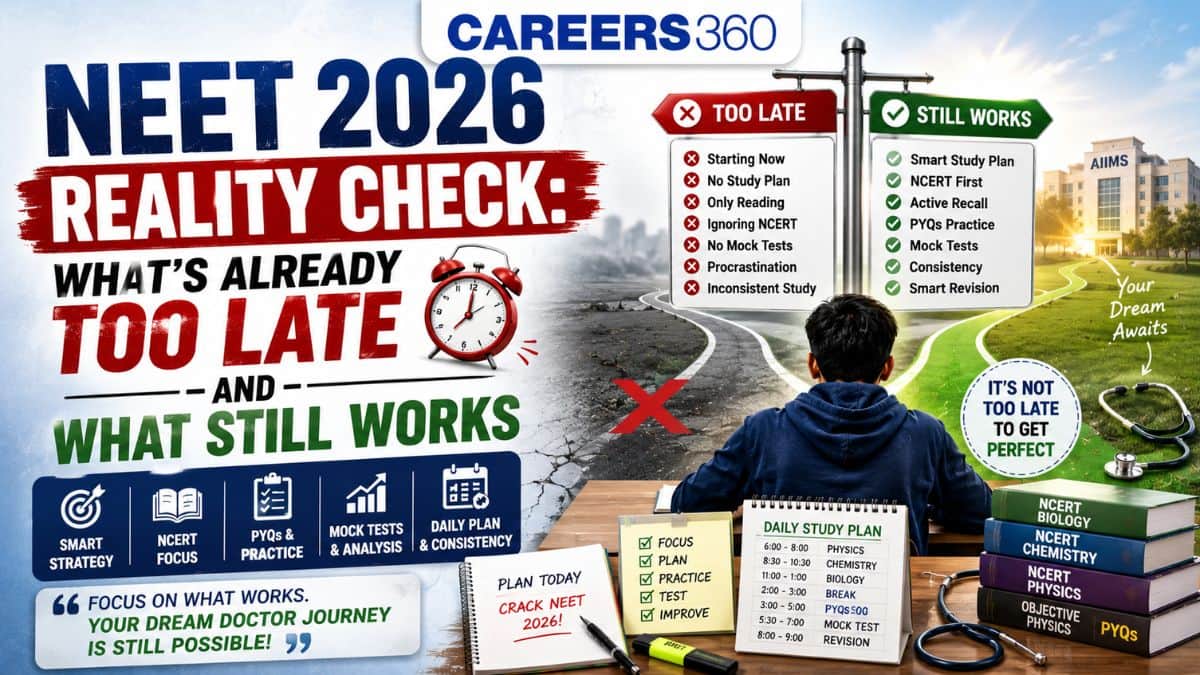
Some are still trying to complete untouched chapters. Others are jumping between crash courses, new teachers, and last-minute PDFs, hoping for a breakthrough. But the reality is harsh: with only a few weeks left, certain strategies don’t just fail-they actively pull your score down.
If you’ve started feeling that you’re studying more but trusting yourself less, this isn’t burnout—it’s a strategic problem. This phase is where most rank losses happen, not because of a lack of effort, but because of wrong decisions under time pressure. This is not motivation. This is a NEET 2026 reality check that many aspirants realise only after the exam.
Every NEET exam cycle repeats the same pattern. Students don’t fall short because they didn’t work hard—they fall short because they focused on the wrong things at the most critical time.
This article breaks down what is already too late to fix in the final month, which habits are silently lowering your score, and what actually works now if your goal is a safe and realistic MBBS seat in NEET 2026.
Let’s be very clear.
Effort is no longer the problem. Wrong decisions are.
Covering the Entire Syllabus From Scratch Is No Longer a Strategy: At this stage, trying to finish large untouched portions without prioritisation often becomes self-sabotage.
Completion without:
revision
testing
recall under pressure
does not convert into marks.
Every NEET cycle proves the same thing:
Selective mastery beats full-syllabus coverage — every single time.
Constant Resource Switching Is Actively Hurting Your Score: These creates the illusion of preparation without real progress.
- New YouTube teachers.
- New crash courses.
- New PDFs every week.
What actually happens:
Your brain keeps resetting
Retention drops
Old mistakes return in mocks
If your resources are still changing in the last month, your preparation lacks direction — and NEET punishes directionless effort brutally.
Ignoring NCERT Lines in Chemistry & Biology Is Rank Suicide Now: NEET does not reward understanding alone.
It rewards recall under pressure.
Ignoring:
NCERT statements
tables
exceptions
At this stage is one of the biggest rank-destroying mistakes aspirants repeat every year.
This is no longer an optional revision.
This is scoring territory.
If this section made you uncomfortable, it should.
Most aspirants are still preparing the wrong way at this stage.
This phase is not about doing more.
It’s about doing less — but correctly.
Selective Syllabus Locking: Why Coverage No Longer Wins Marks - From this point onward, aspirants must lock high-weightage, high-accuracy chapters instead of chasing coverage. Students can check high weightage chapters to cover 60% of NEET paper.
Scoring 620+ in NEET does not require knowing everything.
It requires not making silly mistakes in what you already know.
Uncertainty kills marks faster than weak concepts.
Full-Length Mocks With Deep Analysis (Not Frequency) - More mock tests will not save your rank if the analysis is shallow.
One full-length mock followed by 6–8 hours of brutal mistake analysis is far more powerful than three blind attempts.
If you cannot clearly explain:
why you lost marks
which pattern keeps repeating
how you will prevent it
The mock was wasted.
NCERT-First Revision Loops - From now till the exam:
Notes are secondary
Modules are secondary
Videos are secondary
NCERT is the final authority, especially for Biology and Inorganic Chemistry.
Every revision cycle must start and end with NCERT.
Ask yourself honestly: when was the last time you trusted your revision more than a new resource?
Why Your Mistake Log Matters More Than New Study Now - Your rank will now improve only by learning from your mistakes.
A proper error log exposes:
weak recall points
pressure failures
repeated conceptual traps
This work is uncomfortable — which is exactly why it works.
Many NEET aspirants believe that if they are not already scoring well one month before the exam, there is little or no scope for improvement. However, the final 30 days before NEET 2026 can still have a significant impact on your rank and score if used effectively. Here's how you could do so.
Make Mock Test Analysis a Priority
Simply attempting mock tests is not enough. The real improvement comes from proper analysis of mistakes after every test. Identify the weak topics, and work on time management.
Revise High-Weightage Chapters First
During the final month before the exam, focus on topics that carry the highest weightage. Revise these topics with regular revision.
Build Accuracy Rather Than Study Longer Hours
Simply increasing study hours dramatically in the last month is not going to improve your NEET score unless it is supported by smart revision, mock test analysis, and consistent practice.
The final 30 days before NEET are the time when the students often make avoidable mistakes that negatively affect their performance. Identifying and correcting these errors can help improve overall accuracy, time management, and confidence needed for the exam.
From this stage onwards, your rank will not improve by studying longer hours.
It will improve by making fewer wrong decisions:
what to revise
what to test
what to completely ignore
NEET ranks in the last month are decided by elimination, not expansion.
This article is written for you if you are:
A Class 12 student behind schedule but still serious
A dropper stuck between revision and panic
Scoring 450–580 and unable to break the plateau
Unsure whether your mock strategy is helping or hurting
NEET 2026 is no longer about doing everything right.
It is about stopping what is already wrong.
If you remove the wrong strategies now and double down on what actually works, your rank can still change significantly.
But if you continue chasing syllabus completion, new resources, and false confidence, no amount of hard work will save you.
That decision — what you stop doing from today — will decide your NEET 2026 outcome.
Frequently Asked Questions (FAQs)
Yes — but only if you stop chasing completion. At this stage, NEET rewards accuracy, recall, and mistake control far more than coverage.
There is no ideal number. One deeply analysed mock improves your score more than multiple poorly reviewed tests.
In most cases, no. New courses reset recall instead of strengthening it. Switching now usually lowers retention unless fundamentals are completely broken.
More than ever. Most last-phase score jumps come from NCERT-based corrections, especially in Biology and Inorganic Chemistry.
Trying to do everything. This range improves fastest when aspirants cut low-yield chapters, fix repeat errors, and stop changing strategies.


Know possible Govt/Private MBBS/BDS Colleges based on your NEET rank
College Predictors Webinars One to One Counselling Regular Updates Medical Almanac
Check your expected admission chances in MD/MS/Diploma courses based on your NEET PG Score
Your one-stop NEET PG counseling package with complete hand-holding throughout the admission journey
Highest Package: ₹32 LPA | Placement Rate: 90% students placed | 5000+ Students Placed 900+ Placements Recruiters | Scholarships Available
Get Job Ready in Healthcare | Employability-Focused Programs