NEET PG College Predictor
NEET PG All India & State College Predictor with Admission Process Guide


NORCET 11 Subject-Wise Preparation Strategy: Every nursing subject in NORCET needs a different approach. Fundamentals of Nursing require fast, daily fact recall. OBG needs case-reading skills. Pharmacology rewards pattern grouping, not rote memorisation of every drug name. Treating every subject the same way, reading each one cover to cover in the same style, is one of the most common reasons well-prepared aspirants still underperform. The AIIMS NORCET syllabus lists what each subject covers, but it does not say how to study each one differently, which is the gap this article fills.
This Story also Contains
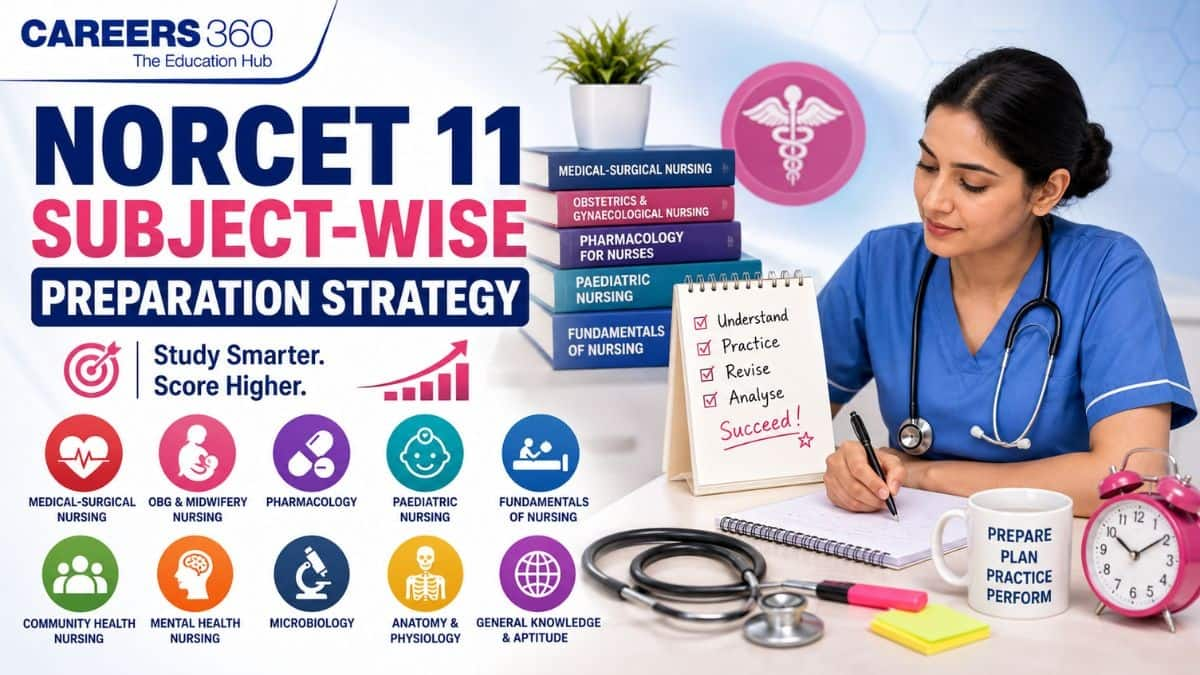
This strategy is built on an analysis of 446 real questions across five previous-year NORCET papers, 2020 to 2024. Medical-Surgical Nursing accounted for 22% of those questions, OBG and Midwifery Nursing for 11%, Pharmacology for 9%, and Paediatric Nursing for 9%. The approach below is matched to each subject's actual question style in past papers, not a generic study method applied uniformly. Full previous year papers, with solutions, are available through the AIIMS Nursing Officer previous year question papers, which are worth cross-referencing against the strategy for each subject below.
The subject-wise preparation strategy is based on the subject-wise weightage in past papers.
Subject | Weightage% |
Medical-Surgical Nursing | 22.2% |
OBG and Midwifery Nursing | 11.2% |
Pharmacology | 9.4% |
Paediatric Nursing | 9.0% |
Fundamentals of Nursing | 5.6% |
General Knowledge and Aptitude | 3.6% |
Community Health Nursing | 3.4% |
Anatomy and Physiology | 2.0% |
Mental Health (Psychiatric) Nursing | 2.0% |
Microbiology | 2.0% |
Nursing Research, Trends, and Management | 1.1% |
The strategy below follows this order, heaviest subjects first, with a study method suited to how each one is actually tested.
Get expert advice on college selection, admission chances, and career path in a personalized counselling session.
Medical-Surgical questions link three things together in a single stem: the disease, its treatment, and the nursing care that follows. Studying disease, drug, and nursing action as three separate topics is slower and less accurate. While studying all three as one connected unit is more accurate and less time-consuming. For example, when revising heart failure, it covers the pathology, the drugs used to manage it, and the nursing assessments in the same sitting, not across three different days.
Cardiovascular disorders carry the largest share within this subject, so start there. Within Cardiovascular, prioritise ECG interpretation and electrolyte imbalance, since both repeat across different years in past papers.
OBG questions in NORCET are usually written as a short patient case: a gestational age, a symptom, sometimes a lab value, followed by a diagnosis or action question. The skill this subject actually tests is reading the case for the one detail that changes the answer, such as pain versus painless bleeding, or a specific test result, rather than memorising definitions in isolation.
Practise by reading real past-paper OBG cases and identifying and deciding detail before checking the options. This builds faster than reading a textbook chapter start to finish because it trains the exact skill the exam needs.
Pharmacology in NORCET rarely asks about an individual drug. It asks about a drug class: what antibiotics do as a group, what a diuretic class affects, which drug interacts with which condition. Grouping drugs by class and learning shared actions and shared risks is faster than memorising each drug as a separate fact.
Dosage calculation also falls within this subject in practice, even when it appears within Fundamentals or Paediatric Nursing questions. A calculator is not provided in the exam, so manual calculation speed on formulas like dose-from-stock and mg/kg dosing needs daily practice, not a one-time read of the formula.
Neonatal care and immunisation together account for close to half of the Paediatric Nursing questions in past papers. Both are fact-based chapters with a single correct number or term per question: a normal newborn value, a vaccine's storage rule, a milestone age. This subject needs fact memorisation. It is better for short daily fact review than long conceptual study sessions.
Vaccine cold-chain facts repeat across different years in past papers. A simple table of every vaccine's storage temperature and freeze tolerance is one of the highest-value single documents to build for this subject.
Fundamental questions are short and direct: a procedure's steps, a vital sign scenario, an IV flow rate calculation. The suctioning technique repeats often across past papers, alongside IV flow rate and drip rate calculations.
Because this subject is small in total weight but high in clarity, two or three focused days are usually enough to cover it well. It rewards being studied early, not left for the final week, since the facts are simple enough to retain with minimal repetition once learnt.
This subject tests health team roles, national health programmes, and communicable disease facts, most of which are static and unlikely to change year to year. ASHA and ANM role distinctions, along with WHO-linked programme facts, are common across past papers.
A single reference sheet that covers each national health programme's year, target group, and goal covers most of what this subject actually tests, without needing a full textbook read-through.
These three subjects carry a smaller combined weightage of past papers, but each still deserves a focused study rather than being skipped. Mental Health Nursing questions often ask for the distinguishing feature between similar-sounding conditions. Anatomy and Physiology questions test specific organ functions and hormone actions. Microbiology tests infection control and sterilisation facts that overlap with Fundamentals of Nursing.
Given their smaller weight, a single day per subject, focused on definitions and distinguishing features rather than deep mechanisms, is a reasonable balance of time.
This section appears only in Stage 1, not Stage 2, and carries 20 of the 100 prelims questions. Current affairs from the past six months and basic quantitative aptitude, ratio, percentage, time and distance, cover most of what is actually asked.
Because this section can decide whether a candidate qualifies for Stage 2 at all, it should not be left unrevised simply because it sits outside the core nursing syllabus.
The same three mistakes usually occur across all subjects
Giving every subject equal time, instead of following real weightage
Studying disease, drugs, and nursing care as separate topics in Medical-Surgical Nursing, instead of together
Reading OBG cases for the full paragraph, instead of training to spot the one deciding detail quickly
Correcting these three study patterns tends to matter more than adding extra study hours.
Frequently Asked Questions (FAQs)
No. Fact-heavy subjects like Paediatric Nursing and Fundamentals of Nursing respond well to short daily memorisation. Case-based subjects like OBG respond better to practising real past-paper scenarios. Medical-Surgical Nursing should be studied together, linking disease with related drugs and nursing care.
Medical-Surgical Nursing, based on its share of past papers, at 22%. Within it, Cardiovascular disorders carries the largest single chapter weight and deserves attention first.
It still carries 20 of the 100 Stage 1 questions and can decide Stage 2 qualification. A short, regular current affairs habit alongside basic aptitude practice is enough, without needing the same depth as the nursing subjects.
On Question asked by student community
Hello Student,
The AIIMS NORCET (Nursing Officer Recruitment Common Eligibility Test) previous year question papers are available in PDF format at the link given below:
https://medicine.careers360.com/articles/aiims-nursing-officer-previous-year-question-papers
Hello Punitha,
The NORCET (Nursing Officer Recruitment Common Eligibility Test) is conducted by the All India Institute of Medical Sciences for the recruitment of Nursing Officers in AIIMS and participating institutes.
Here are the links to the NORCET important questions and answer resources:

NEET PG All India & State College Predictor with Admission Process Guide
End-to-End NEET PG Admission Guidance | One-to-One Counselling | College Predictors | Regular Updates | E-books