JSS University Mysore Allied Sciences 2026
NAAC A+ Accredited| Ranked #21 in University Category by NIRF | Applications open for multiple UG & PG Programs


Chemical Kinetics NEET previous-year question papers are extremely helpful for candidates preparing for NEET 2027 Chemistry. Chemical Kinetics is a Class 12 Physical Chemistry chapter which tests the knowledge and calculation skills of the candidate. The important topics include rate of reaction, rate law, order and molecularity, integrated rate equation, half-life, activation energy and Arrhenius equation.
This Story also Contains
.jpg)
Based on the analysis of the latest six years' NEET Chemistry papers, it is evident that Chemical Kinetics has been asked in the exam consistently. In 2021, there was 1 question from this topic; 2 in 2022; 1 in 2023; 2 in 2024; 3 in 2025; and 2 in 2026. On average, this chapter consists of 4.63% of the total questions in the six-year trend analysis.
By practising Chemical Kinetics NEET PYQs, candidates can get acquainted with the types of questions and also figure out which concepts need to be practised. It will especially help in solving NEET exam numerical questions in a quick manner.
Chemical Kinetics assists the NEET aspirants to grasp important topics like the Arrhenius equation, collision theory, rate law, and mechanism of reactions. This chapter is among the most important in the NEET Chemistry syllabus, with questions being asked almost every year. Answering Chemical Kinetics NEET PYQs can help aspirants get familiar with important topics as well as enhance their problem-solving ability. The following table gives an idea about the number of questions asked in previous years from Chemical Kinetics.
|
Year |
No. of Questions |
| 2026 | 2 |
|
2025 |
3 |
|
2024 |
2 |
|
2023 |
1 |
|
2022 |
2 |
|
2021 |
1 |
Get expert advice on college selection, admission chances, and career path in a personalized counselling session.
Chemical Kinetics includes some topics based on formulas where continuous practice can definitely help in improving calculation speed and accuracy. Solving questions from previous years can assist candidates in:
Numerical-based questions from Chemical Kinetics appear in the NEET exam. To solve them in less time, an effective NEET preparation timetable is important. The timetable should include 2-3 hours daily for solving the NEET question paper. Provided below are a few NEET chemical kinetics previous year questions with solutions. Going through them makes students familiar with the question pattern
Question 1: If the half-life $(t_{1/2})$ for a first-order reaction is $1$ minute, then the time required for $99.9%$ completion of the reaction is closest to: (NEET 2025)
Options
Answer: For a first-order reaction, the time required for approximately $99.9%$ completion is given by:
$t \approx \frac{6.91}{k}$
Also, the half-life is given by:
$t_{1/2} = \frac{0.693}{k}$
Given $t_{1/2} = 1$ minute,
$1 = \frac{0.693}{k}$
$\Rightarrow k = 0.693\ \text{min}^{-1}$
Therefore,
$t = \frac{6.91}{0.693}$
$\Rightarrow t \approx 10\ \text{min}$
Hence, the correct answer is Option 1) $10$ minutes.
Question 2: If the rate constant of a reaction is $0.03\ \text{s}^{-1}$, how much time does it take for $7.2\ \text{mol L}^{-1}$ concentration of the reactant to get reduced to $0.9\ \text{mol L}^{-1}$? (Given: $\log 2 = 0.3$) (NEET 2025)
Options
Answer: For a first-order reaction,
$t = \frac{2.303}{k}\log\left(\frac{[R]_0}{[R]_t}\right)$
Given,
$k = 0.03\ \text{s}^{-1}$
$[R]_0 = 7.2\ \text{mol L}^{-1}$
$[R]_t = 0.9\ \text{mol L}^{-1}$
Therefore,
$t = \frac{2.303}{0.03}\log\left(\frac{7.2}{0.9}\right)$
$t = \frac{2.303}{0.03}\log 8$
Since $\log 8 = 3\log 2 = 3 \times 0.3 = 0.9$,
$t = \frac{2.303 \times 0.9}{0.03}$
$t = 69.09\ \text{s} \approx 69.3\ \text{s}$
Hence, the correct answer is Option 2) $69.3\ \text{s}$.
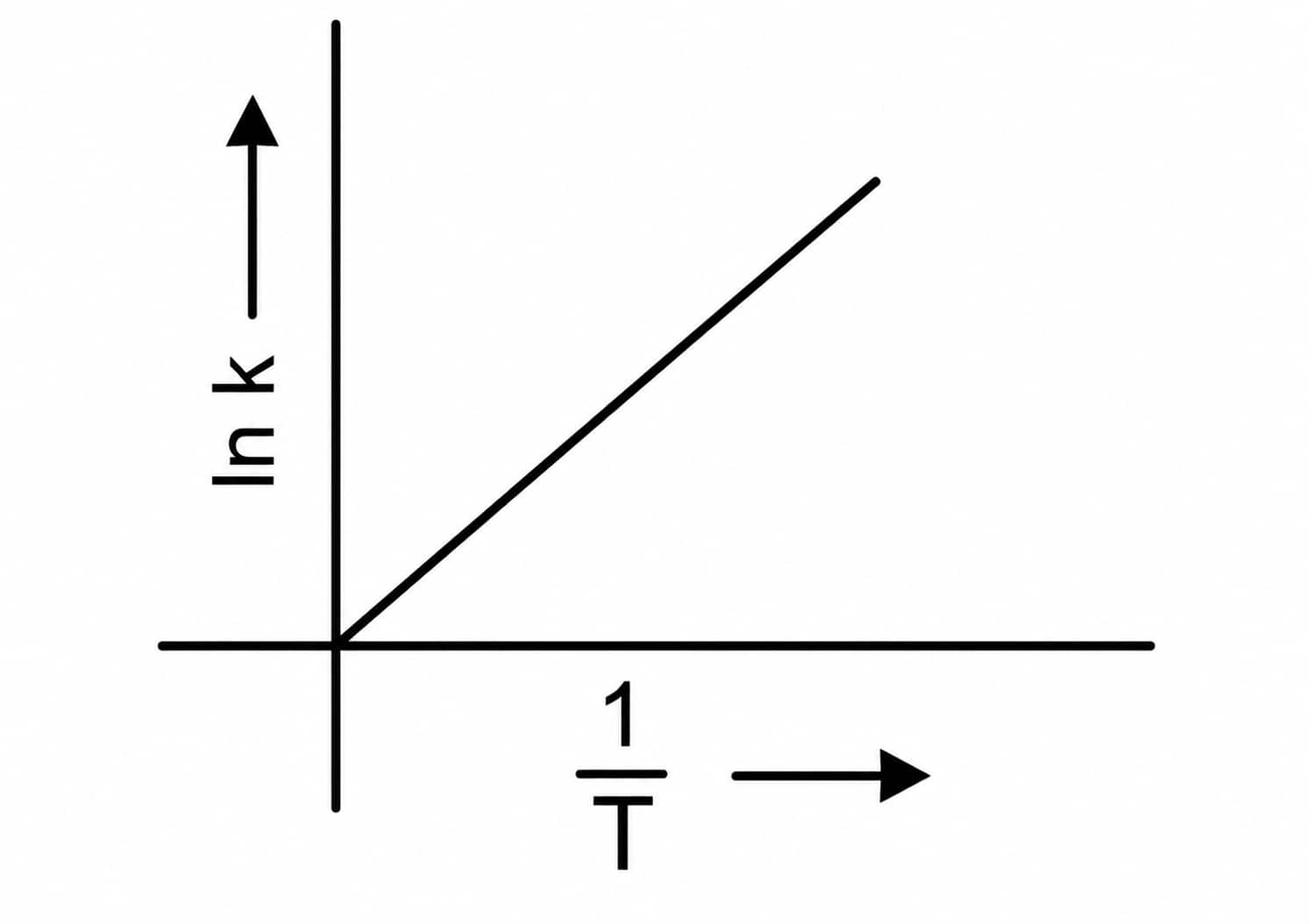
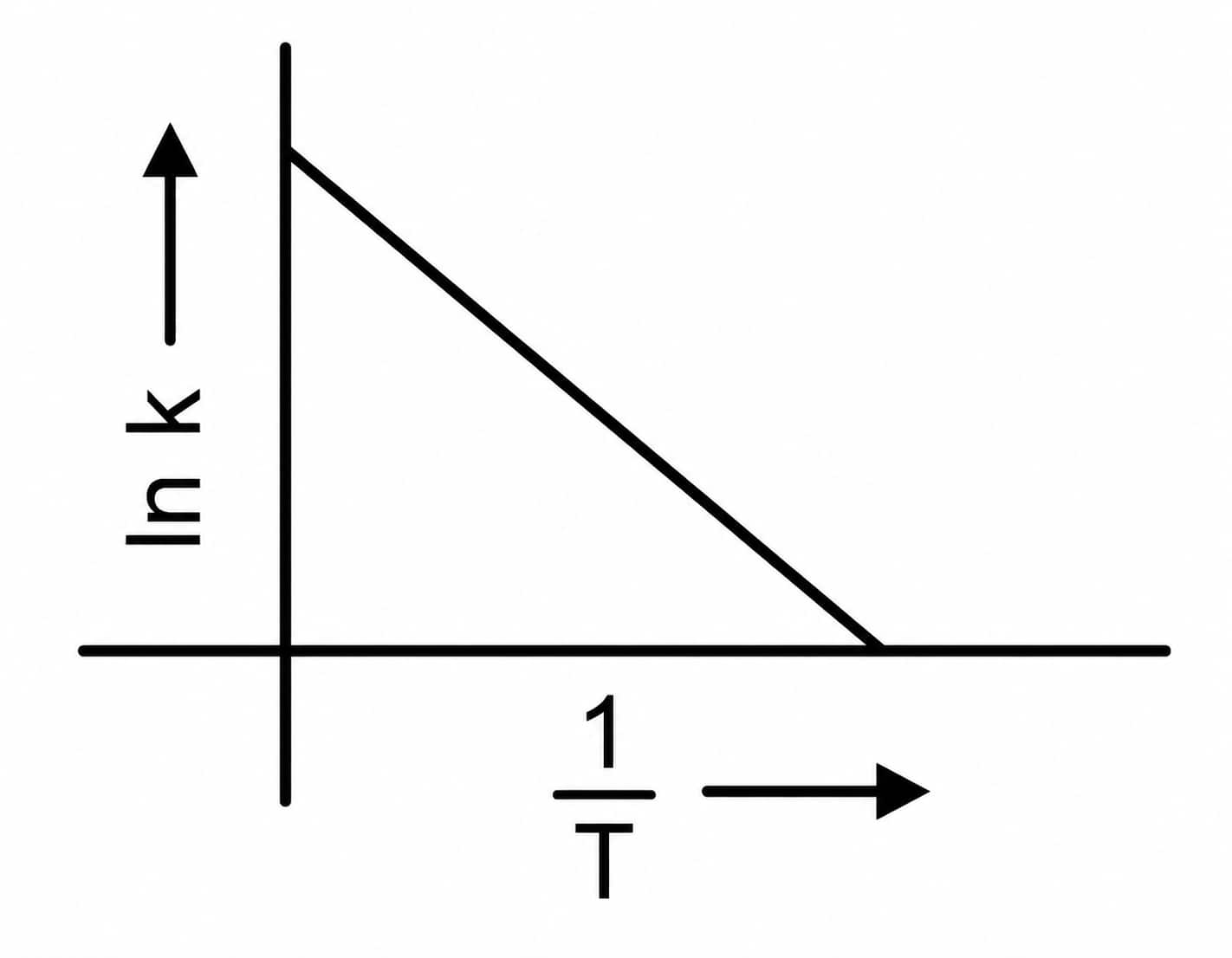
Question 3: Which plot of In k vs 1/T is consistent with the Arrhenius equation? (NEET 2024)
Options
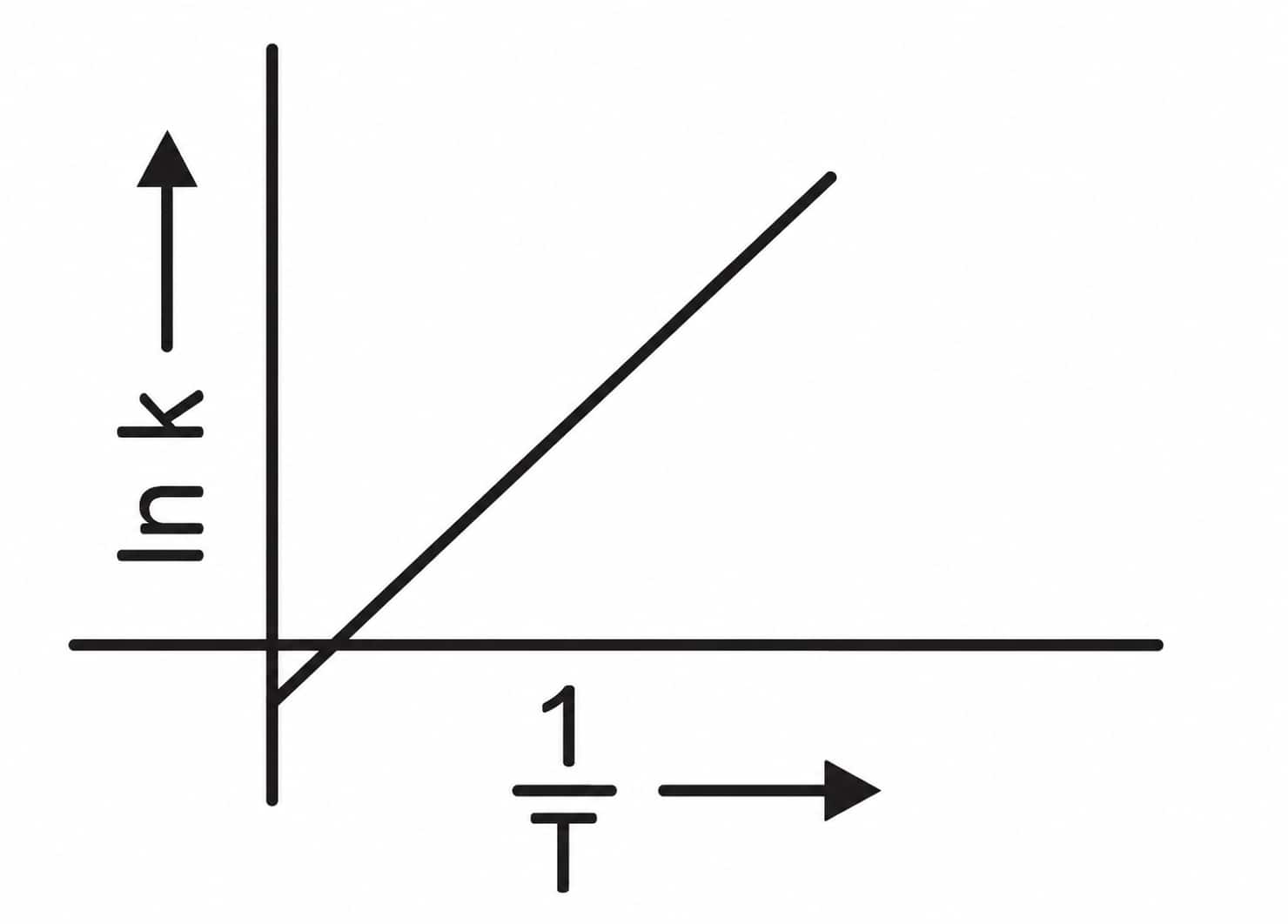
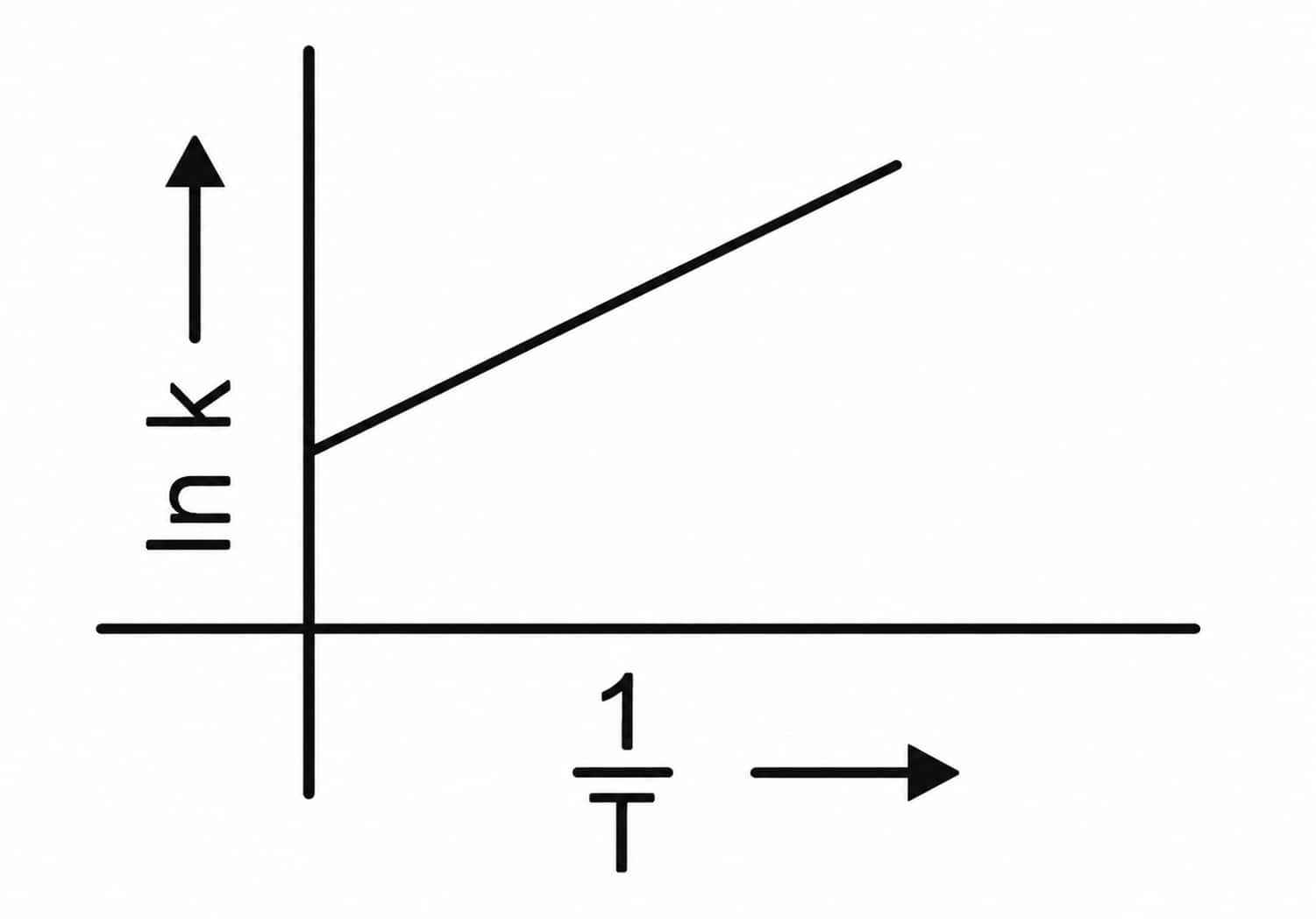
3. 
4. 
Answer:
The Arrhenius equation is given by
$k = Ae^{-\frac{E_a}{RT}}$
Taking the natural logarithm on both sides,
$\ln k = \ln A - \frac{E_a}{RT}$
Thus, a plot of $\ln k$ versus $1/T$ gives a straight line with
$\text{slope} = -\frac{E_a}{R}$
and
$\text{intercept} = \ln A$
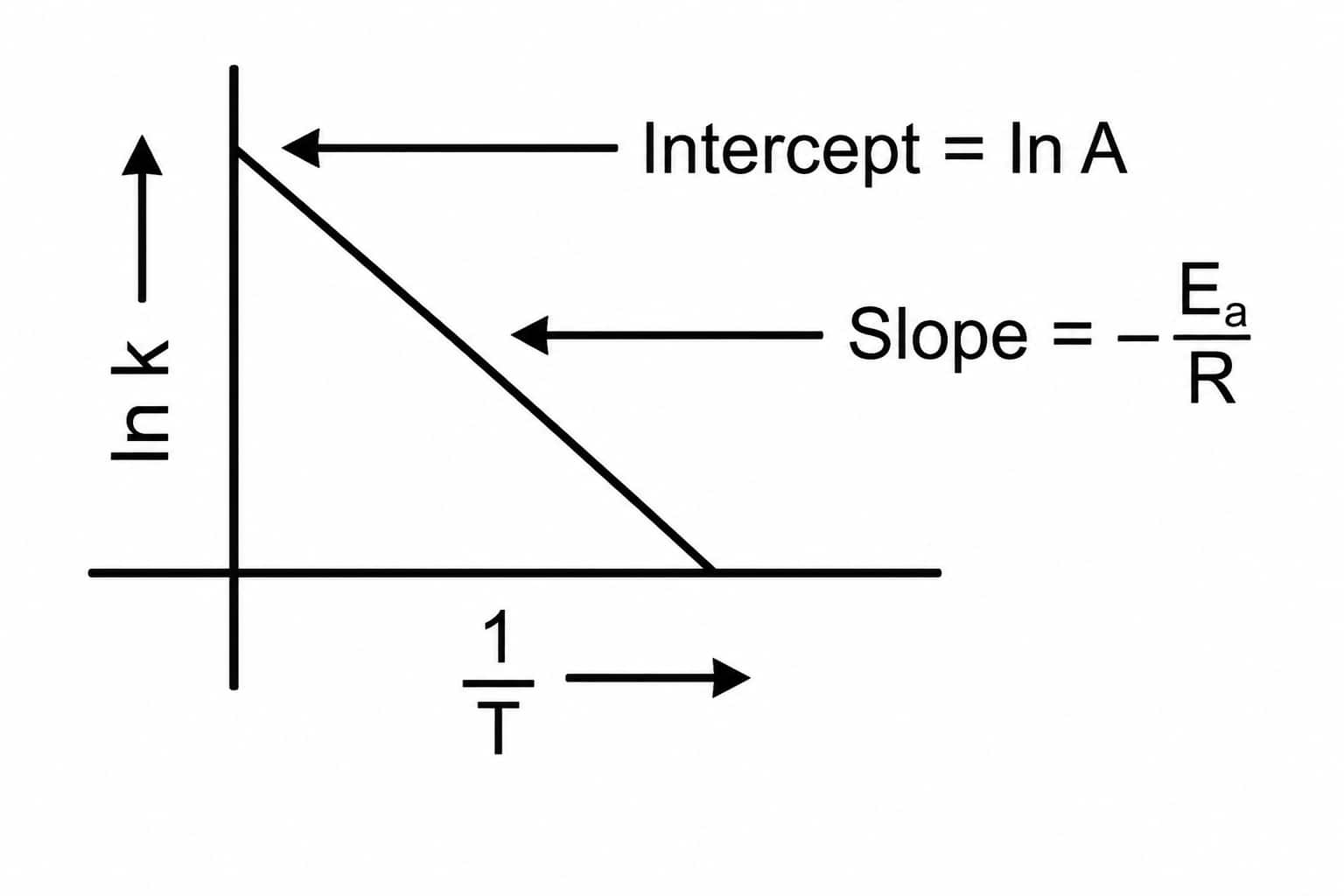
Hence, the correct answer is option (4)
Question 4: For a certain reaction, the rate is $R = k[A]^2[B]$. When the initial concentration of A is tripled, keeping the concentration of B constant, the initial rate would be: (NEET 2023)
Options
Answer:
Given,
$R = k[A]^2[B]$
Since $[B]$ remains constant,
$R \propto [A]^2$
When the concentration of A is tripled,
$[A]{\text{f}} = 3[A]{\text{i}}$
Therefore,
$R_{\text{f}} = k(3[A]_{\text{i}})^2[B]$
$R_{\text{f}} = 9k[A]_{\text{i}}^2[B]$
Thus,
$R_{\text{f}} = 9R_{\text{i}}$
Therefore, the initial rate increases by a factor of 9.
Hence, the correct answer is Option 3) Increase by a factor of nine.
Question 5: Given below are two statements: one is labeled as Assertion A and the other is labeled as Reason R:
Assertion A: A reaction can have zero activation energy.
Reason R: The minimum extra amount of energy absorbed by reactant molecules so that their energy becomes equal to the threshold value is called activation energy.
In light of the above statements, choose the correct answer from the options given below: (NEET 2023)
Options
1. Both A and R are true, and R is the correct explanation of A.
2. Both A and R are true, and R is NOT the correct explanation of A.
3. A is true, but R is false.
4. A is false, but R is true.
Answer:
Free-radical reactions can have zero activation energy. In the termination steps of some free-radical reactions, $E_a = 0$.
Hence, the correct answer is Option 2) Both A and R are true, but R is NOT the correct explanation of A.
Question 6: For a first-order reaction $A \rightarrow \text{Products}$, the initial concentration of $A$ is $0.1,M$, which becomes $0.001,M$ after $5$ minutes. The rate constant for the reaction in $\text{min}^{-1}$ is: (NEET 2022)
Options
Answer:
For a first-order reaction,
$\ln\left(\frac{[A]_0}{[A]_t}\right)=kt$
Substituting the given values,
$\ln\left(\frac{0.1}{0.001}\right)=k(5)$
$\ln(100)=5k$
Since $\ln(100)=4.605$,
$k=\frac{4.605}{5}$
$\Rightarrow k=0.921,\text{min}^{-1}$
Hence, the correct answer is Option 1) $0.9212,\text{min}^{-1}$.
Question 7: The given graph is a representation of the kinetics of a reaction
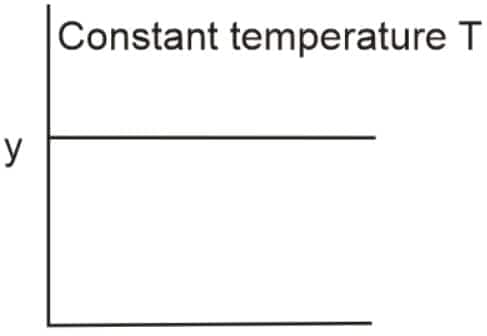
The y and x axes for zero and first-order reactions respectively are: (NEET 2022)
Options
Options
Answer:
For a zero-order reaction,
$\text{Rate} \propto [A]^0$
$\Rightarrow \text{Rate} = k$
For a first-order reaction,
$t_{1/2} = \frac{\ln 2}{k} = \frac{0.693}{k}$
Hence, the correct answer is Option 2.
Question 8: The slope of Arrhenius plot $\ln k$ vs. $\frac{1}{T}$ for a first-order reaction is $-5 \times 10^3\ \text{K}$. The value of $E_a$ is: (NEET 2021)
Given $R = 8.314\ \text{J K}^{-1}\text{mol}^{-1}$
Options
Answer
The Arrhenius equation in logarithmic form is
$\ln k = \ln A - \frac{E_a}{R}\left(\frac{1}{T}\right)$
Comparing this with the equation of a straight line, $y = mx + c$, the slope is
$m = -\frac{E_a}{R}$
Given
$-5 \times 10^3 = -\frac{E_a}{8.314}$
Therefore,
$E_a = 5 \times 10^3 \times 8.314$
$E_a = 41,570\ \text{J mol}^{-1}$
$E_a \approx 41.5\ \text{kJ mol}^{-1}$
Hence, the correct answer is Option 1 — $41.5\ \text{kJ mol}^{-1}$.
Question 9: An increase in the concentration of the reactants of a reaction leads to a change in: (NEET 2020)
Options
1. Collision frequency
2. Activation energy
3. Heat of reaction
4. Threshold energy
Answer:
An increase in concentration increases the number of collisions
Hence correct answer option (1)
Question 10: The rate constant for a first-order reaction is $4.606 \times 10^{-3}\ \text{s}^{-1}$. The time required to reduce $2\ \text{g}$ of reactant to $0.2\ \text{g}$ is: (NEET 2020)
Options
Answer
For a first-order reaction,
$kt = \ln\left(\frac{A_0}{A_t}\right)$
Given,
$A_0 = 2\ \text{g}$, $A_t = 0.2\ \text{g}$ and $k = 4.606 \times 10^{-3}\ \text{s}^{-1}$
Therefore,
$4.606 \times 10^{-3}t = 2.303\log\left(\frac{2}{0.2}\right)$
$4.606 \times 10^{-3}t = 2.303\log(10)$
$4.606 \times 10^{-3}t = 2.303$
Hence,
$t = \frac{2.303}{4.606 \times 10^{-3}}$
$t = 500\ \text{s}$
Hence, the correct answer is Option 4) $500\ \text{s}$.
Chemical Kinetics is a scoring unit in chemistry. It is a high weightage NEET chemistry chapter with consistently asked questions in previous years. Chemical kinetics NEET PYQ includes questions on how reactions occur and the different factors affecting them. Students thinking about how to study chemistry for NEET should start with this unit. Given below are a few important topics from this unit
|
Topics |
Description |
|
Defined as the change in concentration of reactants or products per unit time. | |
|
Order of Reaction |
For complex reactions, the order is determined by the rate-determining step. |
|
The number of reacting species involved in an elementary reaction. | |
|
Rate Constant (k) |
A proportionality constant that relates the rate of the reaction to the concentrations of the reactants. |
|
Activation Energy (Eₐ) |
The minimum energy required for a reaction to occur. |
|
This equation relates the rate constant to temperature and activation energy. It is important for understanding how temperature affects reaction rates. | |
|
Half-Life (t₁/₂) |
The time required for half of the reactant to be consumed is known as half half-life. |
|
Factors Affecting Reaction Rates |
Understanding how concentration, temperature, and catalysts influence reaction rates is important. |
Solving previous year NEET questions regularly builds confidence. It helps students understand the types of questions asked in the exam. Given below are a few tips that they can use to solve NEET chemical kinetics previous year questions.
Not making these mistakes in Chemical Kinetics will help candidates enhance their performance in NEET 2027.
Misunderstanding Between Order and Molecularity
While order is derived through experiments using the rate law, molecularity is related to an elementary reaction.
Using Coefficients of Reaction Directly
The order of a reaction is not usually calculated using the chemical equation of a reaction but rather using the rate law or experimental data.
Mistaking Units of k
Units of (k) are affected by the order of the reaction; hence, a frequent mistake in numerical questions asked in NEET.
Confusing the Two Half-Life Formulas
First-order half-life is not dependent on the initial concentration, while zero-order half-life is dependent on the initial concentration.
Frequently Asked Questions (FAQs)
Because it is a Do or Die chapter with repeated PYQs on rate of reaction, order of reaction, integrated rate equations, and half‑life, making it highly scoring.
On average, 2–3 questions appear every year, mostly numerical and formula‑based, directly from NCERT Class 12 Chemistry.
Focus on rate law, Arrhenius equation, half‑life formulas, integrated rate equations, and graphical interpretation of reaction kinetics.

On Question asked by student community
Hello, you can pursue BPT in Kerala without NEET UG. Admission is generally based on the LBS Centre rank list and the applicable admission process. You can check BPT colleges in Kerala and their details here: https://medicine.careers360.com/colleges/list-of-bpt-in-physiotherapy-colleges-in-kerala
Hello Student,
If you are looking for information about NEET PG 2025 DNB seat allotment and the fees payable at the allotted college or hospital, DNB seats are allotted through the respective counselling process based on your rank, category, choice of speciality, and seat availability.
For the 2025 session, the
Dear Student, with a NEET PG 2026 rank of 6,600 in the EWS category, your options should be assessed using the relevant counselling year's college-wise closing ranks, category-wise seats and counselling round. Please also confirm whether you are applying through the applicable All India counselling route or another quota. That
Hello
If you mean whether a school/college will be strict about attendance when you are preparing for NEET UG, it depends on the institution’s rules. NEET preparation itself is generally not a reason to ignore regular attendance.
For example, CBSE requires 75% attendance for board-exam eligibility, with limited relaxation for
Hello Student,
Aapke NEET marks 372 aur AIR 3,51,532 hain. Lekin 3rd round mein MBBS seat ke liye counselling karani chahiye ya nahi, iska sahi answer dene ke liye mujhe aapki category, domicile state, aur aap AIQ se counselling kar rahe hain ya state quota se—ye details chahiye.
In details
the product 'P' will be ,


| Column A | Column B |
| A |
a) Organisation of cellular contents and further cell growth. |
| B |
b) Leads to formation of two daughter cells. |
| C |
c) Cell grows physically and increase volume proteins,organells. |
| D |
d) synthesis and replication of DNA. |
Match the correct option as per the process shown in the
0.16 g of dibasic acid required 25 ml of decinormal solution for complete neutralisation. The modecular weight of the acid will be
32
64
128
256
0xone is

Know possible Govt/Private MBBS/BDS Colleges based on your NEET rank
College Predictors Webinars One to One Counselling Regular Updates Medical Almanac
Highest Package: ₹32 LPA | Placement Rate: 90% students placed | 5000+ Students Placed 900+ Placements Recruiters | Scholarships Available
33.5 LPA-Highest Package | Up to 100% scholarship worth 30 CR
Get Job Ready in Healthcare | Employability-Focused Programs
Get Started With Your Healthcare Career. 2026 Admissions open.