NEET PG College Predictor
NEET PG All India & State College Predictor with Admission Process Guide


NORCET 11 Mains High-Weightage OBG Topics: NORCET 11 mains is scheduled for September 30, 2026. Obstetric and Gynaecological (OBG) Nursing is one subject where candidates consistently lose marks by distributing equal time across the subject. Some OBG Nursing topics repeat nearly every NORCET cycle in some form, appearing repeatedly across NORCET 9, NORCET 10, and now shaping expectations for NORCET 11 mains. On the other hand, some topics rarely appear at all. Knowing the difference between high-weightage and low-weightage OBG topics helps you decide how you spend your remaining weeks before the NORCET 11 mains exam.
This Story also Contains
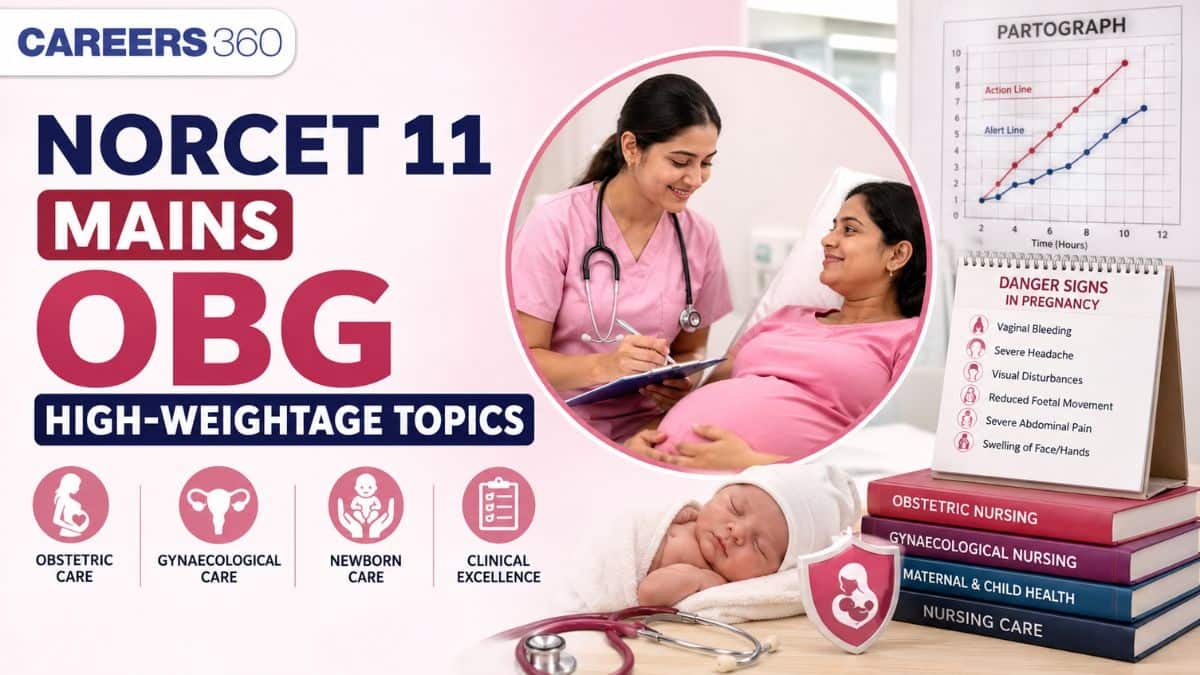
Maternal and child health was marked as one of the recurring high-weightage areas within the nursing section of NORCET mains. The paper shows a clear tilt toward clinical application and patient-care scenarios rather than plain fact recall or theoretical definitions. That data point isn't incidental — it's the lens this entire OBG preparation list is built around, prioritising topics that have repeatedly shown up as scoring opportunities over topics that sound important but rarely convert into marks.
This is the single most scoring topic in OBG for mains. Questions here are designed as short clinical vignettes: a set of symptoms, a gestational week, and a question about what action the nurse should take next. The recurring theme is distinguishing normal antenatal discomforts from warning signs that need immediate referral (bleeding, severe headache, visual disturbances, reduced foetal movement, and epigastric pain). Build a simple two-column list — normal vs. danger sign — and drill it until you can sort a symptom instantly without hesitating.
Get expert advice on college selection, admission chances, and career path in a personalized counselling session.
Labour management questions test whether you actually understand the mechanics of each stage, not just their names. Expect questions designed around partograph readings – recognising when a labour curve crosses the alert or action line, and what that means for management. This is a topic candidates often "know" in theory but freeze on when given an actual graph or scenario. So, practise reading partograph excerpts rather than only reading about them.
Pregnancy-induced hypertension, pre-eclampsia and eclampsia, gestational diabetes, and antepartum haemorrhage form a tight cluster from where questions are designed repeatedly. Because these conditions have clear, memorable criteria (blood pressure thresholds, proteinuria, and specific danger symptoms) that lend themselves naturally to MCQ format. The common mistake is memorising each condition individually instead of building a comparison table — many candidates lose marks mixing up the management priority for eclampsia versus severe pre-eclampsia under time pressure.
Postpartum haemorrhage, puerperal sepsis, and immediate postnatal assessment are recurring obstetric-emergency topics. PPH in particular gets tested from multiple angles — causes, immediate nursing management, and drug of choice — so make sure you can answer it from all three directions, not just one.
It shows up often. A single well-prepared topic here earns marks in two subject areas at once. Focus on APGAR scoring, immediate care after delivery (warmth, airway, and initial assessment), and basic newborn resuscitation steps. If you've already worked through high-weightage paediatric nursing topics, revise this section alongside that material rather than separately. It saves real time.
Janani Suraksha Yojana, Janani Shishu Suraksha Karyakram, PMSMA, and LaQshya are frequent targets for direct, factual questions — launch year, core objective, target beneficiaries. These questions are usually the most scoring in the entire OBG section because they're fact-based rather than scenario-based, yet candidates often skip them assuming they belong purely to Community Health Nursing. Keep one running table of these programmes and revise it in short daily bursts rather than one long session.
Expect questions on method classification, mechanism, and suitability for specific patient profiles (postpartum, lactating, medical contraindications). This topic rewards a simple, organized comparison chart of temporary versus permanent methods far more than narrative reading.
Menstrual disorders, basic infertility concepts, and common gynaecological conditions appear less frequently than the obstetric topics above but still show up consistently enough to not skip entirely. Treat this as a lighter-touch revision area — one focused pass is usually enough, unlike antenatal care and high-risk pregnancy, which need repeated practice.
Don't work through OBG as one continuous block. Split it the way the exam actually tests it: scenario-heavy topics (antenatal danger signs, labour stages, high-risk conditions, postpartum emergencies) need repeated practice with case-style questions, while fact-heavy topics (national programmes, contraceptive classification) need spaced daily revision rather than deep study sessions. Once you've been through this list, practice NORCET 11 OBG case-based questions to test whether you can apply these topics under exam-style conditions rather than just recognise them on a page.
Cross-check this topic order against the confirmed NORCET syllabus as your prep progresses, and use previous year NORCET papers to see how frequently each of these areas has actually appeared. The pattern recognition across a few years is more reliable than any single cycle's paper.
Frequently Asked Questions (FAQs)
Based on recurring patterns, antenatal danger signs, stages of labour, high-risk pregnancy conditions (pre-eclampsia, eclampsia, gestational diabetes), postpartum complications, and essential newborn care are the most consistently tested areas, alongside national maternal health programmes for direct factual questions.
OBG carries less overall weightage than Medical-Surgical Nursing, but it's highly scoring per hour invested because a large share of its questions follow predictable patterns — clinical scenarios built around a small set of high-risk conditions and a handful of programme-based facts.
For topics like essential newborn care and maternal-child health indicators, yes — studying them together avoids repeating the same content twice and reflects how mains questions are often framed at the boundary between the two subjects.

On Question asked by student community
Hello Student,
The AIIMS NORCET (Nursing Officer Recruitment Common Eligibility Test) previous year question papers are available in PDF format at the link given below:
https://medicine.careers360.com/articles/aiims-nursing-officer-previous-year-question-papers
Hello Punitha,
The NORCET (Nursing Officer Recruitment Common Eligibility Test) is conducted by the All India Institute of Medical Sciences for the recruitment of Nursing Officers in AIIMS and participating institutes.
Here are the links to the NORCET important questions and answer resources:

NEET PG All India & State College Predictor with Admission Process Guide
End-to-End NEET PG Admission Guidance | One-to-One Counselling | College Predictors | Regular Updates | E-books