NEET PG College Predictor
NEET PG All India & State College Predictor with Admission Process Guide


NORCET 11 Preparation Strategy for GNM Diploma Holders: GNM diploma holders make up a large part of every NORCET batch. But most prep content online is written for B.Sc. Nursing candidates only. The AIIMS NORCET 11 notification confirms that GNM diploma holders are still eligible. They need two years of clinical experience in a hospital with at least 50 beds. They also need valid Nurse and Midwife registration. This article provides a preparation strategy built just for GNM candidates. It shows what they already know well. It also shows where they need extra revision compared to a B.Sc. Nursing background.
This Story also Contains
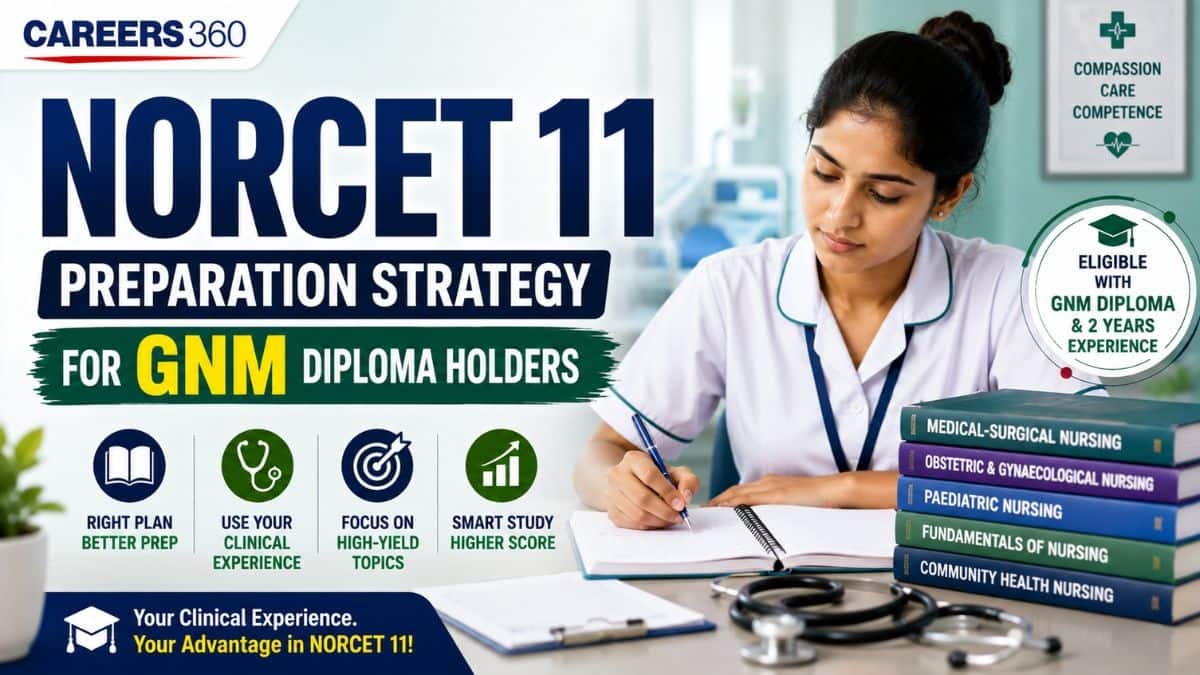
A GNM diploma covers most of the same subjects as a B.Sc. Nursing degree. But it goes less deep in a few theory-heavy areas. At the same time, GNM nurses often get stronger hands-on clinical exposure. This is because their ward postings start earlier. This difference matters for exam strategy. Studying every subject with equal focus wastes time. Many GNM candidates are working nurses. They have limited free hours. The sections below break down the NORCET syllabus from a GNM angle. They also build a study plan around real-time limits, not an ideal schedule with unlimited hours.
NORCET 11 accepts two education routes. The first route is a B.Sc. (Hons.) Nursing, B.Sc. Nursing, or Post-Basic B.Sc. Nursing degree. This needs valid Nursing Council registration. The second route allows a Diploma in General Nursing and Midwifery. This route needs two years of clinical experience too. The hospital must have at least 50 beds. This experience only counts after the diploma is finished. Both routes need a valid Registered Nurse and Registered Midwife certificate. The age limit is usually 18 to 30 years. Reserved categories get age relaxation.
GNM candidates should check their experience certificate carefully. Do this before applying through the NORCET application form. Two mistakes often cause rejection. One is counting experience from before the diploma was done. The other is using a hospital with fewer than 50 beds. Both get caught at document verification.
Get expert advice on college selection, admission chances, and career path in a personalized counselling session.
GNM training sends candidates to clinical wards earlier than most B.Sc. Nursing courses. This gives a real advantage in NORCET. A large share of Stage 1 and Stage 2 questions are scenario-based. They test clinical judgement, not just textbook facts.
Many questions are built around patient assessment. Others test procedure order or ward-based decisions. These questions favour candidates with direct hands-on practice. Medical-Surgical Nursing draws on this kind of applied knowledge. So does Fundamentals of Nursing. Much of OBG and Paediatric Nursing works the same way. GNM candidates who have already handled such cases on the ward often answer these questions faster. They do better than candidates who studied only in a classroom.
This strength should guide study priority. Subjects where ward experience already helps need lighter revision. Focus mainly on exact terms and classification here. There is no need to start from zero.
The GNM curriculum covers some subjects with less depth than a B.Sc. Nursing degree. These subjects need the largest share of study time.
Nursing Research, Trends and Management. GNM training often covers this subject only briefly, if at all. B.Sc. Nursing courses treat it as a full theory paper. Concepts like research steps, sampling methods, and management principles need to be built from the ground up.
Microbiology and Anatomy & Physiology theory. GNM training is strong on applied anatomy learned through practice. But detailed, textbook-style questions are different. These cover microbiology classification or physiological processes. They can catch GNM candidates off guard. Separate revision is needed here.
General Knowledge and Aptitude. This section is not nursing-specific for either background. But working GNM nurses often have the least free time for current affairs. A short daily habit works better than long, occasional study sessions.
Community Health Nursing and Pharmacology sit in between. Ward experience helps with practical drug administration knowledge. But exact dosage rules need direct revision. So do drug classifications and national health programme details. Practice alone is not enough for these.
Many GNM candidates preparing for NORCET 11 already work full shifts. This rules out long, uninterrupted study blocks. A realistic plan works around duty hours. It does not ignore them.
Fix one subject per week for structured revision. Start with Nursing Research and Management. This is the least familiar subject for most GNM candidates.
Use short breaks during duty hours for General Knowledge. A daily habit of 10 to 15 minutes works better than one long session.
Turn ward experience into active revision. Link a real patient case from your shift to the matching NORCET topic. Do not treat clinical work and exam prep as separate things.
Save weekly off days for full-length mock tests. These are hard to fit into a working day. But they matter the most for checking real exam readiness.
Revisit the NORCET negative marking rule often. Limited revision time can tempt you to guess more in the exam. This raises the risk of losing marks.
This structure spreads preparation across weeks. It avoids daily marathon sessions. Those are hard to keep up with full-time nursing duty.
A few patterns repeat often among GNM aspirants. Most of these are easy to avoid with early planning.
Assuming ward experience covers exam-style questions. Clinical skill and exam performance are related. But they are not the same thing. A candidate confident in inserting an IV line can still struggle with a question. The question may ask for the exact rate calculation behind it. This needs separate practice.
Delaying Nursing Research and Management until the final weeks. This subject often starts from a lower base for GNM candidates. Leaving it for last-minute revision usually backfires.
Skipping mock tests due to shift schedules. Full-length mock tests are the only reliable way to check real exam-day pace. They also check accuracy. Treating them as optional is a mistake. Schedule them on off days instead. Otherwise, gaps in preparation stay hidden until exam day.
Studying every subject at the same intensity. Equal time for every subject sounds fair. But it ignores something important. GNM candidates already have a head start in clinically grounded subjects. They also have a real gap in theory-heavy ones. Study time should reflect both.
Frequently Asked Questions (FAQs)
Yes. GNM diploma holders are eligible for NORCET 11. They need two years of clinical experience in a hospital with at least 50 beds. This experience must come after the diploma. Valid Nurse and Midwife registration is also required.
Nursing Research, Trends and Management needs the most attention. Detailed Microbiology and Anatomy & Physiology theory need extra focus too. GNM training covers these subjects with less depth than a B.Sc. Nursing degree.
A weekly subject-wise plan works well. Short daily General Knowledge sessions during breaks help too. Mock tests scheduled on off days complete the routine. This works better than long daily study blocks that are hard to sustain.

On Question asked by student community
Hello Student,
The AIIMS NORCET (Nursing Officer Recruitment Common Eligibility Test) previous year question papers are available in PDF format at the link given below:
https://medicine.careers360.com/articles/aiims-nursing-officer-previous-year-question-papers
Hello Punitha,
The NORCET (Nursing Officer Recruitment Common Eligibility Test) is conducted by the All India Institute of Medical Sciences for the recruitment of Nursing Officers in AIIMS and participating institutes.
Here are the links to the NORCET important questions and answer resources:

NEET PG All India & State College Predictor with Admission Process Guide
End-to-End NEET PG Admission Guidance | One-to-One Counselling | College Predictors | Regular Updates | E-books