JSS University Mysore Allied Sciences 2026
NAAC A+ Accredited| Ranked #21 in University Category by NIRF | Applications open for multiple UG & PG Programs


The NEET Chapter Wise Weightage 2026 helps aspirants identify the most important chapters, high-scoring topics, and frequently repeated concepts asked in the NEET UG examination. Although the National Testing Agency (NTA) does not officially release chapter-wise marks distribution, analysing previous 5 years’ NEET question papers reveals clear trends in Physics, Chemistry, and Biology.
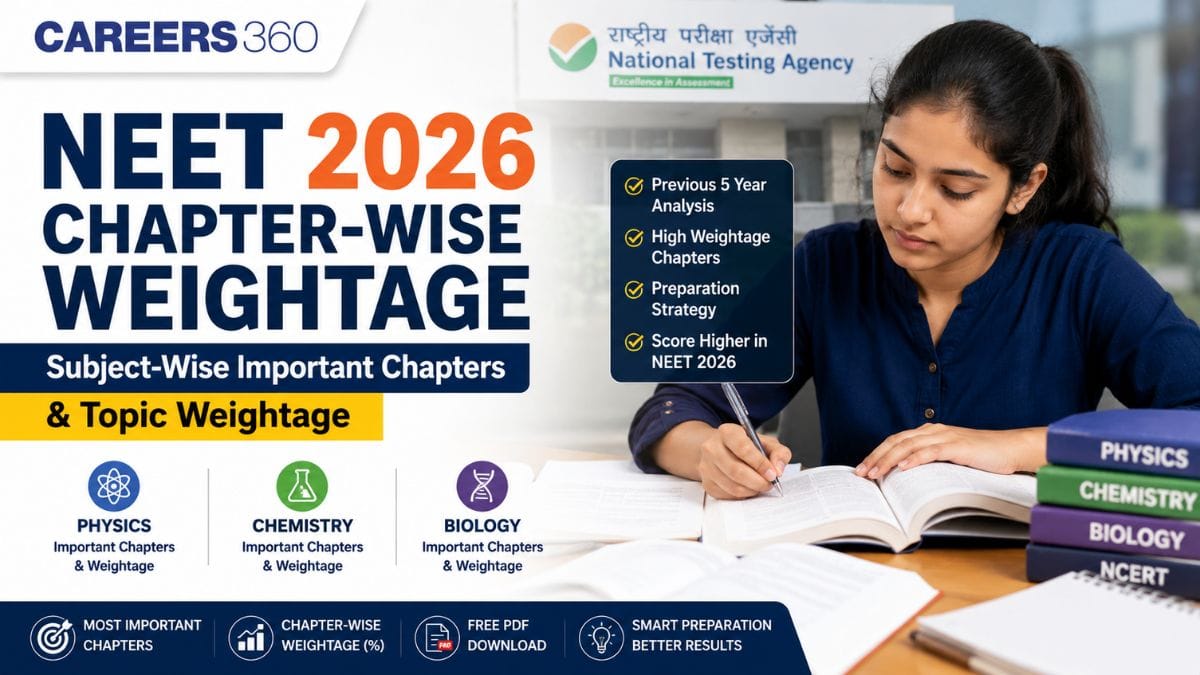
For NEET 2026 preparation, understanding chapter-wise weightage is extremely important because certain chapters consistently contribute a higher number of questions every year. Topics such as Current Electricity, Ray Optics, Thermodynamics, Coordination Compounds, Human Physiology, Genetics, Biotechnology, and Ecology have repeatedly carried strong weightage in recent NEET papers.
This article provides detailed NEET chapter-wise weightage for Physics, Chemistry, and Biology based on previous 5-year paper analysis, important topics, expected trends for NEET 2026, subject-wise preparation strategy, and chapter prioritisation to help students prepare more efficiently.
Get expert advice on college selection, admission chances, and career path in a personalized counselling session.
Understanding NEET chapter-wise weightage helps students prepare more strategically instead of giving equal time to every topic. Since certain chapters consistently contribute a higher number of questions in the examination, analysing previous year trends helps aspirants prioritise revision, NEET mock test, and question practice more effectively.
Benefits of analysing NEET chapter-wise weightage include:
Experts recommend that NEET aspirants should not completely skip low-weightage chapters, as the final paper pattern can vary every year. However, prioritising historically important chapters can significantly improve preparation quality and score potential.
NEET chapter-wise weightage is not officially released by the National Testing Agency (NTA). The weightage provided here is based on detailed analysis of previous years’ NEET question papers, expert reviews, coaching analysis, and NEET PYQs chapter-wise question trends observed over multiple exam sessions.
Since the NEET paper pattern can vary every year, students are advised to prepare the complete syllabus while using chapter-wise weightage as a strategic preparation tool rather than an absolute prediction.
Students preparing for NEET exam should focus first on chapters that consistently contribute the highest number of questions in previous years’ papers. These chapters from NEET 2026 Syllabus are considered the core scoring areas of the examination and are frequently targeted in mock tests and coaching analysis.
Current Electricity
Ray Optics and Optical Instruments
Thermodynamics
Electrostatics
Semiconductor Electronics
Laws of Motion
Alternating Current
Modern Physics
Chemical Bonding
Coordination Compounds
Hydrocarbons
Organic Chemistry
Thermodynamics
Solutions
Chemical Kinetics
Electrochemistry
Human Physiology
Molecular Basis of Inheritance
Biotechnology
Genetics and Evolution
Ecology
Plant Physiology
Reproduction
Cell Biology
Experts recommend completing these chapters first before moving to lower-weightage topics because they form a major portion of the NEET question paper every year.
Best NEET 2026 Study Resources for Revision and Practice:
Students preparing for the exam can strengthen preparation using mock tests, previous year papers, formula sheets, and expected-question PDFs.
The NEET exam comprises 180 questions from Physics, Chemistry and Biology subjects. To follow NEET important topics subject-wise is important, as it will help the students to prepare in a systematic way. The competition is tough, but with the right practice and following useful NEET 2026 preparation tips, it is possible to score well in the exam. The subject-wise weightage is provided below. Students can prepare by going through the NEET chapter-wise weightage for all subjects.
Scoring well in Physics is important for success in the NEET UG exam, and understanding the NEET Physics chapter-wise weightage makes preparation more focused.
Below is a table for NEET topic‑wise weightage in Physics, based on the NEET previous years' analysis, to guide students in preparing strategically.
| Chapter Name | 2021 | 2022 | 2023 | 2024 | 2025 | Weightage % |
| Current Electricity | 4 | 4 | 4 | 4 | 3 | 7.95% |
| Moving Charges and Magnetism | 3 | 3 | 3 | 2 | 2 | 5.44% |
| Electromagnetic Waves | 2 | 2 | 1 | 2 | 2 | 3.77% |
| Waves | 1 | 0 | 0 | 0 | 1 | 0.84% |
| Ray Optics and Optical Instruments | 4 | 4 | 3 | 2 | 1 | 5.86% |
| Magnetism and Matter | 0 | 0 | 0 | 3 | 2 | 2.09% |
| Thermodynamics | 1 | 1 | 1 | 3 | 2 | 3.35% |
| Kinetic Theory | 1 | 1 | 1 | 0 | 1 | 1.67% |
| Alternating Current | 2 | 3 | 3 | 2 | 2 | 5.02% |
| Gravitation | 3 | 3 | 3 | 2 | 3 | 5.86% |
| Semiconductor Electronics: materials, devices and simple circuits | 3 | 3 | 3 | 3 | 2 | 5.86% |
| Dual Nature of Matter and Radiation | 1 | 2 | 0 | 1 | 2 | 2.51% |
| Electrostatic Potential and Capacitance | 3 | 5 | 1 | 4 | 2 | 6.28% |
| Oscillations | 2 | 3 | 2 | 4 | 2 | 5.44% |
| Motion in a Straight Line | 1 | 1 | 2 | 2 | 2 | 3.35% |
| Laws of motion | 2 | 2 | 2 | 0 | 2 | 3.35% |
| Atoms | 0 | 0 | 2 | 2 | 1 | 2.09% |
| System of Particles and Rotational Motion | 2 | 0 | 2 | 2 | 1 | 2.93% |
| Mechanical Properties of Fluids | 1 | 1 | 2 | 0 | 2 | 2.51% |
| Wave Optics | 0 | 0 | 1 | 2 | 3 | 2.51% |
| Thermal Properties of Matter | 0 | 0 | 1 | 0 | 1 | 0.84% |
| Work, energy and power | 1 | 1 | 2 | 2 | 3 | 3.77% |
| Electromagnetic Induction | 2 | 1 | 2 | 1 | 1 | 2.93% |
| Units and Measurements | 3 | 3 | 2 | 3 | 1 | 5.02% |
| Nuclei | 3 | 3 | 1 | 1 | 0 | 3.35% |
| Motion in a Plane | 1 | 1 | 2 | 0 | 0 | 1.67% |
| Electric Charges and Fields | 4 | 3 | 3 | 1 | 1 | 5.02% |
| Mechanical Properties of Solids | 0 | 0 | 1 | 2 | 0 | 1.26% |
Preparation as per NEET weightage analysis is important as Chemistry is a scoring subject and plays an important role in overall performance.
Below is a table for NEET Chemistry chapter-wise weightage based on NEET 2025 analysis, arranged for the students to prepare through the NEET Chemistry syllabus 2026 efficiently.
The data is from past five years and chapters States of Matter, Hydrogen, The s-Block Element, Solid State, Surface Chemistry, Polymers, Environmental Chemistry, General Principles and Processes of Isolation of Elements are not in the NEET syllabus now
| Chapter | 2021 | 2022 | 2023 | 2024 | 2025 | Total weightage (%) |
| Basic Concepts of Chemistry | 1 | 1 | 1 | 1 | 3 | 3.91 |
| Structure of Atom | 3 | 3 | 2 | 3 | 2 | 5.12 |
| Classification of Elements & Periodicity | 0 | 0 | 4 | 3 | 4 | 5.57 |
| Chemical Bonding and Molecular Structure | 4 | 3 | 3 | 3 | 2 | 6.12 |
| States of Matter | 3 | 3 | 2 | 0 | 0 | 3.34 |
| Thermodynamics | 3 | 2 | 1 | 4 | 3 | 5.15 |
| Equilibrium | 1 | 1 | 1 | 3 | 1 | 2.97 |
| Redox Reactions | 1 | 1 | 1 | 1 | 1 | 2.82 |
| Hydrogen | 0 | 1 | 1 | 0 | 0 | 0.84 |
| The s-Block Element | 2 | 1 | 1 | 0 | 0 | 1.25 |
| Some p-Block Elements | 3 | 4 | 2 | 2 | 0 | 3.58 |
| d and f Block Elements | 2 | 3 | 2 | 1 | 1 | 3.43 |
| Coordination Compounds | 2 | 1 | 2 | 6 | 5 | 6.94 |
| Solid State | 2 | 2 | 2 | 0 | 0 | 2.34 |
| Solutions | 3 | 3 | 0 | 5 | 3 | 6.33 |
| Electrochemistry | 1 | 2 | 2 | 1 | 0 | 2.32 |
| Chemical Kinetics | 1 | 2 | 1 | 2 | 3 | 4.73 |
| Surface Chemistry | 0 | 0 | 2 | 0 | 0 | 0.87 |
| Organic Chemistry – Some Basic Principles and Techniques | 0 | 2 | 3 | 4 | 4 | 5.44 |
| Hydrocarbons | 3 | 3 | 1 | 5 | 4 | 6.63 |
| Haloalkanes and Haloarenes | 3 | 2 | 1 | 2 | 2 | 4.28 |
| Alcohols, Phenols and Ethers | 2 | 2 | 4 | 2 | 1 | 4.28 |
| Aldehydes, Ketones and Carboxylic Acids | 5 | 2 | 3 | 0 | 1 | 4.7 |
| Amines | 2 | 2 | 4 | 0 | 3 | 3.66 |
| Biomolecules | 1 | 0 | 1 | 2 | 2 | 2.6 |
| Polymers | 1 | 1 | 1 | 0 | 0 | 1.25 |
| Environmental Chemistry | 0 | 1 | 1 | 0 | 0 | 0.87 |
| General Principles and Processes of Isolation of Elements | 1 | 2 | 1 | 0 | 0 | 1.28 |
Biology carries the highest weightage (50%) in the NEET exam, making it the most important subject for aspirants.
The NEET chapter-wise weightage for Biology highlights the most important chapters that carry maximum marks in the exam. Topics like the molecular basis of inheritance, the animal kingdom, and biotechnology are expected to contribute heavily. Focusing on these high-weightage chapters helps students prioritise revision and improve their overall Biology score.
The table below shows the NEET chapter-wise weightage for Class 11 Biology based on the NEET previous years' analysis.
The data is from the past 5 years, and the chapters transport in plants, digestion and absorption, and mineral nutrition are not a part of the syllabus now.
Chapter | 2021 | 2022 | 2023 | 2024 | 2025 | Total Weightage (%) |
| 2 | 2 | 0 | 2 | 1 | 1.54% | |
| 0 | 3 | 3 | 1 | 6 | 2.86% | |
| 4 | 1 | 3 | 5 | 3 | 3.52% | |
| 3 | 3 | 3 | 4 | 2 | 3.30% | |
| 3 | 3 | 2 | 4 | 3 | 3.30% | |
| 5 | 6 | 6 | 5 | 0 | 4.84% | |
| 3 | 3 | 3 | 5 | 6 | 4.40% | |
| 5 | 4 | 4 | 6 | 6 | 5.49% | |
| 5 | 4 | 5 | 2 | 3 | 4.18% | |
| 0 | 2 | 1 | 2 | 0 | 1.10% | |
| 0 | 0 | 2 | 2 | 1 | 1.10% | |
| 2 | 2 | 3 | 3 | 2 | 2.64% | |
| 1 | 1 | 2 | 2 | 0 | 1.32% | |
| 1 | 2 | 2 | 2 | 1 | 1.76% | |
| 1 | 0 | 2 | 4 | 6 | 2.86% | |
| Transport in Plants | 1 | 1 | 3 | 0 | 0 | 1.10% |
| Digestion and Absorption | 3 | 2 | 2 | 0 | 0 | 1.54% |
| Mineral Nutrition | 0 | 0 | 2 | 0 | 0 | 0.44% |
The table below shows the chapter-wise weightage for Class 12 Biology based on the NEET previous years' analysis.
The data is from the past 5 years, and the chapters strategies for enhancement in food production and reproduction in organisms are not a part of the syllabus now.
Chapter | 2021 | 2022 | 2023 | 2024 | 2025 | Total Weightage (%) |
| 8 | 6 | 3 | 2 | 3 | 4.84% | |
| 3 | 4 | 3 | 4 | 7 | 4.62% | |
| 4 | 2 | 2 | 2 | 0 | 2.20% | |
| 2 | 4 | 5 | 6 | 5 | 4.84% | |
| 11 | 9 | 7 | 6 | 7 | 8.79% | |
| 3 | 2 | 2 | 4 | 1 | 2.64% | |
| 4 | 4 | 4 | 4 | 7 | 5.06% | |
| 2 | 2 | 1 | 1 | 4 | 2.20% | |
| 8 | 6 | 5 | 7 | 4 | 6.60% | |
| 3 | 4 | 2 | 2 | 3 | 3.08% | |
| 4 | 3 | 4 | 2 | 2 | 3.30% | |
| 3 | 4 | 2 | 1 | 5 | 3.30% | |
| Strategies for Enhancement in Food Production | 1 | 3 | 1 | 0 | 0 | 1.10% |
| Reproduction in Organisms | 0 | 1 | 0 | 0 | 0 | 0.22% |
Access Other Preparation Resources:
Understanding the NEET chapter-wise weightage is useful only when you apply it smartly in your study plan. Below is a clear strategy on how to prioritise chapters, divide your study time, and use practice resources effectively.
1. Divide NEET important topics chapter-wise by Weightage
The chapters are grouped into high, medium, and low weightage based on the NEET previous year papers. Aspirants can also practise chapter-wise NEET MCQ based on weightage analysis.
High Weightage Chapters (>5% of subjects) | Medium Weightage (~2–5% of subjects) | Low Weightage (1–2% of subjects) |
Biology | ||
Sexual Reproduction in Flowering Plants | Ecosystem | Morphology of Flowering Plants |
Molecular Basis of Inheritance | Organisms & Populations | Photosynthesis in Higher Plants |
Human Reproduction | Biotechnology: Principles & Processes | Body Fluids & Circulation |
Biomolecules | Plant Kingdom | Animal Tissues |
Human Health and Disease | Principles of Inheritance & Variation | Chemical Coordination and Integration |
Animal Kingdom | Microbes in Human Welfare | Excretory Products and Elimination |
Sexual Reproduction in Flowering Plants | Cell: The Unit of Life | Biological Classification |
Molecular Basis of Inheritance | Plant Growth and Development | Biotechnology & Its Applications |
Physics | ||
Gravitation | Behaviour of Perfect Gas and Kinetic Theory | Electromagnetic Induction |
Current Electricity | Dual Nature of Radiation and Matter | Oscillations |
Ray Optics and Optical Instruments | Electromagnetic Waves | Rotational Motion |
Electrostatic Potential and Capacitance | Kinematics | Thermal Properties of Matter |
Laws of Motion | Oscillations and Waves | Work, Energy and Power |
Magnetic Effects of Current and Magnetism | Semiconductor Electronics | Electromagnetic Induction |
Units and Measurements | Thermodynamics | Oscillations |
Gravitation | Behaviour of a Perfect Gas and Kinetic Theory | Rotational Motion |
Current Electricity | Dual Nature of Radiation and Matter | Thermal Properties of Matter |
Chemistry | ||
Coordination Compounds | Structure of an Atom | Alcohols, Phenols and Ethers |
Hydrocarbons | Purification and Characterisation of Organic Compounds | Aldehydes, Ketones and Carboxylic Acids |
Some p-Block Elements | Structure of Atom | Classification of Elements & Periodicity in Properties |
Chemical Kinetics | Haloalkanes and Haloarenes | d and f block elements |
Solutions | Organic Chemistry – Some Basic Principles and Techniques | Electrochemistry |
Haloalkanes and Haloarenes | Equilibrium | |
Organic Chemistry – Some Basic Principles and Techniques | ||
Candidates preparing for the re-exam can also follow the detailed Re-NEET 2026 30-Day Study Plan PDF for a complete day-wise timetable, revision strategy, mock test plan, and subject-wise preparation roadmap for Physics, Chemistry, and Biology.
| Timeline | Focus Area | Strategy |
|---|---|---|
| Week 1 (Foundation Revision Phase) | NEET high-weightage chapters of Biology: Human Physiology, Genetics, Biotechnology, Ecology | Revise NCERT line-by-line, make short notes, and solve chapter-wise PYQs daily |
| NEET important Physics chapters: Current Electricity, Electrostatics, Mechanics, Optics | Focus on formulas, numericals, and concept-based MCQs | |
| NEET important Chemistry chapters: Organic Chemistry, Coordination Compounds, Thermodynamics | Revise reactions, mechanisms, NCERT inorganic facts, and practice MCQs | |
| Week 2 (Strengthening Phase) | Medium-weightage chapters of Physics, Chemistry & Biology | Attempt topic-wise MCQ practice sets and revise weak concepts |
| Parallel revision of high-weightage chapters | Solve previous 10 years’ NEET PYQs and analyse mistakes daily | |
| Daily sectional tests | Attempt 90-minute subject-wise mock tests for speed improvement | |
| Week 3 (Mock Test & Revision Phase) | Full syllabus revision | Revise formulas, diagrams, reactions, and important NCERT tables |
| Full-length NEET mock tests | Attempt 3–4 full syllabus mock tests in exam-like conditions | |
| Error analysis | Maintain an error notebook and revise frequently repeated mistakes | |
| Week 4 (Final Revision Phase) | Quick revision of low-weightage chapters | Cover only important NCERT concepts and previously marked notes |
| Final practice | Revise Biology diagrams, Physics formulas, and Chemistry reactions daily | |
| Final NEET preparation | Attempt alternate-day mock tests and focus on accuracy over guesswork |
Knowing the most asked concepts in Biology, Physics, and Chemistry helps the candidates to focus on scoring concepts initially. These important chapters for NEET are the base of the exam. Practice NEET weightage topic-wise questions, along with the NCERT-based study, can help aspirants gain the maximum marks.
Students can prepare important concepts after going through NEET topic-wise weightage Biology:
Molecular Basis of Inheritance – structure of DNA, replication, and genetic code.
Human Physiology – circulation, reproduction, and nervous system.
Genetics & Biotechnology – Mendelian ratios, DNA fingerprinting, recombinant DNA.
The important topics that students can prepare based on the NEET topic-wise weightage Physics are:
Electrostatics – Coulomb’s law, potential, and capacitance.
Mechanics – laws of motion, gravitation, work-energy-power.
Optics – ray diagrams of lenses and mirrors.
The most important concepts based on NEET topic-wise weightage Chemistry are:
Organic Chemistry – reaction mechanisms, functional groups, IUPAC nomenclature.
Coordination Compounds – bonding, hybridisation, colour.
Physical Chemistry – mole concept, thermodynamics, chemical kinetics.
Students should use NEET chapter-wise weightage as a strategic preparation tool instead of relying on random study patterns. The ideal approach is to complete high-weightage chapters first while maintaining regular revision of medium- and low-weightage topics.
Experts recommend the following strategy for NEET preparation:
Start with NCERT Biology and complete all high-weightage chapters first
Prioritise Physics chapters involving numericals and repeated formulas
Focus on Organic Chemistry reaction mechanisms and Physical Chemistry concepts
Solve previous 10 years’ NEET question papers chapter-wise
Attempt regular mock tests to improve speed and accuracy
Maintain an error notebook for revision of repeated mistakes
Revise formulas, diagrams, reactions, and NCERT line-based concepts daily
While chapter-wise weightage helps students prioritise preparation, aspirants should avoid completely skipping low-weightage chapters because the NEET paper pattern changes slightly every year.
Students preparing for NEET 2026 should use chapter-wise weightage mainly for revision planning, mock-test strategy, and prioritisation of important topics. High-weightage chapters should be revised multiple times before the examination because they contribute a major share of marks in the paper.
Some effective preparation tips include:
Complete NCERT Biology thoroughly before moving to reference books
Practise Physics numericals daily to improve calculation speed
Revise Chemistry reactions and formulas regularly
Solve chapter-wise previous year questions after every topic
Attempt full-length mock tests weekly
Analyse mistakes after each mock test carefully
Focus on accuracy along with speed
A balanced strategy combining high-weightage chapters, NCERT revision, PYQ analysis, and mock tests usually gives the best results in NEET preparation.
Also Read:
Frequently Asked Questions (FAQs)
650+ marks can be scored in NEET 2026 by studying NCERT thoroughly, prioritising high-weightage chapters, and practising daily with previous year questions and mock tests.

On Question asked by student community
Hello Dear Student,
In NEET counselling , both your All India Rank (AIR) and State Rank are important. The rank considered depends on the counselling quota under which you are applying.
| Counselling Quota | Percentage of Seats | Rank Considered | Counselling Authority |
|---|---|---|---|
| All India Quota (AIQ) | 15% | All India Rank (AIR) | Medical |
Hello Dear Student,
Could you provide more specific information so that i could help you further!
Hello Dear Student,
A NEET score of 449 is competitive for several medical and allied health courses. While securing an MBBS seat in a government medical college may be difficult in most states under the General category, you have good opportunities in BAMS , B.Sc. Nursing , and other AYUSH
Hello Dear Student,
Yes, it is possible
to secure a private MBBS seat with a score of 380 in the SC category, though it depends heavily on your state of domicile, whether you are utilizing State Quota or Management Quota, and the college's fee structure.
You can check, find and
Hello Dear Student,
It is very difficultto get admission in government BAMS/BDS colleges in Delhi or UP with a score of 300+. The cutoff for government AYUSH seats usually starts from 430-450 marks even for EWS category. However, you can get excellent BAMS and BDS seats in private colleges of
the product 'P' will be ,


| Column A | Column B |
| A |
a) Organisation of cellular contents and further cell growth. |
| B |
b) Leads to formation of two daughter cells. |
| C |
c) Cell grows physically and increase volume proteins,organells. |
| D |
d) synthesis and replication of DNA. |
Match the correct option as per the process shown in the
0.16 g of dibasic acid required 25 ml of decinormal solution for complete neutralisation. The modecular weight of the acid will be
32
64
128
256
0xone is

Recognized as Category 1 University by UGC | Accredited with A+ Grade by NAAC | Scholarships available
Ranked as India’s #1 Not for profit pvt. University by India Today
Ranked among the top Dental Colleges for 7 consecutive years by India Today poll
Get Started With Your Healthcare Career. 2026 Admissions open.
Get Job Ready in Healthcare | Employability-Focused Programs
Allied & Healthcare programs | 20+ Partner Universities & Institutes | 98% placement record