JSS University Mysore Allied Sciences 2026
NAAC A+ Accredited| Ranked #21 in University Category by NIRF | Applications open for multiple UG & PG Programs


NEET Preparation Tips 2026 helps aspirants plan smartly for India’s one of the toughest medical entrance exams. A clear NEET study plan 2026 helps balance focus on Physics, Chemistry and Biology. Aspirants must clearly understand the NEET Class 11 & Class 12 syllabus and focus on high-weightage chapters according to NEET PYQs analysis. Biology contributes nearly 50% of the total marks, while Physics often determines the final AIR. Building strong NCERT-based concepts, practising NEET MCQs, and revising regularly are an important part of effective NEET 2026 preparation.
This Story also Contains
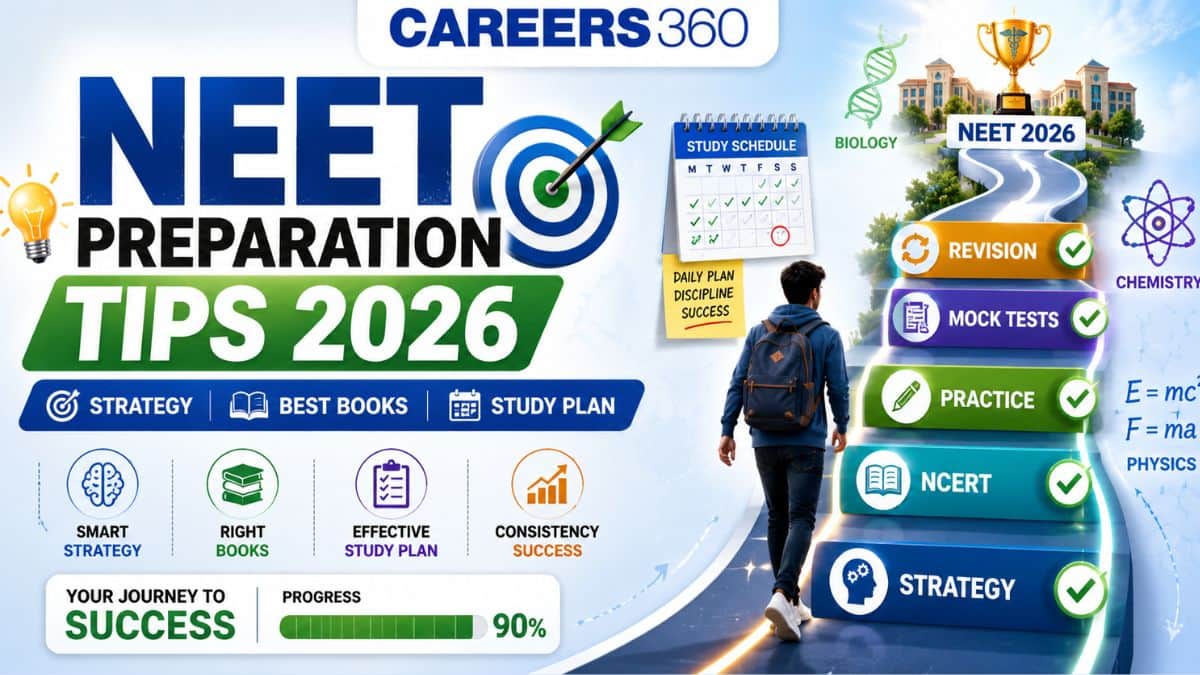
As competition increases every year, students must combine their NEET 2026 preparation with performance analysis. Solving NEET previous year questions (PYQs), attempting NEET mock tests, and analysing mistakes help improve accuracy and reduce repeated errors. A disciplined NEET preparation strategy 2026 with revision, PYQ practice, and time management can help aspirants aim for 650+ marks in NEET 2026.
If you want a clear overview of how to prepare smartly and score 620+ in NEET 2026, follow this high-impact strategy recommended by toppers and experts:
Start with NCERT first, especially Biology, as it contributes 50% of NEET marks
Focus on NEET high-weightage chapters from Physics, Chemistry, and Biology to maximise scoring potential
Practice 150-200 NEET MCQs daily across all three subjects to build speed and accuracy
Take at least one full-length mock test every week and analyse mistakes thoroughly
Follow the NEET 2026 last-minute revision checklist to cover full preparation.
Maintain a mistake notebook to track repeated errors and weak concepts
Revise daily using short notes, formulas, and diagrams instead of repeatedly learning new topics
Prioritise revision over new chapters in the final months before the exam
This strategy ensures balanced syllabus coverage, regular revision, and continuous performance tracking—three key factors for improving rank and scoring higher in NEET 2026.
Get expert advice on college selection, admission chances, and career path in a personalized counselling session.
To achieve success in NEET 2026 preparation, it's necessary to have a different strategy for each chapter. Biology needs more memory-based study and recollection, chemistry requires conceptual clarity, and physics requires rational thinking and regular practice. Many students worry about completing the entire syllabus, but that is not always necessary to score well. With the right strategy, focused revision, and smart topic selection, you can still achieve a high score. You can also check our guide on how to score 600+ in NEET without completing the syllabus to learn a more efficient preparation approach. Here's a subject-wise strategy to help you achieve maximum marks.
Stick to NCERT biology books, as 85–90% of the questions are exactly related to them.
Start with NCERT line-by-line reading - every line can be a question.
Pay close attention to important biology diagrams, tables, and highlighted facts.
Create short notes for definitions, processes, and examples to revise regularly.
Practice NCERT- based MCQs daily to improve accuracy and speed.
Solve previous years' NEET biology questions to recognise common patterns and often repeated concepts.
Use flashcards or apps for quick revisions of difficult concepts like plant and human physiology.
Take mock tests or weekly quizzes to check your accuracy for questions.
From the NEET physical chemistry Chapters, learn the formulas and practice numerical problems every day to improve calculation speed.
Study NEET inorganic chemistry thoroughly for NCERT-based facts and reactions.
Learn named reactions, reaction mechanisms, practice converting reactants to products quickly, and practice general reaction trends from NEET organic chemistry chapters.
Keep a separate notebook for NEET chemistry formulas and conversions, and practice them weekly.
Practice balancing chemical equations and assertion-reason questions to improve concept clarity.
Attempt topic-wise NEET chemistry mock tests for improving conceptual clarity and application skills.
The NEET syllabus is very large, including the concepts and topics from both Class 11 and Class 12. So, choosing the right study material for effective preparation is very important.
NCERT books for NEET must be the main study material, as most of the questions in the exam directly come from NCERT.
A good NEET study plan is to include other best books for NEET preparation, along with the NCERT, such as MTG Objective NCERT, DC Pandey, and Trueman's Biology, to increase the knowledge of concepts.
Solving previous year papers and mock tests are important NEET exam tips to gain confidence and increase performance. A large number of online and offline NEET study materials can be used for practice.
With the Re-NEET 2026 exam announced to be conducted on June 21, the final four weeks are extremely important for revision and practice. At this stage, students should focus on NCERT revision, NEET MCQ practice, and mock test analysis rather than learning completely new topics. A structured 28-day NEET study plan helps improve accuracy, time management, and confidence before the exam.
A 4-week NEET 2026 preparation strategy is given below to help students prepare in a focused and organised manner.
Day 1–2:
Day 3–4:
Day 5–6:
Chemistry Physical: Mole Concept, Thermodynamics, Solutions.
Revise formulas + practice 30 numericals.
Solve PYQs from 2021–2025.
Practise important formulas and numerical questions.
Day 7:
Full‑length mock test under exam conditions.
Analyse mistakes in a notebook.
Revise weak areas.
Day 8–9:
Organic Chemistry: Named reactions, conversions, mechanisms.
Practice 100 MCQs.
Revise NCERT Inorganic facts (p‑Block, Coordination Compounds).
Day 10:
Biology quick notes: Ecology, Biotechnology, Human Health.
Revise NCERT tables + diagrams.
Solve 150 MCQs.
Day 11:
Physics: Modern Physics, Current Electricity, Magnetism.
Practice mixed MCQs + numericals.
Revise the formula sheet.
Day 12:
Chemistry mixed practice: Physical + Organic + Inorganic.
Revise reaction mechanisms.
Solve assertion‑reason questions.
Day 13 and 14:
Full‑length NEET mock test.
Analyse mistakes, revise formulas + diagrams.
Focus on high‑weightage chapters.
Practice reaction-based and assertion-reason questions.
Day 15–16:
Day 17–18
Day 19–20
Day 21
Day 22–28:
As the exam approaches, candidates should shift from full-syllabus coverage to targeted revision. Check the NEET Last 7 Days Strategy 2026 for a detailed day-wise revision plan, important chapters, mock test schedule, and exam-day preparation tips.
This phase helps improve time management, accuracy, and exam temperament, which are crucial for performing well in NEET 2026.
A regular NEET exam daily schedule is the foundation of good preparation, whether you are a school student or a dropper. NEET Time management keeps you focused, away from distractions, and helps in completing the vast syllabus with ease and stress.
Whether you're preparing at a coaching centre or preparing for NEET at home, a realistic NEET daily routine study improves learning. Here's a NEET study routine for the aspirants:
Timetable for NEET 2026 (Droppers & Freshers)
Time Slot | Task |
|---|---|
6:00 AM – 8:00 AM | Revise the previous day’s concepts |
8:00 AM – 9:00 AM | Breakfast + light break |
9:00 AM – 1:00 PM | Study 1st subject + MCQs |
1:00 PM – 2:00 PM | Lunch + rest |
2:00 PM – 5:00 PM | Study 2nd subject + questions |
5:00 PM – 6:00 PM | Tea + break |
6:00 PM – 9:00 PM | Study 3rd subject + test review |
9:00 PM – 10:30 PM | Dinner + light revision |
Cracking NEET in the first attempt is quite possible if you follow the proper guidance, stay regular, and utilise every study hour effectively. The best study tips to crack NEET in first attempt based on proven techniques and toppers' feedback are:
Key Tips to Crack NEET 2026:
Start your preparation with good NEET study material by mastering the NCERT first and then going for selected reference books for a better understanding.
Make sure to cover the entire NEET syllabus of both Class 11 and 12 without leaving out any do or die chapters for NEET, mainly Biology.
Stick to a set and realistic NEET daily routine with slots for studying, solving questions, revision, and short breaks.
Practice mock tests and sample papers on a regular basis to familiarise yourself with the exam pattern and the most important NEET concepts.
Make short, clear notes while reading so that you can easily revise main formulas, diagrams, and points at examination time.
Find your weak areas at mock tests and give special time to those particular topics by revising and solving questions.
Learning from the students who have already cleared the exam can bring a change to a large extent. Here are some NEET Preparation tips provided by the top performers to build a strong foundation for the exam. These tips are also beneficial for students who are thinking about NEET preparation without coaching.
Follow a well-structured plan
Focus on NCERT concepts
Practice regularly with mock tests
Solve previous years’ papers to understand the pattern.
Prepare short notes in your own words.
Maintain a healthy routine
Knowing how to begin NEET preparation is one of the biggest concerns of the candidates. Most students are not sure if it would be better to start in Class 11 or delay it until Class 12. The fact is, starting early with a proper plan provides you with a huge edge. Knowing the NEET syllabus and when to begin will help you avoid the pressure of the exam.
Here are some important points to keep in mind if the aspirants are confused on how to start preparing for NEET from Class 11 or start their NEET preparation from class 12:
| Starting from Class 11 | Starting from Class 12 |
|---|---|
| Best for building a strong foundation from the start. | Requires better time management and a tighter schedule. |
| More time to understand concepts and revise well. | Need to study Class 11 topics along with Class 12. |
| Easier to clear doubts, practice mock tests, and improve weak topics. | Best for disciplined students who can follow a strict plan. |
| Easier to manage both boards and NEET prep together. | Good preparation is possible if consistent and focused on NCERT. |
NEET preparation tips 2026 include careful and effective planning with proper time management. Avoiding the NEET most common mistakes can help you stay on track and improve your chances of success.
Many aspirants make the mistake of ignoring the NCERT, but most questions come from these books only. Always build a very strong foundation with the NCERT first.
Without a clear plan, time would be wasted. A focused NEET preparation schedule helps in managing time efficiently.
Some of the students spend too much time on new topics and ignore revision on a regular basis. Revision is very important to retain the concepts.
Mock tests and NEET previous year papers help in evaluating the performance and exam pattern. Students are advised to practise these to identify the weak areas.
The NEET 2026 preparation includes the complete Physics, Chemistry, and Biology syllabus from both Class 11 and Class 12. Knowing the NEET chapter-wise weightage and prioritising topics helps in studying smartly.
NEET Physics Chapterwise Weighatge:
| Chapter Name | 2021 | 2022 | 2023 | 2024 | 2025 | Weightage % |
|---|---|---|---|---|---|---|
| Current Electricity | 4 | 4 | 4 | 4 | 3 | 7.95% |
| Moving Charges and Magnetism | 3 | 3 | 3 | 2 | 2 | 5.44% |
| Electromagnetic Waves | 2 | 2 | 1 | 2 | 2 | 3.77% |
| Waves | 1 | 0 | 0 | 0 | 1 | 0.84% |
| Ray Optics and Optical Instruments | 4 | 4 | 3 | 2 | 1 | 5.86% |
| Magnetism and Matter | 0 | 0 | 0 | 3 | 2 | 2.09% |
| Thermodynamics | 1 | 1 | 1 | 3 | 2 | 3.35% |
| Kinetic Theory | 1 | 1 | 1 | 0 | 1 | 1.67% |
| Alternating Current | 2 | 3 | 3 | 2 | 2 | 5.02% |
| Gravitation | 3 | 3 | 3 | 2 | 3 | 5.86% |
| Semiconductor Electronics: materials, devices and simple circuits | 3 | 3 | 3 | 3 | 2 | 5.86% |
| Dual Nature of Matter and Radiation | 1 | 2 | 0 | 1 | 2 | 2.51% |
| Electrostatic Potential and Capacitance | 3 | 5 | 1 | 4 | 2 | 6.28% |
| Oscillations | 2 | 3 | 2 | 4 | 2 | 5.44% |
| Motion in a Straight Line | 1 | 1 | 2 | 2 | 2 | 3.35% |
| Laws of motion | 2 | 2 | 2 | 0 | 2 | 3.35% |
| Atoms | 0 | 0 | 2 | 2 | 1 | 2.09% |
| System of Particles and Rotational Motion | 2 | 0 | 2 | 2 | 1 | 2.93% |
| Mechanical Properties of Fluids | 1 | 1 | 2 | 0 | 2 | 2.51% |
| Wave Optics | 0 | 0 | 1 | 2 | 3 | 2.51% |
| Thermal Properties of Matter | 0 | 0 | 1 | 0 | 1 | 0.84% |
| Work, energy and power | 1 | 1 | 2 | 2 | 3 | 3.77% |
| Electromagnetic Induction | 2 | 1 | 2 | 1 | 1 | 2.93% |
| Units and Measurements | 3 | 3 | 2 | 3 | 1 | 5.02% |
| Nuclei | 3 | 3 | 1 | 1 | 0 | 3.35% |
| Motion in a Plane | 1 | 1 | 2 | 0 | 0 | 1.67% |
| Electric Charges and Fields | 4 | 3 | 3 | 1 | 1 | 5.02% |
| Mechanical Properties of Solids | 0 | 0 | 1 | 2 | 0 | 1.26% |
NEET Chemistry Chapterwise Weightage:
The data is from the past five years and chapters States of Matter, Hydrogen, The s-Block Element, Solid State, Surface Chemistry, Polymers, Environmental Chemistry, General Principles and Processes of Isolation of Elements are not in the NEET syllabus now
| Chapter | 2021 | 2022 | 2023 | 2024 | 2025 | Total weightage (%) |
|---|---|---|---|---|---|---|
| Basic Concepts of Chemistry | 1 | 1 | 1 | 1 | 3 | 3.91 |
| Structure of Atom | 3 | 3 | 2 | 3 | 2 | 5.12 |
| Classification of Elements & Periodicity | 0 | 0 | 4 | 3 | 4 | 5.57 |
| Chemical Bonding and Molecular Structure | 4 | 3 | 3 | 3 | 2 | 6.12 |
| States of Matter | 3 | 3 | 2 | 0 | 0 | 3.34 |
| Thermodynamics | 3 | 2 | 1 | 4 | 3 | 5.15 |
| Equilibrium | 1 | 1 | 1 | 3 | 1 | 2.97 |
| Redox Reactions | 1 | 1 | 1 | 1 | 1 | 2.82 |
| Hydrogen | 0 | 1 | 1 | 0 | 0 | 0.84 |
| The s-Block Element | 2 | 1 | 1 | 0 | 0 | 1.25 |
| Some p-Block Elements | 3 | 4 | 2 | 2 | 0 | 3.58 |
| d and f Block Elements | 2 | 3 | 2 | 1 | 1 | 3.43 |
| Coordination Compounds | 2 | 1 | 2 | 6 | 5 | 6.94 |
| Solid State | 2 | 2 | 2 | 0 | 0 | 2.34 |
| Solutions | 3 | 3 | 0 | 5 | 3 | 6.33 |
| Electrochemistry | 1 | 2 | 2 | 1 | 0 | 2.32 |
| Chemical Kinetics | 1 | 2 | 1 | 2 | 3 | 4.73 |
| Surface Chemistry | 0 | 0 | 2 | 0 | 0 | 0.87 |
| Organic Chemistry – Some Basic Principles and Techniques | 0 | 2 | 3 | 4 | 4 | 5.44 |
| Hydrocarbons | 3 | 3 | 1 | 5 | 4 | 6.63 |
| Haloalkanes and Haloarenes | 3 | 2 | 1 | 2 | 2 | 4.28 |
| Alcohols, Phenols and Ethers | 2 | 2 | 4 | 2 | 1 | 4.28 |
| Aldehydes, Ketones and Carboxylic Acids | 5 | 2 | 3 | 0 | 1 | 4.7 |
| Amines | 2 | 2 | 4 | 0 | 3 | 3.66 |
| Biomolecules | 1 | 0 | 1 | 2 | 2 | 2.6 |
| Polymers | 1 | 1 | 1 | 0 | 0 | 1.25 |
| Environmental Chemistry | 0 | 1 | 1 | 0 | 0 | 0.87 |
| General Principles and Processes of Isolation of Elements | 1 | 2 | 1 | 0 | 0 | 1.28 |
NEET Biology Chapterwise Weightage:
The data is from the last five years, and the chapters on plant transport, food production improvement strategies, digestion and absorption, organism reproduction, and mineral nutrition are no longer part of the syllabus.
Divide your NEET 2026 syllabus into weekly and monthly targets, and combine it with NCERT-based revision to stay ahead.
A smart NEET revision strategy is the secret to increasing your NEET score. Using NEET revision techniques, you can maintain an error notebook. It is useful for tracking mistakes, avoiding them, and targeting your revision where it is most needed.
How to use it:
After each mock test or practice, list the questions that you answered incorrectly or guessed.
Add the mistake made and the right explanation.
Go through this notebook every few days, and mainly during the final month of revision.
Pay more attention to patterns - whether you tend to make calculation mistakes, misunderstand theory, or miss keywords.
Board exams and preparation for NEET 2026 can be difficult to balance, but can be managed easily with a good study schedule.
Prepare each topic first to understand the concept (useful for NEET), then practice from detailed answers (required for boards).
Divide your day, spend the morning on NEET-type MCQs and evening on board-type answers.
Use weekends for full-length mock tests and board sample papers.
Ease up on NEET preparation in the months of board exams, but still keep light revision going.
NEET exam preparation at home is totally possible with the correct strategy, self-discipline, and useful resources. Many toppers have cleared NEET without coaching by opting for a self-directed, focused study plan.
Self-study tips for NEET exam preparation at home without coaching:
Start with a well-planned schedule and follow a regular NEET study routine.
Go through the NCERT books first, mainly for biology and inorganic chemistry.
Refer to the credible reference books and online lectures (YouTube, apps, websites) to resolve doubts.
Practice NEET previous year question papers and mock tests regularly at home.
Track your improvement in weak topics in a mistake notebook.
Prepare short notes, flashcards, and study summary sheets for last-minute practice.
Be motivated by dividing your goals into small weekly ones and rewarding yourself for regularity.
Frequently Asked Questions (FAQs)
Start by knowing the syllabus and pattern of NEET. Focus on developing good fundamentals in NCERT Physics, Chemistry, and Biology from Class 11.
Yes, many students crack NEET without coaching. With self-discipline, a good study schedule, and quality study resources, it is possible.
Attempt 2–3 full-length mock tests per week under exam conditions. Analyse mistakes daily.
The best books for NEET 2026 are:
Biology - NCERT (Class 11 & 12), Trueman's Biology
Chemistry - NCERT, O.P. Tandon, N. Awasthi for Physical & Inorganic
Physics - NCERT, HC Verma, DC Pandey

On Question asked by student community
Hey there,
With 340 marks in NEET 2026 and ST category, you should definitely participate in Karnataka NEET counselling. While getting a government medical college (GMC) seat may be difficult, you may still have a chance in later counselling rounds depending on the final cutoff, seat availability, and whether you
Hello Aspirant,
If you have appeared for NEET and meet the eligibility criteria you can apply for BPT (Bachelor of physiotherapy) course in many colleges. Admission rule may vary by University some institutes offer admission based on NEET scores, while other admit student based on class 12th (PCB) marks or
Hello,
The marks required for admission to BPT (Bachelor of Physiotherapy) vary from one college to another. Many colleges admit students based on Class 12 marks or their own entrance process, while some institutions also accept NEET scores.
Generally, a higher NEET score improves your chances of getting admission to
Hello Aspirant,
With a NEET score of 300 getting an MBBS seat in Government medical College is very difficult under the current cut off trend. However, you may still have a chance of other government allied health science courses such as BSc nursing, BPT, B.Sc medical laboratory technology, B.Sc. radiology
Hello Dear Student,
With a score of
235 marks
, it is very difficult to secure a government merit seat; however, your son is
eligible
to apply for
Management Quota
and
NRI Quota
seats in private medical colleges. Every seat in India, including Management and NRI quotas, requires a candidate
the product 'P' will be ,


| Column A | Column B |
| A |
a) Organisation of cellular contents and further cell growth. |
| B |
b) Leads to formation of two daughter cells. |
| C |
c) Cell grows physically and increase volume proteins,organells. |
| D |
d) synthesis and replication of DNA. |
Match the correct option as per the process shown in the
0.16 g of dibasic acid required 25 ml of decinormal solution for complete neutralisation. The modecular weight of the acid will be
32
64
128
256
0xone is

Recognized as Category 1 University by UGC | Accredited with A+ Grade by NAAC | Scholarships available
Ranked as India’s #1 Not for profit pvt. University by India Today
Ranked among the top Dental Colleges for 7 consecutive years by India Today poll
Get Started With Your Healthcare Career. 2026 Admissions open.
Get Job Ready in Healthcare | Employability-Focused Programs
Allied & Healthcare programs | 20+ Partner Universities & Institutes | 98% placement record