Pursue MD/MS in Ireland
Want to study abroad? Plan your Journey


INI CET Common Mistakes to Avoid 2026: Every INI CET session, a familiar pattern repeats itself. Someone who studied sincerely for months walks out of the exam hall disappointed, not because they didn't know the syllabus, but because of something smaller and more avoidable. Maybe they spent too long on one tricky question and ran out of time in that section. Maybe they never touched Psychiatry or FMT because "there wasn't time," even though these are short subjects that could have been finished in a couple of focused sittings. Small mistakes like these do not show up anywhere in a syllabus checklist, which is exactly why they are so easy to overlook until it is too late to fix them.
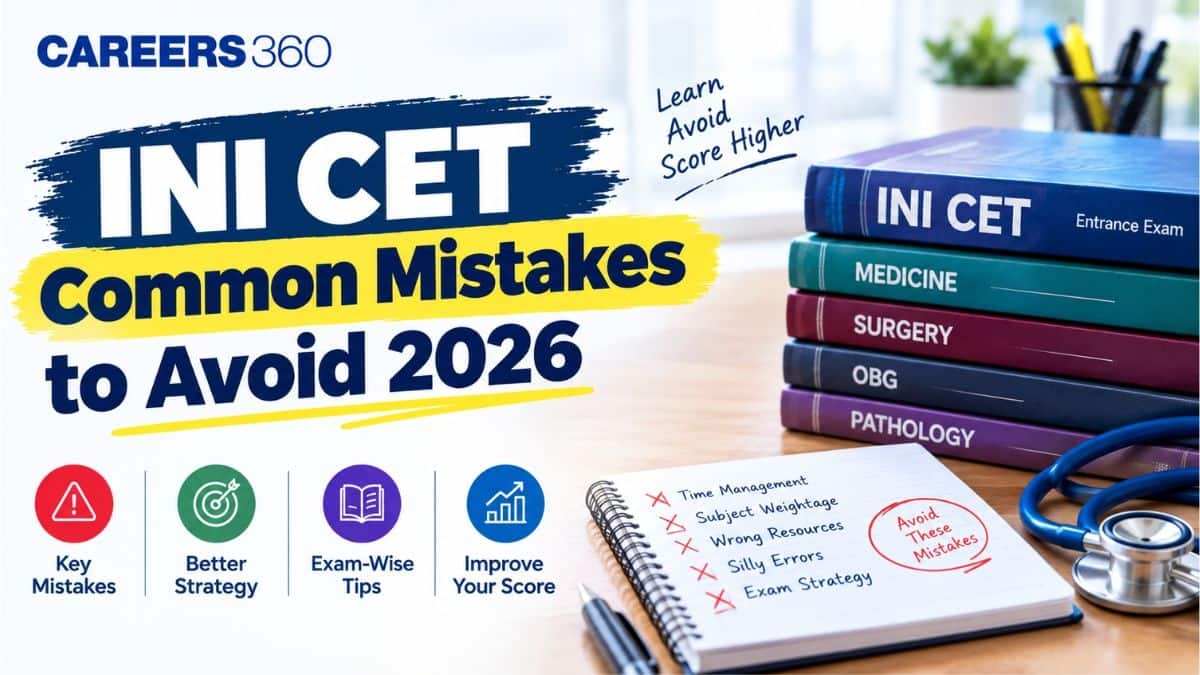
This article lists the INI CET common mistakes that show up repeatedly across INI CET sessions. These include how faculty, coaching platforms, and aspirants themselves describe what actually goes wrong, both during preparation and inside the exam hall. How you study, how you handle the exam's unusual format, and how you stay calm enough to think clearly for three hours straight matters. None of it is complicated once you know what to look out for, but knowing it in advance is what makes the difference.
Most mistakes INI CET aspirants make are not about a lack of knowledge. They come from treating INI CET like just another PG exam, when it has its own syllabus twists, its own question style, and its own exam-day format that punishes poor time management more. Below are the mistakes listed, grouped by when they usually happen: during preparation, during revision, and inside the exam hall itself.
This is probably the single most repeated mistake across every INI CET session. Aspirants naturally incline toward subjects like Medicine, Surgery, and Pathology, since these feel more "important" and get revised again and again. Meanwhile, shorter subjects like Psychiatry, Forensic Medicine, Ophthalmology, and ENT keep getting pushed to revise later and later never arrives. These shorter subjects are usually quicker to revise to a high level of confidence precisely because they have fewer topics, which makes skipping them one of the easiest ways to lose easy marks.
In the rush to prepare, it's tempting to collect everything, multiple textbooks, coaching notes, Telegram PDFs, and video lectures from three different platforms. This usually becomes a mistake. Jumping between sources divides your understanding and consume time you could have spent revising. A more effective approach is picking one or two trusted resources per subject and going through them multiple times, rather than reading everything once and retaining very little.
Knowing a concept and being able to apply it under exam conditions are two different skills. INI CET tests the second one more than most exams do. Aspirants who spend most of their time reading and relatively little time solving questions often struggle when a question frames a familiar concept inside a clinical scenario. Daily MCQ practice, not just reading, is what actually builds the recall speed and applied thinking the exam demands.
Radiology films, pathology slides, and dermatology images are a real and recurring part of the INI CET paper. They are exactly the kind of questions a text-only revision leaves you unprepared for. If your practice has been entirely about one-liners and theory, an X-ray-based question or a clinical vignette can cost you marks. Not because you don't know the underlying concept, but because you've never practised applying it visually or in a scenario format. Building in regular image-spotter practice, especially in Radiology, Pathology, and Dermatology, closes this gap early instead of discovering it in the exam hall.
INI CET's biggest structural twist is that its 200 questions are split into four sections of 50 questions each, with a fixed 45-minute window per section that auto-submits when time runs out. There is no way to go back once a section closes. A lot of aspirants practise using generic mock tests that let them move freely between all 200 questions, which does not prepare them for this sectional, locked format at all. Practising with tests that replicate this exact structure is the only real way to build the pacing and decision-making the actual exam demands.
Even aspirants who know the sectional format in theory sometimes forget to plan around it in practice. Spending too long on one difficult question inside a 45-minute section means less time, or no time, for other questions in the same section that you might have answered easily. A good approach is to decide early which questions to attempt first within a section. Move on quickly from questions that are taking too long, and come back to them only if time allows before that section auto-submits.
INI CET's marking scheme awards one mark for a correct answer, deducts one-third of a mark for a wrong one, and there is no penalty for questions left unattempted. This creates two opposite mistakes. Some aspirants guess on almost everything, hoping probability works in their favour, and end up losing marks through a string of wrong guesses. Others become so afraid of negative marking that they skip questions they genuinely knew the answer to. A wise middle ground is to attempt a question only if you can eliminate at least two options and skip it otherwise rather than guessing blindly.
Under time pressure, it's easy to skim a question, miss a word like "except" or "not," and answer confidently, but wrong. This kind of careless mistake has nothing to do with knowledge and everything to do with rushing. Slowing down by even a few seconds per question to read it properly, especially negatively-framed ones, prevents a surprising number of silly errors that add up across 200 questions.
Cramming through the night before the exam, skipping meals, and disrupting your sleep schedule for "one more revision round" causes more harm than good. Your ability to think clearly and recall information for a full three hours depends heavily on proper rest. Matching your sleep and study hours to the actual exam timing in the days before, rather than only on the night before, helps your mind and body be genuinely ready.
This sounds basic, but it trips up more candidates than expected. Forgetting your admit card, a valid photo ID, or your MCI registration certificate, or misjudging travel time to a far-off exam centre, can cost you the exam before you've even opened the question paper. Keep all your documents ready a day in advance, confirm your exam centre location ahead of time, and plan to reach early rather than exactly on time.
Also Read:
Frequently Asked Questions (FAQs)
Ignoring short subjects like Psychiatry, FMT, ENT, and Ophthalmology while over-focusing on longer subjects is one of the most repeated mistakes, since these shorter subjects are usually quicker to revise fully.
INI CET splits its 200 questions into four sections of 50 questions each, with a fixed 45-minute limit per section that auto-submits. Not practising with this exact format is a common reason candidates run out of time within a section.
It is generally safer to attempt a question only if you can eliminate at least two of the options. Random guessing on questions you are unsure about can lower your score because of the negative marking for wrong answers.


Know possible Govt/Private MBBS/BDS Colleges based on your NEET rank
College Predictors Webinars One to One Counselling Regular Updates Medical Almanac
Check your expected admission chances in MD/MS/Diploma courses based on your NEET PG Score
Your one-stop NEET PG counseling package with complete hand-holding throughout the admission journey
Get Job Ready in Healthcare | Employability-Focused Programs
Ranked among the top Dental Colleges for 7 consecutive years by India Today poll