NEET PG College Predictor
NEET PG All India & State College Predictor with Admission Process Guide


NORCET 11 Mains Subject-Wise Preparation Strategy: Most NORCET Mains aspirants do not lose marks because they didn’t study enough. They lose marks because they studied every subject with equal intensity. NORCET Mains carries a total of 160 marks, and the subject-wise split is nowhere close to balanced: a dominant 140 marks for core nursing subjects, while only 20 marks are allocated to general knowledge, general English, and aptitude combined. Treating every subject in the NORCET syllabus as equally important is the single most common reason candidates who clear NORCET prelims comfortably still end up missing the NORCET mains cut-off.
This Story also Contains
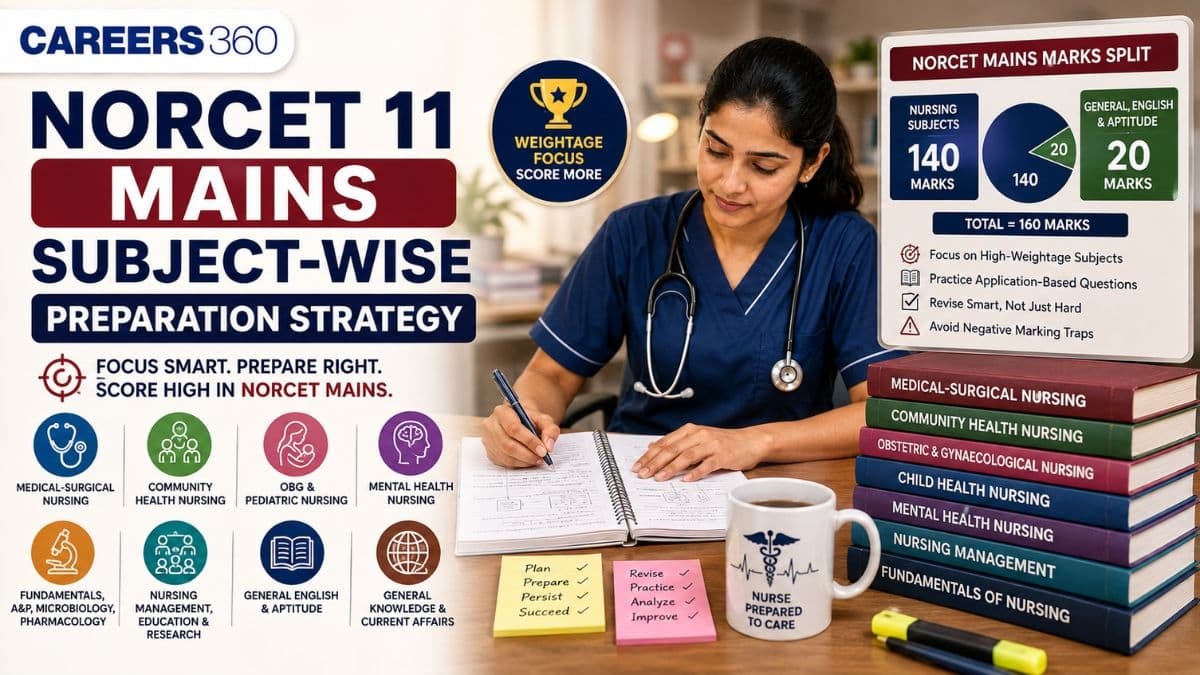
This NORCET 11 mains preparation strategy breaks your study plan down subject by subject, in the exact order they deserve your time based on actual weightage. This article also addresses the specific conceptual sticking points that challenge NORCET candidates year after year in Medical-Surgical Nursing, Community Health Nursing, and other high-weightage areas. This is not another "read the syllabus and revise" checklist; it's a weightage-first approach built around where Stage 2 marks are actually scored.
This single subject carries more weight in mains than any other, and it's also where most candidates lose marks to confusion rather than ignorance. The problem usually isn't that you don't know the disease. It's that two or three conditions with overlapping symptoms get mixed up under exam pressure, or a drug classification question catches you between two similar-sounding categories.
Study this subject system by system (cardiovascular, respiratory, renal, neuro, endocrine) rather than disease by disease. For every condition, build the same four-part mental map every time: pathophysiology in one line, the two or three symptoms that distinguish it from lookalike conditions, the nursing priority action, and the drug class involved. Candidates who memorise disease facts in isolation freeze on application-based questions; candidates who build this comparison habit answer them fast.
Get expert advice on college selection, admission chances, and career path in a personalized counselling session.
This is the subject candidates most often underestimate until the exam, because it's less clinical. In reality, it's dense with numeric data. National health programme targets, immunisation schedules, vital statistics formulas. These numbers are exactly what Mains loves to test as distractor options.
Don't read this subject as plain English. Build a single table of every national health programme with its year of launch, key target, and current status, and revise that table daily in five-minute bursts rather than re-reading full chapters. The same applies to the National Immunization Schedule, which resurfaces constantly across both Community Health and Pediatric Nursing questions — memorize it once, apply it everywhere.
These two subjects reward precision over volume. In OBG, the recurring pain point is separating normal antenatal findings from danger signs that require immediate referral — questions are frequently framed as clinical scenarios rather than direct fact recall, so passive reading won't cut it. Practice converting every "normal vs. warning sign" list into scenario-based self-quizzing.
Pediatric Nursing overlaps heavily with the immunization table you've already built for Community Health, plus growth and development milestones by age. Keep a single growth-milestone chart rather than separate notes for each age group — most errors here come from candidates mixing up milestones across adjacent age brackets, not from not knowing the milestones at all.
Aspirants consistently report the same issue with this subject: mixing up classification systems and therapeutic communication techniques under time pressure, even when the underlying concept is well understood. The fix isn't more reading; it's active recall — cover the answer, name the classification or technique from the scenario description, then check yourself. Passive re-reading of psychiatric nursing notes creates false confidence that collapses the moment a question is phrased slightly differently from the textbook.
These foundational subjects are where candidates waste the most time by treating them as separate, sequential chapters. In practice, mains questions constantly cut across them — a question about a nursing procedure will assume you already know the underlying anatomy and the drug interactions involved. Instead of finishing Anatomy, then starting Pharmacology, then Fundamentals, integrate them around body systems as you go through Medical-Surgical Nursing. It cuts revision time significantly because you stop re-learning the same physiology three separate times under three different subject headings.
This cluster gets pushed to the last week or skipped by most aspirants because it feels theoretical and low-priority. That's a mistake. These topics are fact-based rather than application-based, which means they're some of the fastest marks available once you've read them even once carefully. A focused two-day pass covering leadership theories, the nursing process, sampling methods in research, and quality management principles usually locks in this entire section reliably.
Twenty marks feels small next to 140, but it's still more than a full subject's worth of scoring potential, and it's often where candidates lose ground purely through neglect. Spend 20–30 minutes daily on recent healthcare policy news, health-related current affairs, and basic reasoning/aptitude practice rather than a dedicated cramming block — this section rewards consistency over intensity.
In your last revision cycle before the exam, stop revising subject by subject. Revise disease and topic clusters instead — diabetes, for instance, shows up across Medical-Surgical Nursing, Community Health, and Nutrition, and revising it once across all three angles is far more efficient than three separate passes. You can also check NORCET previous year papers to find out which subjects have carried the most questions.
Also check:
Frequently Asked Questions (FAQs)
Medical-Surgical Nursing carries the highest weightage among nursing subjects in stage 2, and nursing subjects overall account for 140 of the total 160 marks, against just 20 marks for general knowledge and aptitude.
No. Twenty marks can still be the difference between clearing and missing the mains cut-off, especially since cut-offs are calculated on total marks. A short daily revision slot is enough — it doesn't need a dedicated study block.
Early in preparation, study subject by subject to build a solid base. In your final revision pass, switch to topic-cluster revision (like revising diabetes across Medical-Surgical, Community Health, and Nutrition together) — it reflects how mains questions are actually asked and saves significant revision time.

On Question asked by student community
Hello Student,
The AIIMS NORCET (Nursing Officer Recruitment Common Eligibility Test) previous year question papers are available in PDF format at the link given below:
https://medicine.careers360.com/articles/aiims-nursing-officer-previous-year-question-papers
Hello Punitha,
The NORCET (Nursing Officer Recruitment Common Eligibility Test) is conducted by the All India Institute of Medical Sciences for the recruitment of Nursing Officers in AIIMS and participating institutes.
Here are the links to the NORCET important questions and answer resources:

NEET PG All India & State College Predictor with Admission Process Guide
End-to-End NEET PG Admission Guidance | One-to-One Counselling | College Predictors | Regular Updates | E-books