


AIAPGET 2026 Most Expected Questions PDF: High-Weightage Topics & Important MCQs
AIAPGET 2026 candidates across all four AYUSH streams, Ayurveda (BAMS), Homoeopathy (BHMS), Unani (BUMS), and Siddha (BSMS), are searching for one thing above all in the final stretch of preparation: a reliable set of expected questions built around the topics that actually carry weight in the exam. This article and the four downloadable eBooks linked below are built to answer exactly that.
This Story also Contains
- About AIAPGET 2026 Exam
- Download the Full AIAPGET 2026 Expected Questions eBooks
- How These Expected Questions Were Prepared
- Sample Questions: Ayurveda (BAMS)
- Sample Questions: Homeopathy (BHMS)
- Sample Questions: Unani (BUMS)
- Sample Questions: Siddha (BSMS)
- Why Download the Complete eBooks
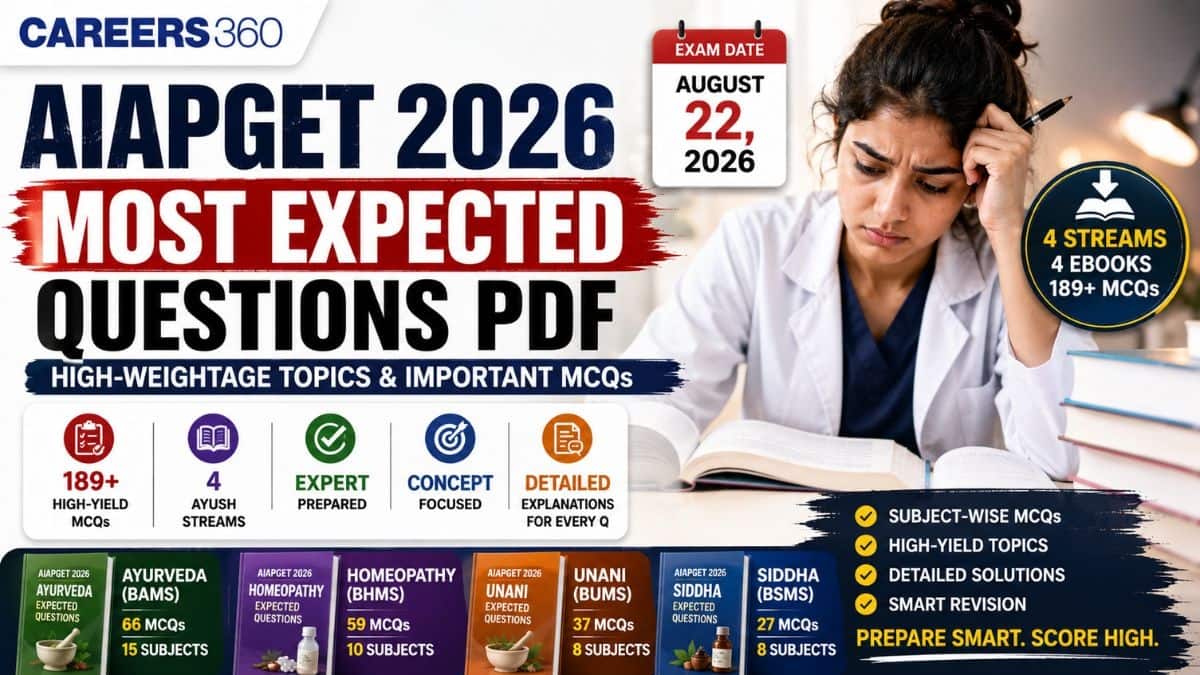
These are expert-prepared expected questions, written around the high-yield topics and concepts that repeat across each stream's syllabus and past AIAPGET exam patterns. They are original questions, not extracted or reproduced from any official AIAPGET paper — no justified expected questions resource can honestly claim otherwise, since real exam questions aren't recycled year to year, and past papers aren't available for that kind of recreation in any case. Treat these as a rigorous practice resource for testing conceptual clarity, not as a leaked or guaranteed preview of the actual 2026 paper.
About AIAPGET 2026 Exam
AIAPGET (All India AYUSH Post Graduate Entrance Test) is conducted by the National Testing Agency for admission to MD/MS and PG Diploma courses across India's four AYUSH systems. The syllabus for each stream is taken from the candidate's own undergraduate curriculum — BAMS for Ayurveda, BHMS for homoeopathy, BUMS for Unani, and BSMS for Siddha — so there is no single shared subject list across streams, unlike NEET, which has a common physics-chemistry-biology structure. Each of the four eBooks below is therefore created specifically around its own stream's syllabus and high-yield areas, not a generic syllabus applied across all four.
Confused About College Admissions?
Get expert advice on college selection, admission chances, and career path in a personalized counselling session.
Download the Full AIAPGET 2026 Expected Questions eBooks
Stream | Resource | Download Here |
Ayurveda (BAMS) | AIAPGET 2026 Ayurveda Expected Questions eBook (PDF) | |
Homeopathy (BHMS) | AIAPGET 2026 Homoeopathy Expected Questions eBook (PDF) | |
Unani (BUMS) | AIAPGET 2026 Unani Expected Questions eBook (PDF) | |
Siddha (BSMS) | AIAPGET 2026 Siddha Expected Questions eBook (PDF) |
Each eBook includes the correct answer clearly marked and a detailed explanation for every question, organised subject-wise with a clickable table of contents for quick navigation.
Also Read: AIAPGET Previous Year Question Paper
How These Expected Questions Were Prepared
Each question set was created by first identifying the confirmed high-yield subjects for that specific stream — for example, Materia Medica, Organon of Medicine, and Repertory together account for more than half the homoeopathy paper. At the same time, Charaka Samhita's Sutrasthana and Chikitsasthana carry particular weight in Ayurveda. Questions were then written around the core concepts within those subjects, checked for factual accuracy, and organised so that working through the eBook reflects revising the actual high-yield portions of the syllabus.
One honest note on scope: the depth of each eBook varies by stream, reflecting the amount of reliable, verifiable reference material available for that discipline. Ayurveda and Homeopathy, being more extensively documented, have larger question sets; Unani and particularly Siddha eBooks are intentionally more conservative in size, prioritising accuracy over volume.
Sample Questions: Ayurveda (BAMS)
Q1. According to Charaka Samhita, the total number of Mahabhutas along with Atma that constitute Purusha (the individual) is:
A. Five
B. Six
C. Seven
D. Eight
Correct Answer: B. Six
Explanation: Charaka Samhita describes Purusha as constituted of the Panchamahabhuta (five basic elements) together with Atma, making a total of six — the Shadatuka Purusha concept underlying the Ayurvedic view of the body as a microcosm of the universe.
Q2. The total number of Dhatus (tissues) in the body, per Ayurvedic physiology, is:
A. Five
B. Six
C. Seven
D. Eight
Correct Answer: C. Seven
Explanation: Ayurveda describes seven Dhatus — Rasa, Rakta, Mamsa, Meda, Asthi, Majja, and Shukra — sequentially nourished through Dhatu Poshana, a foundational concept in Ayurvedic tissue physiology.
Q3. The classical Ayurvedic technique of nasal reconstruction using a skin flap, a precursor to modern rhinoplasty, was pioneered by:
A. Acharya Charaka
B. Acharya Sushruta
C. Acharya Vagbhata
D. Acharya Dridhabala
Correct Answer: B. Acharya Sushruta
Explanation: Sushruta Samhita describes nasal reconstruction using a forehead flap technique, one of classical Ayurvedic surgery's most historically significant contributions to reconstructive surgery.
Q4. 'Prameha' is classically subdivided into how many types based on Dosha and urine characteristics?
A. 10 types
B. 20 types
C. 5 types
D. 15 types
Correct Answer: B. 20 types
Explanation: Prameha is described as twenty types — ten Kaphaja, six Pittaja, and four Vataja — differentiated by urine colour and consistency, with advanced Vataja Prameha described as Madhumeha.
Q5. Which of the following is NOT one of the five classical Panchakarma procedures?
A. Vamana
B. Virechana
C. Basti
D. Abhyanga
Correct Answer: D. Abhyanga
Explanation: The five Panchakarma procedures are Vamana, Virechana, Basti, Nasya, and Raktamokshana. Abhyanga (oil massage) is a Purvakarma/general wellness procedure, not one of the five main procedures itself.
(The complete Ayurveda eBook contains 61 more questions across Kriya Sharir, Dravyaguna, Rasashastra, Kayachikitsa, Roga Nidan, and more — download it above.)
Sample Questions: Homeopathy (BHMS)
Q1. The 'Law of Similia' (Similia Similibus Curentur) means:
A. Like cures like
B. Opposite symptoms are treated with opposite remedies
C. Only diluted substances have therapeutic action
D. Disease and remedy must share the same chemical composition
Correct Answer: A. Like cures like
Explanation: A substance capable of producing specific symptoms in a healthy person can cure similar symptoms in a sick person, when given in minimal, potentised doses — the foundational therapeutic principle of homoeopathy.
Q2. 'Chilly patient, ailments from anger with indignation, and desire for stimulants' are keynotes of which remedy?
A. Nux Vomica
B. Pulsatilla
C. Sepia
D. Ignatia
Correct Answer: A. Nux Vomica
Explanation: Nux Vomica is classic for the chilly, irritable, ambitious individual with a lifestyle of overindulgence in stimulants, along with ailments from anger with indignation.
Q3. 'Potentisation' in homoeopathic pharmacy refers to:
A. Simple dilution without any additional process
B. Sequential dilution combined with succussion or trituration
C. Heating a substance to increase concentration
D. Freeze-drying a substance
Correct Answer: B. Sequential dilution combined with succussion or trituration
Explanation: Potentisation involves dilution combined with succussion (liquids) or trituration (insoluble solids), described in classical theory as enhancing a substance's therapeutic property.
Q4. Hahnemann classified chronic miasms into three fundamental types:
A. Psora, Sycosis, and Syphilis
B. Psora, Tuberculosis, and Cancer
C. Sycosis, Syphilis, and Leprosy
D. Psora, Syphilis, and Pseudo-psora
Correct Answer: A. Psora, Sycosis, and Syphilis
Explanation: These three form Hahnemann's original miasmatic framework; later homoeopaths expanded this to include Tubercular and Cancer miasms.
Q5. 'Weeping, mild, yielding disposition with thirstlessness and desire for open air' describes which remedy?
A. Pulsatilla
B. Lycopodium
C. Arsenicum Album
D. Natrum Muriaticum
Correct Answer: A. Pulsatilla
Explanation: Pulsatilla suits a mild, tearful individual seeking sympathy, generally thirstless, with marked amelioration from open air and characteristically changeable symptoms.
(The complete Homeopathy eBook contains 54 more questions across Organon, Repertory, Pharmacy, Practice of Medicine, and more — download it above.)
Sample Questions: Unani (BUMS)
Q1. The human body's physiology, per Unani medicine, is governed by how many Umoor-e-Tabiya (natural factors)?
A. Six
B. Seven
C. Eight
D. Four
Correct Answer: B. Seven
Explanation: Arkan, Mizaj, Akhlat, Aaza, Arwah, Quwa, and Afaal together form the seven natural factors framing Unani physiological theory.
Q2. The four classical Akhlat (humours) in Unani medicine are:
A. Dam, Balgham, Safra, and Sauda
B. Vata, Pitta, Kapha, and Rakta
C. Air, Water, Fire, and Earth
D. Hot, Cold, Wet, and Dry
Correct Answer: A. Dam, Balgham, Safra, and Sauda
Explanation: Blood, phlegm, yellow bile, and black bile — health is a state of balance (Etidal) among these four humours in classical Unani theory.
Q3. In Unani pharmacology, a drug's 'Mizaj' refers to:
A. Its market price
B. Its inherent hot/cold/wet/dry quality determining therapeutic action
C. Its country of origin
D. Its chemical formula
Correct Answer: B. Its inherent hot/cold/wet/dry quality determining therapeutic action.
Explanation: Treatment is guided by correcting a patient's humoral imbalance using drugs of an opposing or complementary Mizaj.
Q4. 'Ilaj-bit-Tadbeer' (regimenal therapy) refers to treatment through:
A. Pharmaceutical drugs only
B. Regulation of lifestyle and physical regimens such as diet and exercise
C. Surgery exclusively
D. Psychotherapy exclusively
Correct Answer: B. Regulation of lifestyle and physical regimens such as diet and exercise
Explanation: One of Unani medicine's four classical treatment modes, often used as a first-line therapeutic approach before pharmaceutical intervention.
Q5. 'Asbab-e-Sitta Zarooriya' refers to how many essential factors for health maintenance?
A. Six
B. Four
C. Eight
D. Ten
Correct Answer: A. Six
Explanation: Air, food and drink, physical activity and rest, psychological factors, sleep and wakefulness, and retention/evacuation of excretions — the six pillars of classical Unani preventive medicine.
(The complete Unani eBook contains 32 more questions across Kulliyat, Mahiyatul Amraz, Moalajat, and more — download it above.)
Sample Questions: Siddha (BSMS)
Q1. The human body and universe, per Siddha philosophy, are composed of how many basic elements (Panchabootham)?
A. Three
B. Four
C. Five
D. Seven
Correct Answer: C. Five
Explanation: Man (Earth), Neer (Water), Thee (Fire), Vayu (Air), and Aakayam (Ether) combine in varying proportions to form all matter, including the human body.
Q2. The three fundamental humours (Mukkutram) in Siddha medicine are:
A. Vatham, Pitham, and Kapham
B. Dam, Balgham, and Safra
C. Rasa, Rakta, and Mamsa
D. Prana, Apana, and Samana
Correct Answer: A. Vatham, Pitham, and Kapham
Explanation: Health is a state of balance among these three humours, structurally similar in concept to the Tridosha theory but developed within Siddha's own distinct Tamil classical tradition.
Q3. 'Envagai Thervu', the classical eight-fold Siddha examination, includes Naadi (pulse) along with:
A. Sparism, Naa, Niram, Mozhi, Vizhi, Malam, and Moothiram
B. Only pulse and tongue examination
C. Only urine and stool examination
D. Blood pressure and temperature only
Correct Answer: A. Sparism, Naa, Niram, Mozhi, Vizhi, Malam, and Moothiram
Explanation: Touch, tongue, colour, speech, eyes, stool, and urine examination together form this comprehensive classical diagnostic framework.
Q4. 'Varmam' therapy in the Siddha system refers to:
A. An internal medicine approach only
B. A specialised system involving specific vital points on the body, used for treatment and historically for self-defence
C. A dietary regimen
D. A surgical suturing technique
Correct Answer: B. A specialised system involving specific vital points on the body, used for treatment and historically for self-defence
Explanation: Controlled stimulation of Varmam points is used therapeutically, particularly for musculoskeletal and neurological conditions.
Q5. 'Neikuri' examination is a traditional Siddha diagnostic technique involving:
A. Pulse palpation
B. Observing the spread pattern of an oil drop placed on a urine sample
C. Tongue inspection
D. Eye examination
Correct Answer: B. Observing the spread pattern of an oil drop placed on a urine sample
Explanation: Gingelly oil is placed on the patient's urine surface, and the spread pattern is interpreted as part of the broader Moothiram Pariksha (urine examination).
(The complete Siddha eBook contains 22 more questions across fundamental principles, Gunapadam, Noi Naadal, and more — download it above.)
Why Download the Complete eBooks
The 20 questions above are a representative sample — the full eBooks contain 189 questions in total across the four streams, each with the correct answer clearly marked and a detailed explanation to reinforce the underlying concept, organised subject-wise with a clickable table of contents for fast revision. Whether your final days before the exam are best spent drilling Materia Medica keynotes, Charaka Samhita fundamentals, Unani humoral theory, or Siddha diagnostic methods, the stream-specific eBook is built to match exactly where your syllabus weightage sits.
Frequently Asked Questions (FAQs)
No. These are original, expert-prepared questions built around each stream's high-yield syllabus topics and past exam patterns. They are not reproduced from any official or leaked AIAPGET paper, since genuine past papers cannot ethically or legally be repackaged this way, and exam questions are not recycled verbatim year to year in any case.
No. Since Ayurveda, Homeopathy, Unani, and Siddha each have entirely different syllabi based on their respective undergraduate degrees, a separate eBook has been prepared for each stream rather than a single combined set.
Use them to test conceptual understanding of high-yield topics and to identify weak areas needing further revision, not as a guaranteed preview of the actual 2026 paper. Combine them with full syllabus revision and previous years' genuine AIAPGET question papers for the most complete preparation.
Popular Courses and Specializations
Popular Branches
List of colleges accepting AIAPGET

Browse Medicine Colleges by State