NEET PG College Predictor
NEET PG All India & State College Predictor with Admission Process Guide


INI CET 1 Month Study Plan 2026: The INI CET 2026 exam is set for November 1, 2026, for the January 2027 session, which means a genuine one-month study plan for this session really starts around the first week of October. A 30-day INI CET study plan has to assume you have already been through the MBBS syllabus once and is instead about sequencing revision, controlling how you spend time inside INI CET's four locked sections, and deciding which subjects need a second read and which ones only get a formula sheet and a set of PYQs.
This Story also Contains
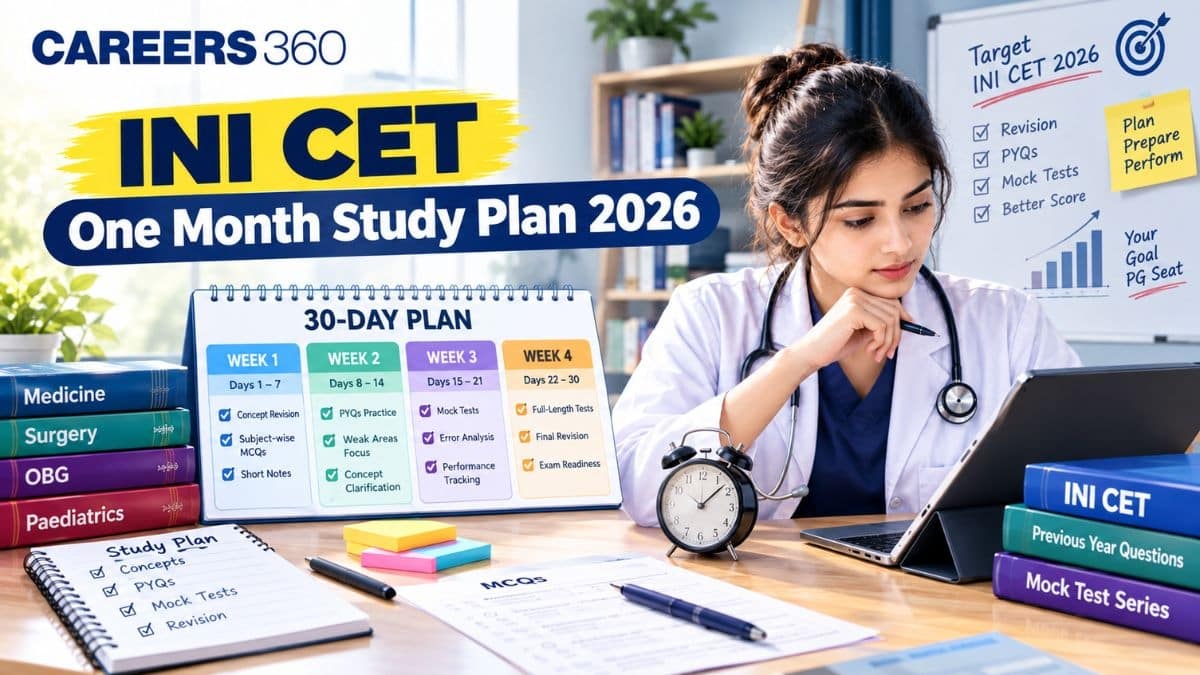
This plan is built around three parameters that are specific to INI CET. The first is four blocks of 50 questions with 45 minutes each, and you cannot go back once a block's timer ends. Second, roughly half the paper still comes from Medicine, Surgery and Obstetrics & Gynaecology, even though the exam covers all 19 MBBS subjects. The last parameter is negative marking; one-third per wrong answer punishes guesswork far more than it punishes leaving a question blank.
A one-month window is enough time to fix all three of these if you sequence it correctly. Start with the subjects that carry the most weight, move to full 200-question timed sets by week three, and spend the final week purely on recall and error correction rather than fresh reading. Then, a week-by-week breakdown built around that logic, along with the subject-wise numbers, the mock test, and the mistakes that actually cost rank in the last month, rather than the generic "manage your time well" advice you've probably already read three times over.
Before splitting the month into weeks, it helps to have the exam's actual shape in front of you, because every decision in this plan — how long you spend on Anatomy versus Medicine, how many mocks you take, when you stop reading and start only revising — comes from these numbers.
Get expert advice on college selection, admission chances, and career path in a personalized counselling session.
Detail | What applies to INI CET Nov 2026 |
Exam date | November 1, 2026 (Sunday), for the January 2027 session |
Result date | November 7, 2026 |
Total questions | 200, across all 19 MBBS subjects |
Format | 4 sections of 50 questions, 45 minutes per section, no return to a closed section |
Marking | +1 for a correct answer, −1/3 for a wrong one, MDS candidates get a shorter 90-question paper |
Qualifying bar | 50th percentile for General/EWS/OCI, 45th percentile for SC/ST/OBC/PwBD |
Registration for this cycle opens through the INI CET application form, and if you haven't completed that step yet, do it in the first two or three days of your plan rather than letting it eat into week two. A rejected photo or signature upload can cost you a correction window you don't have time to spare. Everything else below assumes registration is done and your last 30 days are free for actual preparation.
The 45-minutes-per-block structure changes how you should think about "time management" for this exam specifically. In a normal 3-hour single-block paper, a slow start in one subject can be recovered later. Here, if you're still on question 30 of a 50-question block when the 45 minutes run out, the remaining 20 are gone, unattempted, permanently. That single fact should shape how you practise from week one — not just what you study, but how you time yourself while studying it.
AIIMS doesn't publish an official subject-wise weightage for INI CET. So, anything you read, including the numbers below, comes from an analysis of the last several years' papers rather than an official source. Treat these as a prioritisation guide, not an exact prediction of this session's paper.
Subject group | Typical question range | What this means for your plan |
Medicine | 20–25 | Highest single-subject weight; revise as case-based, not fact-based |
Surgery (incl. Ortho, ENT, Ophtho) | 20–25 | Second-highest; classification-heavy, needs tables not paragraphs |
Pharmacology | 12–20 | Increasingly scenario-based — drug choice in a patient context, not bare recall |
Pathology | 10–20 | Image recognition (histopath slides) is now a real chunk of this |
Obstetrics & Gynaecology | 10–16 | High-risk pregnancy and gynae-oncology screening recur most |
Anatomy | 10–15 | Carries more weight here than in NEET PG; neuroanatomy is a repeat theme |
Biochemistry | 10–15 | Shifted toward molecular biology and genetics over pure biochemistry |
Microbiology | 8–12 | Vaccine schedules and lab identification over pure taxonomy |
Physiology, PSM | 8–10 each | PSM's biostatistics (sensitivity/specificity, screening tests) is near-guaranteed |
Short subjects (Psychiatry, Radiology, Anaesthesia, Dermatology, Forensic Medicine, Paediatrics) | 3–8 each | Individually small, but together roughly a quarter of the paper — don't skip them for a "big four" obsession |
Two clinical patterns worth knowing before you plan your reading list: the paper leans heavily on clinical vignettes rather than one-line recall questions, and image-based questions — X-rays, CT/MRI slices, ECGs, peripheral smears, histopathology slides, dermatology and ophthalmology photographs. Now make up a meaningful share of the total, enough that ignoring image practice in the name of "textbook reading" will cost you real marks.
Don't open a textbook on day one. Take one full-length, 200-question mock under real block-locked conditions first. This tells you two things a study plan can't guess for you: which subjects you're weak in right now, and whether you're actually finishing each 50-question block inside 45 minutes.
With that diagnostic done, spend the rest of week 1 on Medicine, Surgery and Pharmacology. Not because a plan says so, but because these three together typically account for 55–65 questions, and unlike the short subjects, they can't be revised properly in a single afternoon later.
Days 1–2: Diagnostic mock (day 1), then Medicine — Cardiology, Nephrology, Endocrinology, Neurology, high-yield sub-specialities that repeat across sessions.
Days 3–4: Surgery core — General Surgery principles, Orthopaedics (classification systems and management algorithms are the exam's favourite trap here), Surgical Oncology.
Days 5–6: Pharmacology as scenario practice, not as a drug list — go subject by drug class (antihypertensives, antiepileptics, antimicrobials) and force yourself to answer "which drug, in this patient" rather than "what does this drug do."
Day 7: 50-question sectional test in Medicine + Surgery combined, timed at 45 minutes for 50 questions, and a review of every wrong answer before you move on.
By the end of week 1, you should have a solid understanding of the three subjects that decide roughly a third of your score, plus a clear read on your own timing weaknesses from the diagnostic.
Week 2 shifts to Pathology, Obstetrics & Gynaecology, and Microbiology, while adding your first dedicated image-recognition sessions. Don't leave these until the final week, because visual pattern recognition needs repeated exposure over days, not a single session.
Days 8–9: Pathology, prioritising haematology (anaemia classification, leukaemia markers, Hodgkin vs non-Hodgkin) and systemic pathology (glomerular disease, hepatic patterns) over pure general pathology theory.
Days 10–11: Obstetrics & Gynaecology — high-risk pregnancy management, labour complications, gynae-oncology screening protocols.
Day 12: Microbiology, weighted toward vaccine schedules, lab-based identification, and the virology topics that show up as case scenarios rather than direct questions.
Day 13: First dedicated image-based practice block — histopathology slides, X-rays and one round of ECG interpretation, 30–40 minutes purely on visual recall, no text.
Day 14: Full 200-question mock under exam conditions, followed by an error log — not just "which were wrong," but why: concept gap, careless read, or ran out of time in that block.
This is the week where most one-month plans get wrong by either skipping preclinical subjects entirely or giving them equal time to Medicine. Anatomy carries genuinely more weight in INI CET than in NEET PG. So, it's not optional, but it also doesn't need the same volume of hours as surgery.
Days 15–16: Anatomy, with neuroanatomy as the priority topic, followed by embryology and cross-sectional imaging correlation (AIIMS papers have a track record of testing anatomy through radiological images rather than diagrams).
Day 17: Biochemistry, focused on molecular biology, enzyme deficiencies, and inherited metabolic disorders — the parts of biochemistry that have shifted from pure memorisation toward mechanism-based questions.
Day 18: Physiology, concentrated on cardiovascular, renal and endocrine physiology, since these overlap directly with Medicine and reinforce both subjects at once.
Day 19: PSM — biostatistics (sensitivity, specificity, screening test evaluation almost always shows up), immunisation schedules, epidemiological study designs.
Days 20–21: Full 200-question mock on day 20, then a half-day dedicated purely to reviewing previous year question papers with solutions on day 21 — not to learn new facts, but to notice which question formats (assertion-reason, multiple-correct, sequential arrangement) still slow you down.
From this point, aim for at least one full-length, block-locked mock every 3–4 days rather than saving them all for week 4. The correlation between mock performance in the final two to three weeks and actual exam-day rank is strong enough that this shouldn't be treated as optional practice — it's diagnostic data you act on immediately, not a confidence exercise.
The final preparation stretch has one rule that's easy to state and hard to follow under pressure: no new topics after day 25. Anything you haven't touched by then either gets a same-day formula-sheet pass or gets left out. Starting a fresh subject on day 27 disturbs the revision schedule for everything you've already built.
Days 22–23: The short subjects as a block — Ophthalmology, ENT, Orthopaedics, Radiology, Anaesthesia, Psychiatry, Dermatology, Forensic Medicine, Paediatrics. Individually 3–8 questions each, collectively close to a quarter of the paper, and often the easiest marks to pick up because competitors under-revise them, chasing the "big" subjects.
Days 24–25: Integrated, cross-subject revision — deliberately review a Pathology finding alongside its Pharmacological treatment and Surgical indication together, since AIIMS papers are known for exactly this kind of linked question rather than testing subjects in isolation.
Day 26: Full-length mock, treated as a dress rehearsal — same start time as the real exam, same break pattern, same environment if you can manage it.
Days 27–28: Pure error-log revision. Go through every mistake logged across all your mocks this month and re-attempt only those questions, not fresh material.
Day 29: Light revision only — formula sheets, high-yield tables, image flashcards. No mocks, no new reading.
Day 30 / exam eve: No studying past the early evening. Confirm admit card, ID, and exam centre logistics; sleep on schedule rather than pushing a last read-through that mainly costs you rest.
Almost every generic INI CET study plan talks about "time management" without mentioning the one structural feature that actually determines it: once a 45-minute, 50-question block closes, you cannot return to it, no matter how many questions you left unattempted. This is closer to how some banking and defence exams are timed than to a typical medical PG paper, and it means a subject-wise imbalance across the four blocks can hurt you even if your overall accuracy is fine.
Practically, this means your last two weeks of mocks should include at least a few sectional tests that mirror the actual 50-question, 45-minute block structure, not just full 200-question papers attempted in one continuous sitting. If you consistently find yourself with 8–10 unattempted questions in one particular block, that's telling you something about pacing in that subject mix specifically. Adjust which questions you skip first (skip immediately, don't linger).
Switching resources in week 3 or later. Jumping between question banks or notes because someone else's material looks more complete disrupts pattern recognition you've already built; pick one primary source in week 1 and stay with it.
Treating negative marking as a reason to guess less than you should. With −1/3 marking, a question where you can eliminate two of four options is still worth attempting. The real trap is guessing blind on questions where you can't eliminate anything.
Ignoring the qualifying percentile while chasing a "good score." The qualifying percentile itself — 50th for General/EWS, 45th for reserved categories This is a separate number from the rank you need for a specific institute or branch; don't let final-month anxiety blur the two.
Under-revising short subjects because they "don't matter." Collectively, they're close to a quarter of the paper, and because competitors neglect them, they're often the easiest place to gain rank relative to effort spent.
Comparing daily progress with classmates. Everyone's diagnostic weak areas are different in week 1. A plan built around someone else's gaps will misallocate your own limited 30 days.
Also Read:
Frequently Asked Questions (FAQs)
One month is realistic for revision and rank improvement, but it is not enough time to build MBBS concepts from scratch. This plan works if you've already been through the core subjects at least once during your NEET PG or internship-phase preparation and now need to convert that knowledge into exam-ready speed and accuracy.
Because pre-clinical subjects, particularly Anatomy, carry more weightage.
Aim for a minimum of one full-length, 200-question mock every three to four days from week two onwards, plus additional sectional (50-question, 45-minute) tests to practise the block-locked format.

On Question asked by student community
Hello there,
If your provisional registration expired in July 2026, you should get it renewed or obtain your permanent registration as soon as possible. An expired registration may create an issue during document verification or admission.
You can still check your INI-CET eligibility for the relevant session. Still, I strongly
You can download the INI CET previous year papers from the link given below:
Hello Student,
INI SS Round 2 seat allotment was released on July 9. I am sharing a link where you can find the seat allotment list and other details.
Article Link - INI SS July 2026 Counselling Round 2 Seat Allotment Result OUT: Direct Link.
Hello Aniket,
Please refer to the given link to access the INI-CET solved previous year question papers. In this article, we have provided all the previous years' question papers in one place for your convenience.
Hope this helps!
Hello Dear Student,
For the May 2026 session (conducted in July 2025, results released May 23, 2026), the Round 1 cutoff rank for the ST category is 31,313 .
January 2026 Session (Round 1 ST Cutoff): 27,569
May 2026 Session (Round 1 ST Cutoff): 31,313
You can get directly find,

NEET PG All India & State College Predictor with Admission Process Guide
End-to-End NEET PG Admission Guidance | One-to-One Counselling | College Predictors | Regular Updates | E-books