NEET PG College Predictor
NEET PG All India & State College Predictor with Admission Process Guide


INI CET Best Books 2027: Ask INI CET toppers which books they used, and you will get slightly different answers. But the overlap between those answers is bigger than the differences. There are a few well-known books that keep showing up across topper interviews, Telegram study groups, and coaching faculty recommendations. On the other hand, a much longer list of books that aspirants buy, barely open, and eventually abandon. The INI CET syllabus is the same size as your MBBS course, so the real skill in book selection isn't finding more books; it's picking the right one per subject and sticking with it through multiple revisions.
This Story also Contains
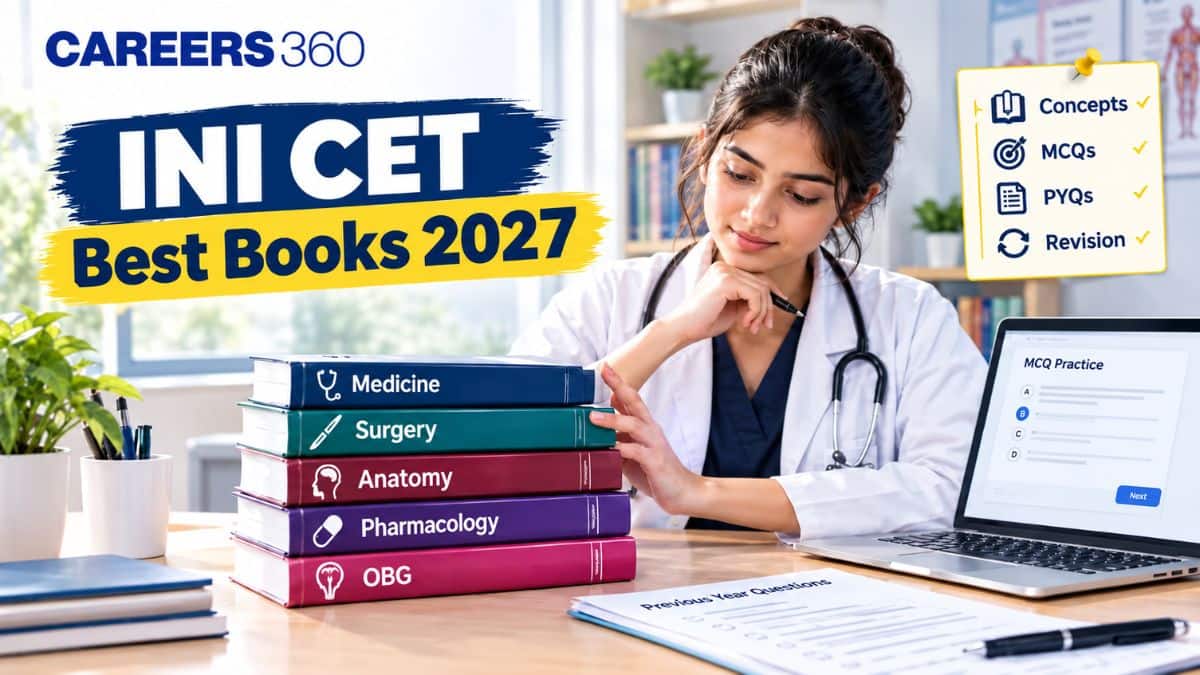
This article lists the INI CET books 2027 that aspirants are actually using right now, subject by subject, split the way the exam itself is split: pre-clinical, para-clinical, and clinical. For each subject, we've picked one theory or reference book and one MCQ or review book, based on what shows up consistently across current recommendations, rather than listing every book that exists. We've also covered the INI CET-specific PYQ books separately, since these are different from your regular NEET PG book list and matter more than people realise. Every book named below is a real, currently used title, and where two options genuinely compete for the same subject, we've explained which one to pick and why.
INI CET best books 2027 are not different from good NEET PG books, because the underlying MBBS syllabus, laid out in the INI CET Syllabus, is common to both exams. What is different is how you should use them. INI CET tends to test deeper, more applied questions, so your books need to support two things at once: strong conceptual reading and heavy MCQ practice on the same topic, back-to-back. Keep that in mind as you go through the subject-wise INI CET reference books below.
Get expert advice on college selection, admission chances, and career path in a personalized counselling session.
Pre-clinical subjects, Anatomy, Physiology, and Biochemistry, carry a smaller weightage in the INI CET question paper compared to clinical subjects, but skipping them is a mistake since they are quick to revise and often scoring if done right.
Subject | Reference/Theory Book | MCQ/Review Book |
Anatomy | BD Chaurasia's Human Anatomy (regional volumes, for applied and clinical anatomy) | Review of Anatomy by Rajesh Kaushal |
Physiology | Guyton and Hall Textbook of Medical Physiology (for concepts you're weak in) | Review of Physiology by Soumen Manna |
Biochemistry | Harper's Illustrated Biochemistry (for reference only, not full reading) | Review of Biochemistry by Rebecca James |
For pre-clinical subjects, most aspirants don't need to re-read the full reference textbook. Use it only to clear up a concept the review book explains too briefly, and spend most of your actual revision time inside the MCQ book.
INI CET questions come from medium-weightage para-clinical subjects and chapters, and picking the right combination of theory and MCQ books actually changes your score.
Subject | Reference/Theory Book | MCQ/Review Book |
Pathology | Robbins and Cotran Pathologic Basis of Disease (for high-yield chapters only) | Review of Pathology and Genetics by Gobind Rai Garg & Sparsh Gupta |
Microbiology | Ananthanarayan and Paniker's Textbook of Microbiology | Review of Microbiology and Immunology by Apurba Sastry & Sandhya Bhat |
Pharmacology | Essentials of Medical Pharmacology by KD Tripathi | Review of Pharmacology by Gobind Rai Garg & Sparsh Gupta |
Forensic Medicine & Toxicology | The Essentials of Forensic Medicine and Toxicology by Sumit Seth | Same book doubles as MCQ practice; a separate review book is usually not needed |
Community Medicine (PSM) | Park's Textbook of Preventive and Social Medicine (reference only) | Review of Preventive and Social Medicine by Vivek Jain |
A quick note on Pathology, since this is where aspirants get stuck choosing between books. Some prefer Devesh Mishra's Pathology Quick Review and MCQs for its image-heavy, high-yield format, while others stick with the Garg and Gupta Review of Pathology for its wider question bank. Either is fine. What matters is not switching between the two in the middle of your preparation.
Clinical subjects make up the biggest share of INI CET's 200 questions. So, this is where your book choice matters most.
Subject | Reference/Theory Book | MCQ/Review Book |
Medicine | Harrison's Principles of Internal Medicine (for reference, not cover-to-cover reading) | Self-Assessment and Review of Medicine by Mudit Khanna or Amit Ashish |
Surgery | Bailey & Love's Short Practice of Surgery (reference only) | Surgery Essence by Pritesh Singh |
Obstetrics & Gynaecology | DC Dutta's Textbook of Obstetrics and DC Dutta's Textbook of Gynecology by Hiralal Konar | Self-Assessment & Review Obstetrics and Gynecology by Sakshi Arora Hans |
Pediatrics | Ghai Essential Paediatrics by Vinod K Paul & Arvind Bagga | Self-Assessment and Review of Paediatrics by Arvind Arora |
Orthopedics | Essential Orthopaedics by Maheshwari & Mhaskar | Orthopaedics Quick Review by Apurv Mehra |
Anaesthesia | Anaesthesia Essence by Pritesh Singh & Usica Chandan (works as both theory and MCQ) | No separate MCQ book needed |
Radiodiagnosis | DAMS Review of Radiology by Sumer K Sethi | No separate MCQ book needed |
Ophthalmology | AK Khurana's Comprehensive Ophthalmology (covers theory and MCQs together) | No separate MCQ book needed |
ENT | Dhingra's Diseases of Ear, Nose and Throat | No separate MCQ book needed |
For subjects like Anaesthesia, Radiology, Ophthalmology, and ENT, a single combined book is usually enough, since these are shorter subjects and don't need a separate theory and MCQ split the way Medicine or Surgery do.
Psychiatry and Dermatology don't have one single dominant book the way Pharmacology or Pathology do. Most aspirants cover these through the "short subjects" combined review books published by Arvind Arora or similar authors, which bundle Psychiatry, Dermatology, and a few other minor subjects into one volume. Given how few questions these subjects typically carry individually, a combined short-subjects book is usually a better use of your limited revision time than buying a separate book for each.
This is the part of the book list that is genuinely different from a plain NEET PG list, and it's worth treating as a separate category rather than mixing it in with your subject-wise books.
Self-Assessment and Review of AIIMS and INI-CET by Arvind Arora — built specifically around past AIIMS and INI-CET question patterns, useful for understanding how the exam frames questions differently from other PG entrances.
Preparation Review of AIIMS (2015–2019) and INI-CET (2020–2022) by Dr. Pritesh Singh — compiles high-yield topics with colour images, which is particularly useful given how many image-based questions show up in INI-CET.
Several subject review books, including the Garg and Gupta Review of Pharmacology and Review of Pathology, now include a dedicated section of solved INI-CET papers from recent sessions. Check the latest edition of whichever subject book you're using, since this section is usually more current than a standalone old PYQ book.
Since AIIMS does not officially release INI CET question papers, these compiled and recall-based books are the closest thing to real past papers you'll find. So it's useful to spend time with them rather than skipping straight to random online question banks.
A common mistake is collecting three or four books for the same subject out of anxiety that one might not be "enough." In practice, one reference book and one MCQ book per subject are sufficient for almost everyone.
Pick one book per subject and revise it fully at least twice before you consider adding another.
Use the reference textbook only for concepts the review book explains too thinly, not for full reading.
If two books cover the same subject well, like Devesh Mishra and Garg-Gupta for Pathology, choose one and ignore the other rather than trying to read both.
Add a second book only for a subject where your mock test scores show a genuine, repeated weakness.
Also Read:

On Question asked by student community
Hello there,
If your provisional registration expired in July 2026, you should get it renewed or obtain your permanent registration as soon as possible. An expired registration may create an issue during document verification or admission.
You can still check your INI-CET eligibility for the relevant session. Still, I strongly
You can download the INI CET previous year papers from the link given below:
Hello Student,
INI SS Round 2 seat allotment was released on July 9. I am sharing a link where you can find the seat allotment list and other details.
Article Link - INI SS July 2026 Counselling Round 2 Seat Allotment Result OUT: Direct Link.
Hello Aniket,
Please refer to the given link to access the INI-CET solved previous year question papers. In this article, we have provided all the previous years' question papers in one place for your convenience.
Hope this helps!
Hello Dear Student,
For the May 2026 session (conducted in July 2025, results released May 23, 2026), the Round 1 cutoff rank for the ST category is 31,313 .
January 2026 Session (Round 1 ST Cutoff): 27,569
May 2026 Session (Round 1 ST Cutoff): 31,313
You can get directly find,

NEET PG All India & State College Predictor with Admission Process Guide
End-to-End NEET PG Admission Guidance | One-to-One Counselling | College Predictors | Regular Updates | E-books