
Search Colleges, Exams, Schools & more


Login
What are memory-based questions in NEET PG?
Memory-based questions for NEET PG are questions recollected by the aspirants after appearing for the exam based on their memory. These questions are then collected and compiled by various coaching institutions, medical educators, and other sources to form question banks.
This Story also Contains
- Why Are Memory-Based Questions Used for NEET PG?
- Are NEET PG Memory Based Questions Official?
- How Are NEET PG Memory Based Questions Prepared?
- What do memory-based questions typically look like?
- How Reliable are NEET PG Memory-Based Questions
- How to Use Memory-based Questions in NEET PG Preparation
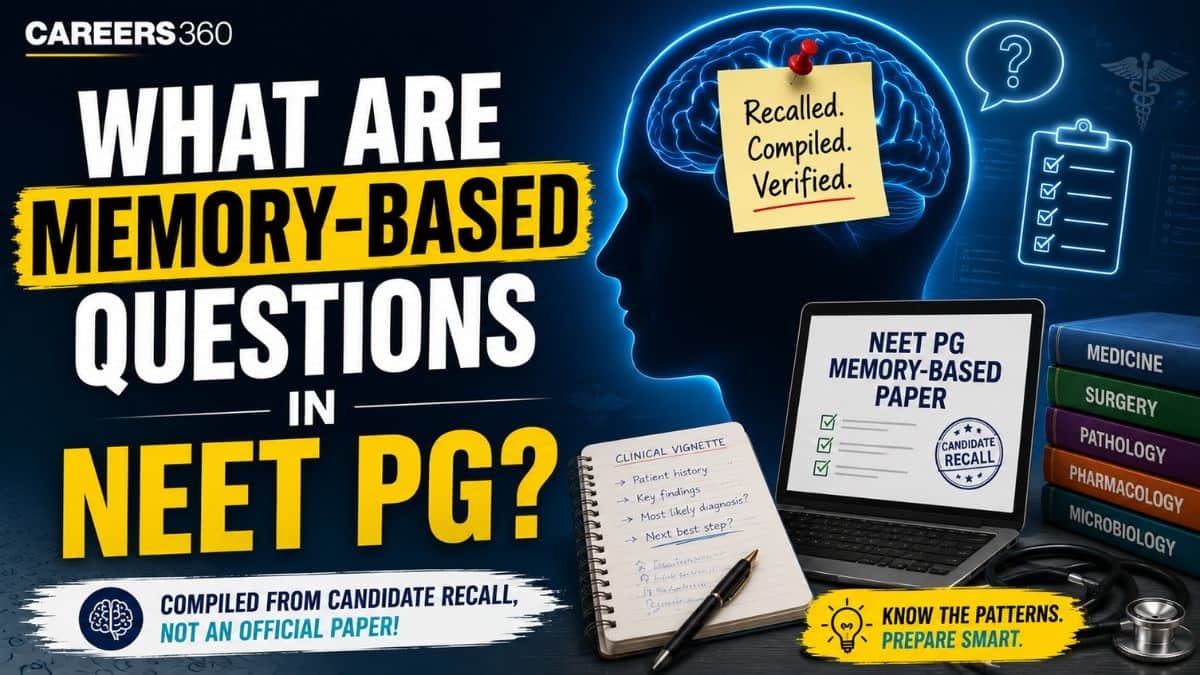
As the memory-based questions are not official question papers or an answer key of the exam, the wording, the options and the answers of these questions could differ among the various question banks. Nevertheless, they could be valuable for knowing about the topics tested and the level of difficulty of that particular NEET PG exam.
This article discusses the memory-based questions of NEET PG and their compilation, authenticity and effective use of these questions by aspirants.
Why Are Memory-Based Questions Used for NEET PG?
NEET PG memory-based questions act as a bridge for the lack of information that is there due to the exam process and the information available to candidates after the test. The NEET PG memory-based questions will assist candidates in analysing the topics covered and comparing their preparation with that of others.
These questions must be considered as recall-based questions, and not as the authentic question paper and answer key.
Are NEET PG Memory Based Questions Official?
No. Memory-based papers are not official question papers or answers released by the NEET PG authority, which is the National Board of Examinations in Medical Sciences (NBEMS). These are created using candidates' memories and may be missing some parts or have changed answers and options.
The NBEMS is the official exam conducting body, and all exam-related information is updated on their official website. Candidates must refer to NBEMS for official exam information.
How Are NEET PG Memory Based Questions Prepared?
It is normally carried out through four stages.
Candidate recalls
Candidates make records of questions, clinical scenarios, pictures, medications, investigations, or concepts that they recall from the exam.
Data collection
Data on various recalls is collected from candidates who sat for the examination.
Cross checking
Comparisons are made between similar recalls to identify consistent questions.
Compilation
Available data is compiled into a memory-based question paper, which may include the answers from the experts in the subject.
What do memory-based questions typically look like?
After a few years of these compilations, a fairly consistent pattern emerges. Many of the questions are clinical vignettes, which are: a short patient history, then a single specific ask such as identifying a nerve involved, naming the most likely diagnosis, or choosing the next best investigation. Pure recall-type questions, asking for a definition, a classification, or the full form of an abbreviation, also appear regularly, though usually in smaller numbers than case-based ones. A meaningful portion involves images as well, ranging from X-rays and ECGs to clinical photographs, which candidates try to describe from memory even though reproducing the exact image afterwards is rarely possible.
This mix closely resembles what NEET PG is thought to test: applied clinical reasoning based on a foundation of core medical knowledge, rather than isolated factual recall.
How Reliable are NEET PG Memory-Based Questions
This is the question most aspirants eventually ask, and the honest answer is that memory-based papers are useful but imperfect. The exact wording of a question, the precise set of answer options, and sometimes even the correct answer itself can shift slightly depending on who is recalling it and how soon after the exam they wrote it down. Two candidates sitting for the same shift might remember a question’s detail differently, which is why compiled answer keys for memory-based papers are generally treated as provisional rather than authoritative.
What memory-based papers are genuinely good at is revealing patterns, not precision. Across several years of compiled recalls, certain subjects consistently show up with a high weightage in questions, certain question formats repeat, and certain high-scoring topics keep appearing in questions.
How to Use Memory-based Questions in NEET PG Preparation
For a candidate actively preparing, the most effective way to use these papers is as a trend indicator rather than a verified answer bank. Reading through several years of memory-based questions side by side, rather than just the most recent one, tends to reveal which subjects and question types repeat most reliably. This works well alongside a candidate's own practice of official previous-year question papers; most mentors recommend working through at least the last five to ten years of papers. Careers360's own compiled sets, including the NEET PG memory-based question paper and the NEET PG mock test series, are built with exactly this cross-verification approach in mind, taken from multiple candidates' recollection inputs rather than a single source.
When a recalled question belongs to a concept that a candidate isn't completely confident in, going back to a standard textbook or review book to confirm the underlying fact is a better use of time than taking an unverified answer key literally. When used this way, memory-based papers become a diagnostic resource, indicating which parts of the syllabus require additional attention, rather than a shortcut that replaces genuine preparation.
Given that NEET PG's exam pattern itself has changed for the 2026 cycle. The paper will be a shorter, sectioned format. However, memory-based recalls from previous years are still useful for subject-level trends, even if the structure candidates encounter on exam day now differs from the previous year's memory-based question papers.
Frequently Asked Questions (FAQs)
Q: Does NBEMS officially release the NEET PG question paper after the exam?
A:
No. NBEMS does not publish an official question paper or answer key based on the original exam. Whatever candidates access afterward is compiled from recollections shared by test-takers, not an official release.
Q: Who prepares memory-based question papers for NEET PG?
A:
They are typically compiled by coaching platforms, faculty, and senior candidates who collect recalled questions from multiple test-takers across different shifts and cross-check them for consistency before publishing a combined set.
Q: Are memory-based questions accurate?
A:
They are reasonably accurate at the level of topic and pattern, but individual questions may have minor differences in wording, options, or even the marked answer, since they rely entirely on human recall rather than an official record.
Q: Should candidates rely only on memory-based papers for NEET PG preparation?
A:
No. They work best alongside standard textbooks, review books, and official previous year papers, rather than as a standalone or primary resource.
Q: Why do different memory-based papers for the same year contain different questions?
A:
Since each is compiled independently from a different group of candidates' recollections, the number and exact content of recalled questions naturally varies between sources.
Q: Are memory-based questions available for both NEET PG and NEET UG?
A:
Yes. The same practice of compiling recalled questions from candidates is common across most large-scale computer-based medical entrance exams, including NEET PG, NEET UG, and FMGE, wherever the official paper isn't released after the exam.
Upcoming Medicine Exams

Certifications By Top Providers
Explore Top Universities Across Globe
List of colleges accepting exam
Browse Medicine Colleges by State

Study Resources, Applications and Opportunities
Know possible Govt/Private MBBS/BDS Colleges based on your NEET rank
NEET 1-to-1 Counseling Guidance
ApplyCollege Predictors Webinars One to One Counselling Regular Updates Medical Almanac
NEET PG 2026 College Predictor
ExploreCheck your expected admission chances in MD/MS/Diploma courses based on your NEET PG Score
NEET PG 2026 Counseling Guidance
EnquireYour one-stop NEET PG counseling package with complete hand-holding throughout the admission journey
Emversity Allied Health Programs
ApplyGet Job Ready in Healthcare | Employability-Focused Programs
KCDSH- Krishnadevaraya Dental College & Sciences Admis 2026
ApplyRanked among the top Dental Colleges for 7 consecutive years by India Today poll
News and Notifications
Never miss update
Get timely updates directly to your inbox. Stay informed!