NEET PG College Predictor
NEET PG All India & State College Predictor with Admission Process Guide


NEET PG 2026 High-Weightage Subjects can assist candidates in allocating revision of subjects efficiently in case time is limited. The NEET PG 2026 test is going to take place on 30th August 2026 and is organised by the National Board of Examinations in Medical Sciences (NBEMS). The most recent exam pattern consists of 200 multiple-choice questions in total to be answered in 3.5 hours.
This Story also Contains
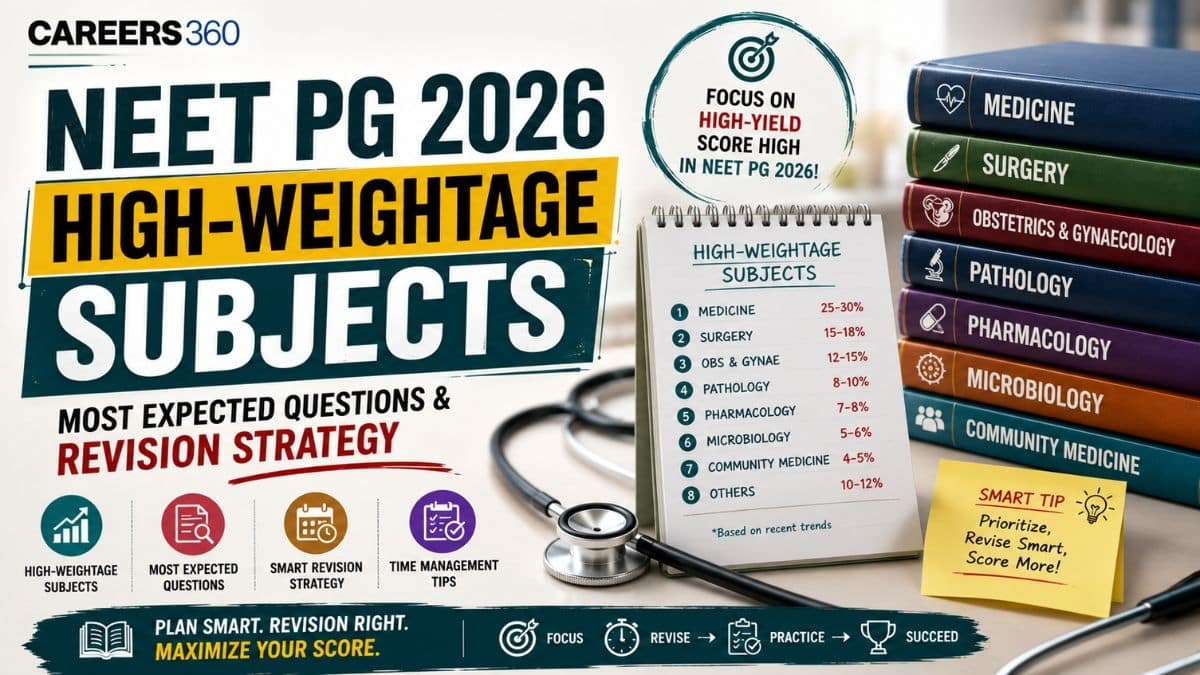
The NBEMS do not release any official distribution of the NEET PG questions on the basis of a subject-wise pattern. Hence, the high-weightage subjects of the NEET PG syllabus mentioned in this article are determined on the basis of past year trends and analysis, and not on the basis of any set allocation. The highest allocation is usually done to General Medicine and General Surgery, and other subjects include Obstetrics and Gynaecology, Pathology, and Social & Preventive Medicine.
For NEET PG 2026 preparation, candidates need to prioritise revision in accordance with this weightage and cannot neglect the low-weightage subjects while preparing for NEET PG 2026.
So which subjects are we actually talking about? Going through the past papers, we realised that the list looks roughly like this: General Medicine carries the highest weightage, most questions are framed from any subject in the paper. Then surgery carries the second highest weightage, and that includes the questions that come from Orthopaedics, Anaesthesia, and Radiology. Then, Obstetrics & Gynaecology also carries high weight year after year, and Pathology usually isn't far behind either, partly because this keeps appearing inside clinical questions too, not just as a subject on its own.
Then there's PSM, which honestly gets underrated a lot more than it should. Pharmacology questions are based on mechanisms and concepts rather than pure memorisation. Microbiology carries a medium to high weightage, including bacteriology and virology.
The chapters like Anatomy, Physiology, and Biochemistry are the medium-weightage subjects. While Paediatrics, Forensic Medicine, ENT, Ophthalmology are low-weightage subjects. But these low-weightage subjects haven't disappeared from any recent paper either, so avoiding them completely would be a mistake.
Get expert advice on college selection, admission chances, and career path in a personalized counselling session.
NEET PG has never treated every subject the same way, and it probably never will. Medicine and Surgery bring in far more questions than something like ENT or ophthalmology. That gap has held steady for years now, even after the NEET PG exam pattern shifted to 180 questions in 2026. NBEMS itself has never released an official subject-wise weightage,
So what candidates actually rely on comes from somewhere else: years of previous papers and memory-based question sets distributed following each exam. When those are placed side by side across cycles, the pattern barely changes.
Why does this matter right now? Because time is the one thing nobody has enough of in the final stretch of preparation. Spending three hours revising ENT while Medicine revision remains untouched for a week is not the right study plan.
It doesn't mean that the smaller subjects are worthless - it just means an hour spent on Medicine or Surgery may pay back more than the same hour spent somewhere smaller.
Now for the topics most students actually think about: what does this look like in question form? Below are the topics that keep coming back across past papers. Below are the topics with a sample question created the way NBEMS designs the NEET PG paper.
General Medicine: Cardiac arrhythmias, ACS, diabetes complications, thyroid disorders, TB treatment, HIV, acid-base disorders.
Here's the kind of question you may expect:
Question: A 55-year-old man has sudden chest pain, sweating, and breathlessness. ECG shows ST elevation in leads II, III, and aVF. Which artery is blocked?
A) Left anterior descending
B) Right coronary artery
C) Left circumflex
D) Left main coronary artery
Answer: B. Inferior wall changes on ECG point to the right coronary artery.*
General Surgery: Acute abdomen, breast cancer staging, fracture management, burns, hernia, shock.
Question: A young man meets with a road accident. His skin is cold and clammy. His BP is 80/50 mmHg. There is no visible bleeding. What type of shock is this?
A) Septic shock
B) Cardiogenic shock
C) Hypovolemic shock
D) Neurogenic shock
Answer: C. This is hypovolemic shock, most likely from internal bleeding after trauma.*
Obstetrics & Gynaecology: Antenatal care, postpartum haemorrhage, pre-eclampsia, normal labour, ectopic pregnancy.
Question: A typical question here would go something like this:* A woman is 34 weeks pregnant. Her BP is 160/110 mmHg. Urine shows 3+ protein. What should be done next?
A) Deliver immediately
B) Start antihypertensives and monitor
C) Reassure and send home
D) Start iron tablets
Answer: B. Start antihypertensives first and watch closely for signs of eclampsia.*
Pathology: Neoplasia, tumour markers, inflammation, leukaemia and lymphoma.
Question: Which tumour marker points to liver cancer?
A) CA-125
B) CEA
C) Alpha-fetoprotein
D) PSA
Answer: C. Alpha-fetoprotein.*
PSM: National health programmes, immunisation schedules, biostatistics, screening tests.
Question: A test correctly finds 90 out of 100 people who actually have a disease. What does this show?
A) Specificity
B) Sensitivity
C) Positive predictive value
D) Negative predictive value
Answer: B. Sensitivity.
Pharmacology: Antimicrobials, anti-TB drugs, cardiovascular drugs, drug interactions.
Question: Which anti-TB drug can cause optic neuritis?
A) Isoniazid
B) Rifampicin
C) Ethambutol
D) Pyrazinamide
Answer: C. Ethambutol.
Microbiology: Bacterial classification, hepatitis markers, STIs, vaccines.
Question: A patient's blood shows HBsAg and anti-HBc IgM together. What does this mean?
A) Past infection with immunity
B) Chronic carrier state
C) Acute hepatitis B infection
D) Successful vaccination
Answer: C. This points to acute hepatitis B infection.*
These are not real exam questions. They are written to show the pattern NEET PG usually follows. For actual past papers and memory-based question sets, use the NEET PG previous year question papers and NEET PG mock test series instead.
The candidates must prioritise high-weightage subjects based on their weightage from past trends, individual accuracy level and revision level, rather than considering only the high-weightage subjects.
Medicine and Surgery must be prioritised due to their traditional higher weightage.
Obstetrics & Gynaecology, Pathology and PSM must get separate revision time.
Pharmacology and Microbiology can be practised via concept-based MCQs and PYQs.
Small subjects must not be ignored from the revision and should be revised along with other subjects.
Mock-test results and errors made can determine the need for further revision of a particular topic.
Clinical Concepts must be considered more often rather than re-reading complete books.
If you are still confused about where to start, Medicine and Surgery should get your biggest time block. Between the two of them, they account for a significant portion of your final score, so hit the high-scoring topics there before anything else.
Obstetrics and Gynaecology and Pathology come next on the list. Both are high weightage subjects on their own. They often overlap with Medicine and Surgery questions, so revising them together makes sense.
For Pharmacology, Microbiology, and PSM, shorter and focused sessions work better. These subjects reward understanding over memorising — a concept you actually get will hold up under pressure far better than a fact you memorised the night before.
And please don't ignore the smaller subjects completely. Twenty to thirty minutes a day on Anatomy, Physiology, Biochemistry, Paediatrics, Forensic Medicine, ENT, and Ophthalmology is really all it takes to keep them from slipping away.
One more thing worth saying plainly: practice matters more than reading at this stage. Solving questions shows you how a topic actually gets tested, not just what it says in a textbook, and it builds the speed you'll need this year in particular, since each section locks the moment 42 minutes are up.
At this point, do not start anything new. Go back over what you already know instead. A topic that you have revised three times will carry you further on exam day than five new ones skimmed once and forgotten by morning.
The last days should be about revising what you already know, rectifying errors, and preparing for exams, and not learning new things.
Revisit high-yield notes rather than whole books.
Attempt PYQs/PYTs from high-scoring subjects.
Keep an error book for those topics which are incorrectly answered repeatedly.
Utilise mock tests to find your subject-wise accuracy and weaknesses.
Revise volatile facts from Pharmacology, Microbiology, PSM, and other small subjects regularly.
Do not leave out low-scoring subjects altogether; take small revision sessions for them.
Do not start too many new books or other learning materials during the last days.
Make sure to sleep well and have a consistent revision schedule before exams.
Frequently Asked Questions (FAQs)
General Medicine and General Surgery carry the most weight. Obstetrics & Gynaecology, Pathology, PSM, Pharmacology, and Microbiology follow next.
No. NBEMS does not publish this. Candidates use trends from past papers and memory-based question sets instead.
No. Subjects like Forensic Medicine, ENT, and Ophthalmology still need short, focused sessions. Do not drop them fully.
Stick to short notes, past questions, and timed mock tests. Do not start new topics this close to the exam.
Yes. NEET PG 2026 now has 180 questions in five sections of 36 questions each. Each section has a fixed 42-minute limit.

On Question asked by student community
Hello, the NEET PG stipend at Parul University depends on the postgraduate course, academic year and applicable university policies.
Hello Student,
If you are looking for information about NEET PG 2025 DNB seat allotment and the fees payable at the allotted college or hospital, DNB seats are allotted through the respective counselling process based on your rank, category, choice of speciality, and seat availability.
For the 2025 session, the
Dear Student, with a NEET PG 2026 rank of 6,600 in the EWS category, your options should be assessed using the relevant counselling year's college-wise closing ranks, category-wise seats and counselling round. Please also confirm whether you are applying through the applicable All India counselling route or another quota. That
Hello, with a NEET PG rank of 11,000, your chances of getting MS ENT at Government Medical College, Thiruvananthapuram depend on your category, state quota, counselling round and previous year’s closing rank. You can check the cutoff details here: https://medicine.careers360.com/articles/kerala-neet-pg-cut-off
Dear Student, with a NEET PG rank of 8,571, you can explore DNB Pediatrics options through the relevant counselling process. If Bangalore is your preferred location, it would be useful to compare the available hospitals on factors such as patient load, paediatric case exposure, teaching environment, stipend, bond conditions and

NEET PG All India & State College Predictor with Admission Process Guide
End-to-End NEET PG Admission Guidance | One-to-One Counselling | College Predictors | Regular Updates | E-books