SRM Kattankulathur Dental College and Hospital, Kattankulathur
Ranked #19 by NIRF, NAAC A++ Accredited | Recognized by dental council of India


Physical Chemistry is where most NEET aspirants lose marks just because they forget important formulas under pressure. In the NEET 2026, questions heavily depend directly on the application of formulae, especially from chapters like Thermodynamics, Equilibrium, Electrochemistry, and Solutions.
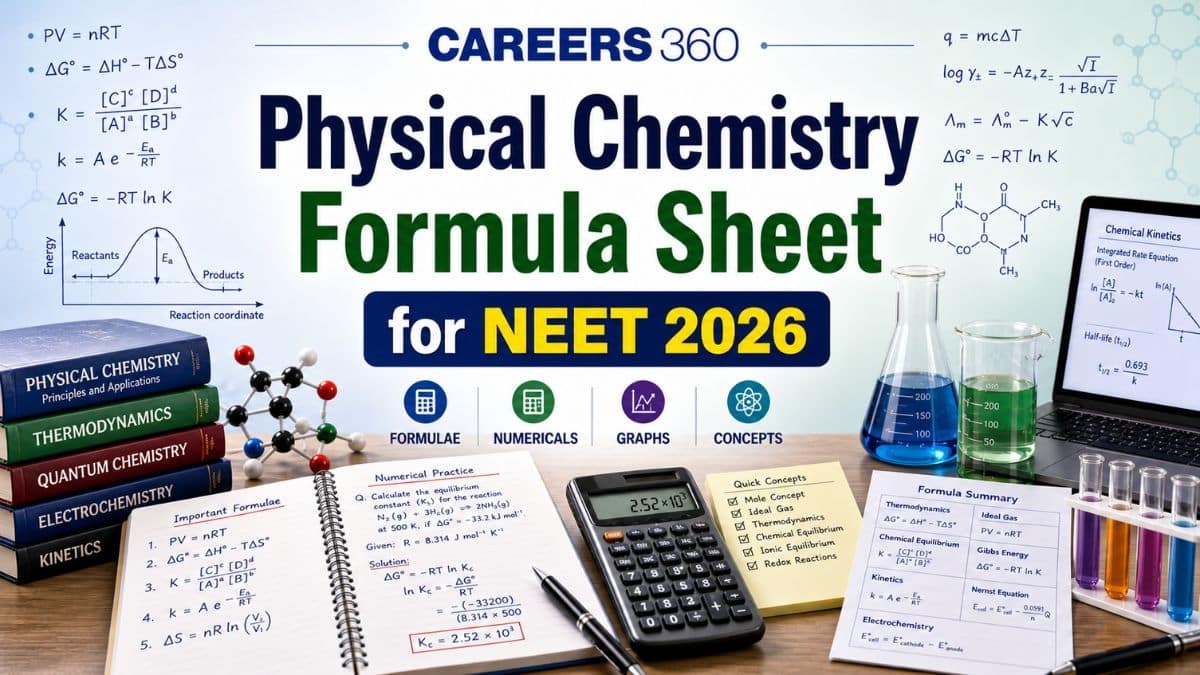
Instead of revising the entire chapters now, refer to this clear and concise NEET 2026 formula sheet. This sheet will not only help you revise faster, but also boost your confidence. Pair this NEET formula sheet with quick practice resources to get the most out of it.
Scoring well in Physical Chemistry starts with having the right resources ready. This physical chemistry formula sheet covers every chapter from the latest NEET 2026 syllabus organized for last-minute revision.
Mole Concept:
Number of moles: $n = W / M$
Number of particles: $N = n \times N_A$
Molar volume at STP: $V = n \times 22.4 \text{ L}$
Mole fraction: $\chi_A = n_A / (n_A + n_B)$
Mole fraction (sum): $\chi_A + \chi_B = 1$
Concentration Terms:
Molarity: $M = \text{moles of solute} / \text{L of solution}$
Molality: $m = \text{moles of solute} / \text{kg of solvent}$
Normality: $N = \text{equivalents of solute} / \text{L of solution}$
Relation between M and N: $N = M \times n\text{-factor}$
% by mass: $% w/w = (W_{solute} / W_{solution}) \times 100$
% by volume: $% v/v = (V_{solute} / V_{solution}) \times 100$
ppm: $\text{ppm} = (W_{solute} / W_{solution}) \times 10^6$
Stoichiometry
Empirical formula factor: $n = \text{molecular formula mass} / \text{empirical formula mass}$
Limiting reagent yield: $\text{theoretical yield} = \text{moles of LR} \times \text{stoichiometric ratio} \times M$
% yield: $% \text{ yield} = (\text{actual yield} / \text{theoretical yield}) \times 100$
% purity: $% \text{ purity} = (\text{pure mass} / \text{total mass}) \times 100$
Ranked #19 by NIRF, NAAC A++ Accredited | Recognized by dental council of India
Special Scholarship for Students from Goa (Get an exclusive scholarship of ₹20,000 if you're a Goa-based student) | Bringing Parul Education Trust's 30-year Education Legacy to Goa
Equivalent Concept:
Equivalents: $\text{eq} = W / E$
Equivalent weight (acid): $E = M / \text{basicity}$
Equivalent weight (base): $E = M / \text{acidity}$
Equivalent weight (oxidant/reductant): $E = M / n\text{-factor}$
Normality equation: $N_1 V_1 = N_2 V_2$
Molarity equation: $M_1 V_1 = M_2 V_2$
Electromagnetic Radiation:
Wave relation: $c = \nu \lambda$
Energy of photon: $E = h\nu = hc/\lambda$
Wave number: $\bar{\nu} = 1/\lambda$
Bohr's Model:
Radius of nth orbit: $r_n = 0.529 \times n^2 / Z \text{ Å}$
Velocity of electron in nth orbit: $v_n = 2.18 \times 10^6 \times Z/n \text{ m/s}$
Energy of nth orbit: $E_n = -13.6 \times Z^2/n^2 \text{ eV}$
Energy of nth orbit (J): $E_n = -2.18 \times 10^{-18} \times Z^2/n^2 \text{ J}$
Energy of emitted photon: $\Delta E = E_{n_2} - E_{n_1} = h\nu$
Frequency of emitted radiation: $\nu = (E_{n_2} - E_{n_1}) / h$
Rydberg Equation
Rydberg formula: $1/\lambda = R_H (1/n_1^2 - 1/n_2^2)$
Rydberg constant: $R_H = 1.097 \times 10^7 \text{ m}^{-1}$
For hydrogen series: $\bar{\nu} = R_H \times Z^2 (1/n_1^2 - 1/n_2^2)$
Quantum Mechanics
de Broglie wavelength: $\lambda = h/mv = h/p$
de Broglie (for electron accelerated through V volts): $\lambda = h/\sqrt{2meV}$
Heisenberg uncertainty principle: $\Delta x \cdot \Delta p \geq h/4\pi$
Heisenberg (energy–time form): $\Delta E \cdot \Delta t \geq h/4\pi$
Quantum Numbers
Max electrons in shell n: $2n^2$
Max electrons in subshell: $2(2l+1)$
Number of orbitals in subshell: $(2l+1)$
Number of subshells in nth shell: $n$
Number of orbitals in nth shell: $n^2$
(No mathematical formulas; concept-based chapter. Key trends below.)
Atomic radius trend (period): $\text{decreases} \rightarrow$
Atomic radius trend (group): $\text{increases} \downarrow$
Ionisation enthalpy trend (period): $\text{increases} \rightarrow$
Electronegativity trend (period): $\text{increases} \rightarrow$
Effective nuclear charge: $Z_{eff} = Z - \sigma$ (Slater's rules)
Formal Charge
Formal charge: $FC = V - N - B/2$
where V = valence electrons, N = non-bonding electrons, B = bonding electrons
Bond Parameters
Bond order: $BO = (\text{bonding electrons} - \text{antibonding electrons}) / 2$
Relation: higher bond order → shorter bond length → higher bond energy
Dipole Moment
Dipole moment: $\mu = q \times d$
Unit: $1 \text{ D} = 3.336 \times 10^{-30} \text{ C·m}$
Gas Laws
Boyle's law: $P_1 V_1 = P_2 V_2$
Charles's law: $V_1/T_1 = V_2/T_2$
Gay-Lussac's law: $P_1/T_1 = P_2/T_2$
Avogadro's law: $V_1/n_1 = V_2/n_2$
Combined gas law: $P_1 V_1/T_1 = P_2 V_2/T_2$
Ideal gas equation: $PV = nRT$
Density form: $PM = dRT$
Dalton's law: $P_{total} = P_1 + P_2 + P_3 \ldots$
Partial pressure: $P_i = \chi_i \times P_{total}$
Kinetic Theory of Gases
RMS speed: $u_{rms} = \sqrt{3RT/M}$
Average speed: $u_{avg} = \sqrt{8RT/\pi M}$
Most probable speed: $u_{mp} = \sqrt{2RT/M}$
Speed ratio: $u_{mp} : u_{avg} : u_{rms} = 1 : 1.128 : 1.224$
Average KE per mole: $KE = (3/2)RT$
Average KE per molecule: $KE = (3/2)k_BT$
Graham's law: $r_1/r_2 = \sqrt{M_2/M_1} = \sqrt{d_2/d_1}$
Real Gases
van der Waals equation: $(P + an^2/V^2)(V - nb) = nRT$
Compressibility factor: $Z = PV/nRT$
For ideal gas: $Z = 1$
Boyle temperature: $T_B = a/Rb$
Critical temperature: $T_c = 8a/27Rb$
Critical pressure: $P_c = a/27b^2$
Critical volume: $V_c = 3b$
Basic Relations
First law: $\Delta U = q + w$
Work at constant pressure: $w = -P_{ext} \Delta V$
Work in reversible isothermal: $w = -2.303 nRT \log(V_2/V_1)$
Enthalpy: $H = U + PV$
At constant pressure: $\Delta H = q_p$
At constant volume: $\Delta U = q_v$
Relation: $\Delta H = \Delta U + \Delta n_g RT$
Thermochemistry
Hess's law: $\Delta H_{rxn} = \Sigma \Delta H_f(\text{products}) - \Sigma \Delta H_f(\text{reactants})$
From bond enthalpies: $\Delta H = \Sigma \text{ BE(reactants)} - \Sigma \text{ BE(products)}$
Kirchhoff's equation: $\Delta H_{T_2} = \Delta H_{T_1} + \Delta C_p (T_2 - T_1)$
Entropy & Gibbs Energy
Entropy change: $\Delta S = q_{rev}/T$
Second law: $\Delta S_{universe} = \Delta S_{sys} + \Delta S_{surr} > 0$
Gibbs free energy: $\Delta G = \Delta H - T\Delta S$
Standard Gibbs energy: $\Delta G° = \Delta H° - T\Delta S°$
Spontaneity: $\Delta G < 0 \rightarrow \text{spontaneous}$
At equilibrium: $\Delta G = 0$
Relation with K: $\Delta G° = -RT \ln K$
Relation with K (log form): $\Delta G° = -2.303 RT \log K$
Heat Capacity
Heat at constant pressure: $q_p = nC_p \Delta T$
Heat at constant volume: $q_v = nC_v \Delta T$
For ideal gas: $C_p - C_v = R$
Ratio: $\gamma = C_p/C_v$
Chemical Equilibrium
Equilibrium constant: $K_c = [C]^c[D]^d / [A]^a[B]^b$
Kp from Kc: $K_p = K_c(RT)^{\Delta n_g}$
Reaction quotient: $Q_c = [C]^c[D]^d / [A]^a[B]^b$ (at any point)
If $Q < K_c \rightarrow \text{forward reaction}$
If $Q > K_c \rightarrow \text{backward reaction}$
If $Q = K_c \rightarrow \text{at equilibrium}$
van't Hoff equation: $\log(K_2/K_1) = \Delta H°/2.303R \times (1/T_1 - 1/T_2)$
Relation with Gibbs: $\Delta G° = -RT \ln K_c$
Degree of Dissociation
General: $\alpha = \text{moles dissociated} / \text{initial moles}$
For $AB \rightleftharpoons A + B$: $K_c = C\alpha^2 / (1-\alpha)$
When $\alpha \ll 1$: $K_c \approx C\alpha^2$, so $\alpha = \sqrt{K_c/C}$
Ionic Equilibrium
pH: $pH = -\log[H^+]$
pOH: $pOH = -\log[OH^-]$
Relation: $pH + pOH = 14 \text{ (at 25°C)}$
Kw: $K_w = [H^+][OH^-] = 10^{-14} \text{ at 25°C}$
pKw: $pK_w = pH + pOH = 14$
Ka: $K_a = [H^+][A^-]/[HA]$
Kb: $K_b = [BH^+][OH^-]/[B]$
Relation: $K_a \times K_b = K_w$
pKa + pKb: $pK_a + pK_b = pK_w = 14$
pH of weak acid: $[H^+] = \sqrt{K_a \times C}$
pH of weak base: $[OH^-] = \sqrt{K_b \times C}$
Degree of dissociation (weak acid): $\alpha = \sqrt{K_a/C}$
Henderson-Hasselbalch (acid buffer): $pH = pK_a + \log([A^-]/[HA])$
Henderson-Hasselbalch (base buffer): $pOH = pK_b + \log([BH^+]/[B])$
Solubility product: $K_{sp} = [M^{n+}]^a[X^{m-}]^b$
For $AB \rightleftharpoons A^+ + B^-$: $K_{sp} = s^2$
For $AB_2 \rightleftharpoons A^{2+} + 2B^-$: $K_{sp} = 4s^3$
For $A_2B_3 \rightleftharpoons 2A^{3+} + 3B^{2-}$: $K_{sp} = 108s^5$
Ionic product vs Ksp: $\text{if } Q > K_{sp} \rightarrow \text{precipitation occurs}$
Oxidation number rule (neutral compound): $\Sigma \text{ oxidation numbers} = 0$
Oxidation number rule (ion): $\Sigma \text{ oxidation numbers} = \text{charge on ion}$
n-factor (acid/base): $n = \text{basicity or acidity}$
n-factor (redox): $n = \text{change in oxidation number per formula unit}$
Equivalents: $\text{meq} = M \times n\text{-factor} \times V(\text{L}) \times 1000$
Equivalents balance: $\text{meq of oxidant} = \text{meq of reductant}$
Concentration
Molarity: $M = n_{solute} / V_{solution}(\text{L})$
Molality: $m = n_{solute} / W_{solvent}(\text{kg})$
Mole fraction: $\chi_A = n_A / (n_A + n_B)$
Mass fraction: $w_A = W_A / (W_A + W_B)$
Relation M and m: $m = (M \times 1000) / (1000d - M \times M_2)$
Raoult's Law & VP
Raoult's law: $P_A = \chi_A \times P°_A$
Total pressure (ideal): $P_{total} = \chi_A P°_A + \chi_B P°_B$
Relative lowering of VP: $(P°_A - P_A)/P°_A = \chi_B$
Relative lowering of VP: $(P°_A - P_A)/P°_A = n_B/(n_A + n_B)$
Colligative Properties
Elevation of boiling point: $\Delta T_b = K_b \times m$
Depression of freezing point: $\Delta T_f = K_f \times m$
Molar mass from $\Delta T_b$: $M_2 = (K_b \times W_2 \times 1000) / (\Delta T_b \times W_1)$
Molar mass from $\Delta T_f$: $M_2 = (K_f \times W_2 \times 1000) / (\Delta T_f \times W_1)$
Osmotic pressure: $\pi = MRT$
Osmotic pressure (Van't Hoff): $\pi V = n_B RT$
Molar mass from osmosis: $M_2 = W_2 RT / \pi V$
Van't Hoff factor: $i = \text{observed colligative property} / \text{calculated colligative property}$
i for dissociation: $i = 1 + (n-1)\alpha$
i for association: $i = 1 - (1 - 1/n)\alpha$
Modified $\Delta T_b$: $\Delta T_b = i \times K_b \times m$
Modified $\Delta T_f$: $\Delta T_f = i \times K_f \times m$
Modified $\pi$: $\pi = i \times MRT$
Degree of dissociation from i: $\alpha = (i-1)/(n-1)$
Henry's Law
Henry's law: $p = K_H \times \chi$
Higher $K_H$ → lower solubility of gas
Electrolytic Conduction
Resistance: $R = \rho \times l/A$
Conductance: $G = 1/R$
Conductivity: $\kappa = 1/\rho = G \times l/A$
Cell constant: $G^* = l/A$
Molar conductivity: $\Lambda_m = \kappa \times 1000/M$
Molar conductivity (SI): $\Lambda_m = \kappa/C$
Kohlrausch's law: $\Lambda°m = \Sigma \lambda°{ions}$
Degree of dissociation: $\alpha = \Lambda_m/\Lambda°_m$
Ka from conductance: $K_a = C\alpha^2/(1-\alpha)$
Electrochemical Cells
Cell EMF: $E°{cell} = E°{cathode} - E°_{anode}$
Gibbs and EMF: $\Delta G° = -nFE°_{cell}$
K and EMF: $\Delta G° = -RT \ln K = -nFE°$
K from EMF: $\log K = nE°/0.0591 \text{ (at 25°C)}$
Nernst Equation
Nernst equation: $E_{cell} = E°_{cell} - (RT/nF) \ln Q$
Nernst at 25°C: $E_{cell} = E°_{cell} - (0.0591/n) \log Q$
At equilibrium: $E_{cell} = 0$ and $Q = K$
Faraday's Laws
First law: $W = ZIt$
Electrochemical equivalent: $Z = M/(n \times F)$
Charge: $Q = It$
Moles deposited: $\text{moles} = It/(n \times F)$
Second law: $W_1/W_2 = E_1/E_2$
Rate of Reaction
Rate (general): $r = -\frac{1}{a} d[A]/dt = -\frac{1}{b} d[B]/dt = \frac{1}{c} d[C]/dt$
Rate law: $\text{rate} = k[A]^m[B]^n$
Overall order: $= m + n$
Units of k (nth order): $k = (\text{mol/L})^{1-n} \text{ s}^{-1}$
Integrated Rate Laws
Zero order: $[A]_t = [A]_0 - kt$
Zero order half-life: $t_{1/2} = [A]_0/2k$
Zero order units of k: $\text{mol L}^{-1} \text{s}^{-1}$
First order: $\ln[A]_t = \ln[A]_0 - kt$
First order (log form): $\log[A]_t = \log[A]_0 - kt/2.303$
First order k: $k = (2.303/t)\log([A]_0/[A]_t)$
First order half-life: $t_{1/2} = 0.693/k$
First order units of k: $\text{s}^{-1}$
Second order: $1/[A]_t = 1/[A]_0 + kt$
Second order half-life: $t_{1/2} = 1/(k[A]_0)$
Second order units of k: $\text{L mol}^{-1} \text{s}^{-1}$
Temperature Dependence
Arrhenius equation: $k = Ae^{-E_a/RT}$
Arrhenius (log form): $\log k = \log A - E_a/(2.303RT)$
Two-temperature form: $\log(k_2/k_1) = E_a/2.303R \times (1/T_1 - 1/T_2)$
Thumb rule: rate doubles for every 10°C rise
Temperature coefficient: $\mu = k_{T+10}/k_T \approx 2$
Activation energy from graph: $E_a = -2.303R \times \text{slope of } \log k \text{ vs } 1/T$
Adsorption
Freundlich adsorption isotherm: $x/m = kP^{1/n}$
Freundlich (log form): $\log(x/m) = \log k + (1/n)\log P$
At low P: $x/m \propto P$ (n = 1)
At high P: $x/m = \text{constant}$ (independent of P)
Langmuir Adsorption
Langmuir isotherm: $x/m = aP/(1 + bP)$
At low P: $x/m \propto P$
At high P: $x/m = a/b$ (monolayer saturation)
Unit Cell
Density of unit cell: $d = (Z \times M)/(N_A \times a^3)$
Edge length from density: $a = (Z \times M/(N_A \times d))^{1/3}$
Packing Efficiency
Simple cubic (SC): $\text{PE} = 52.4%$, $Z = 1$, $r = a/2$
Body-centred cubic (BCC): $\text{PE} = 68%$, $Z = 2$, $r = a\sqrt{3}/4$
Face-centred cubic (FCC/CCP): $\text{PE} = 74%$, $Z = 4$, $r = a\sqrt{2}/4$
Hexagonal close packing (HCP): $\text{PE} = 74%$, $Z = 6$
Radius Ratio Rules
Linear (2-coord): $r^+/r^- < 0.155$
Triangular (3-coord): $r^+/r^- = 0.155 – 0.225$
Tetrahedral (4-coord): $r^+/r^- = 0.225 – 0.414$
Octahedral (6-coord): $r^+/r^- = 0.414 – 0.732$
Cubic (8-coord): $r^+/r^- = 0.732 – 1.000$
Defects
Schottky defect: cation and anion vacancies equal → density decreases
Frenkel defect: ion displaced to interstitial site → density unchanged
Electrical conductivity from defects: $\sigma \propto e^{-E_g/2k_BT}$
Radioactive Decay
Decay law: $N = N_0 e^{-\lambda t}$
Decay law (log form): $\ln(N_0/N) = \lambda t$
Activity: $A = \lambda N$
Decay constant and half-life: $\lambda = 0.693/t_{1/2}$
Half-life: $t_{1/2} = 0.693/\lambda$
Number of half-lives: $n = t/t_{1/2}$
Amount remaining: $N = N_0 \times (1/2)^n$
Average life: $\tau = 1/\lambda = t_{1/2}/0.693$
Activity units: $1 \text{ Curie} = 3.7 \times 10^{10} \text{ disintegrations/s}$
Nuclear Reactions
Mass defect: $\Delta m = [Zm_p + (A-Z)m_n] - m_{nucleus}$
Binding energy: $BE = \Delta m \times c^2$
Binding energy (MeV): $BE = \Delta m \times 931.5 \text{ MeV}$
Binding energy per nucleon: $BE/A$
Get expert advice on college selection, admission chances, and career path in a personalized counselling session.
Just reading formulas won't improve your score. The real benefit comes from knowing how you apply them during revision and practice sessions.
Start with the chapters where you feel weakest
Do not try to memorise everything in one sitting
Combine the formulas with real question practice using mock tests and PYQs.
Frequently Asked Questions (FAQs)
Electrochemistry and Equilibrium have the highest number of individual formulas that are directly tested in NEET.
Use daily revision, active recall, and solve MCQs after learning.
Focus on keywords like pressure, pH, rate, or equilibrium.

On Question asked by student community
Hello Students,
For the NEET UG 2026 Question Paper PDF with Answer Key and Solutions, refer to the article below:
https://medicine.careers360.com/articles/neet-previous-year-question-paper-with-solution
Hello Student,
You can check the resource provided below:
Download NEET Previous 10 Years Question Papers with Solutions PDF
You can also check the NEET 2026 question paper with solutions
Hope this helps!
Hello Chetan,
Here are the links you asked for. I hope they serve your purpose.
Hello Suma,
Here are the links you asked for. I hope they serve your purpose.
Hello Bhanuday,
Here are the links you requested. I hope you find them helpful.
the product 'P' will be ,


| Column A | Column B |
| A |
a) Organisation of cellular contents and further cell growth. |
| B |
b) Leads to formation of two daughter cells. |
| C |
c) Cell grows physically and increase volume proteins,organells. |
| D |
d) synthesis and replication of DNA. |
Match the correct option as per the process shown in the
0.16 g of dibasic acid required 25 ml of decinormal solution for complete neutralisation. The modecular weight of the acid will be
32
64
128
256
0xone is

Ranked #19 by NIRF, NAAC A++ Accredited | Recognized by dental council of India
Special Scholarship for Students from Goa (Get an exclusive scholarship of ₹20,000 if you're a Goa-based student) | Bringing Parul Education Trust's 30-year Education Legacy to Goa
Ranked among the top Dental Colleges for 7 consecutive years by India Today poll