Emversity Allied Health Programs
Get Job Ready in Healthcare | Employability-Focused Programs


The significance of Organic Chemistry in the NEET Chemistry paper cannot be ignored. A number of questions appear every year from named reactions, mechanisms of reaction, reagents, and conversions based on products. Having a clear idea of the top Organic Chemistry reactions for NEET not only gives you an advantage of solving direct questions, but it also enhances your precision in answering assertion-reason and application-based questions. The reason is that a lot of questions appear from NCERT topics and the previous exam pattern.
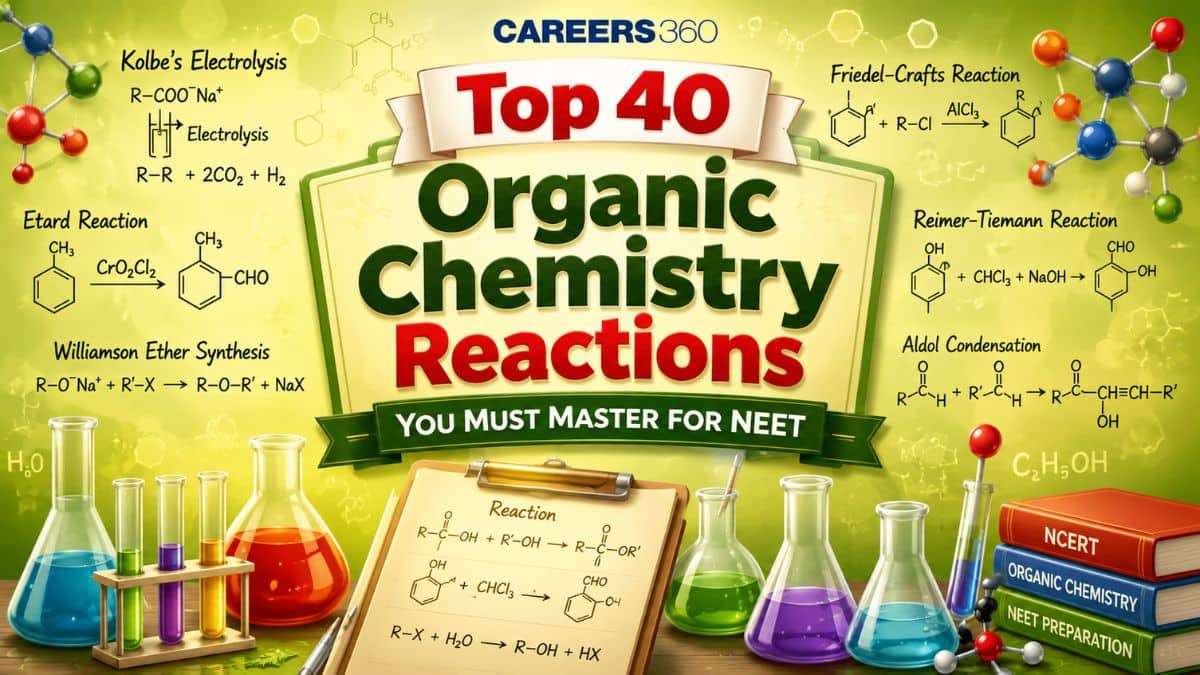
Rather than memorising all the reactions, candidates are advised to learn only those organic chemistry reactions for NEET 2027 which come frequently in previous years' question papers. This article deals with the 40 top organic chemistry reactions which one must learn for the NEET exam, along with the necessary reagents and products involved.
Organic Chemistry includes a lot of organic reactions, be it named reactions, identification of products, or reactions involving reagents. Without knowing the underlying reactions, it becomes really difficult to predict the correct answer.
Learning these organic reactions also improves conceptual clarity and understanding regarding the reaction mechanisms. Apart from this, organic reactions also help build speed and accuracy required during the exam, as many important NEET questions can be solved quickly if the students become familiar with the common reactions and reagents.
Get Job Ready in Healthcare | Employability-Focused Programs
To score well in the NEET organic chemistry section, rather than studying and wasting time on random reactions, it's always better to focus on the most important and frequently asked reactions.
Below are 40 important organic Chemistry reactions that every NEET aspirant should study:
Hydrocarbon reactions mainly involve substitution reactions that help in converting simple hydrocarbons into more complex compounds.
Here are a few important Hydrocarbon reactions:
1. Free Radicals in Halogenation
In halogenation reactions by free radicals, hydrogen in alkanes is replaced by a halogen such as chlorine and bromine with the help of light as the catalyst.
2. Wurtz Reaction
This reaction involves the formation of large hydrocarbons from two different alkyl groups joined together with the help of sodium in dry ether.
3. Wurtz–Fittig Reaction
In this reaction, an alkyl halide reacts with an aryl halide to form an alkyl-substituted aromatic compound.
4. Kolbe’s Electrolysis
It is an electrochemical reaction that includes the electrolysis of the salts of carboxylic acids to form hydrocarbons by the coupling of alkyl groups.
5. Fittig Reaction
Fittig reaction joins two aromatic halides together in the presence of sodium metal, which results in the production of a larger aromatic compound.
Both alkenes and alkynes are unsaturated hydrocarbons that contain double and triple bonds. This is the reason why they are more reactive than alkanes and can undergo a variety of addition and oxidation reactions.
Some of which are:
6. Hydroboration–Oxidation
It is a type of reaction that includes the conversion of alkenes into alcohols, where the hydroxyl group attaches to the carbon that is less substituted.
7. Ozonolysis
Ozone in this reaction helps in breaking the double bond of alkenes, which leads to the production of smaller carbonyl compounds like aldehydes or ketones.
In the same manner, here are a few other Alkene and Alkyne reactions which are important from the point of view of the NEET exam:
8. Markovnikov Addition
In this type of reaction, in an unsymmetrical alkene, hydrogen adds to the carbon already having more hydrogens, and the other group adds to the carbon with fewer hydrogens.
9. Anti-Markovnikov Addition
Anti-markonikov addition is simply an unsymmetrical alkene, hydrogen adds to the carbon with fewer hydrogens, and the other group adds to the carbon with more hydrogens.
10. Baeyer’s Test
This test is used mainly for unsaturated compounds.
11. Lindlar Catalyst Reduction
In this reaction, an alkyne is partially reduced to a cis-alkene by the help of a poisoned Pd catalyst.
12. Birch Reduction
It is a type of reduction where an aromatic ring is reduced with the help of sodium in liquid ammonia in the presence of alcohol.
Alcohols, phenols, and ethers are the functional groups in organic chemistry that appear frequently in NEET chemistry questions.
Some of the most important reactions involving these functional groups are given below
13. Lucas Test
It is a qualitative test to distinguish between primary, secondary, and tertiary alcohols.
14. Williamson Ether Synthesis
A method for preparing ethers by reacting an alkoxide ion with an alkyl halide.
16. Reimer–Tiemann Reaction
Reaction used to introduce an aldehyde group into a phenol ring, producing aromatic aldehydes.
17. Acid Catalyzed Dehydration of Alcohol
Acid-catalyzed dehydration of alcohol reaction.
Aldehydes and ketones are the functional groups that make the organic compound undergo various oxidation, reduction, and addition reactions.
18. Aldol Condensation
Aldehydes or ketones combine to form larger molecules containing both alcohol and carbonyl functional groups
19. Cannizzaro Reaction
Aldehyde undergoes self-oxidation and reduction simultaneously to give out alcohol and carboxylic acid.
20. Clemmensen Reduction
Conversion of aldehydes or ketones into hydrocarbons with the help of strong acidic conditions.
21. Wolff–Kishner Reduction
It is a type of reaction which involves the reduction of a carbonyl compound to an alkane using hydrazine in the presence of a strong base like KOH at high temperature.
22. Haloform Reaction
The reaction between methyl ketones, halogen and a base to give holoform along with a carboxylate salt as a product.
23. Tollens’ Test
Tollen's test is used for aldehydes, while the ketones do not react to the reagent which is used during this test.
24. Fehling’s Test
This test is mainly used for testing the presence of aliphatic aldehydes.
25. Benzoin Condensation
Benzoin condensation is basically when two Molecules of aromatic aldehyde condense in the presence of CN negative to form benzoin, which is an alpha-hydroxy ketone.
26. Perkin Reaction
An aromatic aldehyde reacts with an acid anhydride in the presence of a base like sodium acetate to give an alpha, beta-unsaturated aromatic acid.
Carboxylic Acids are organic compounds that contain the carboxyl functional group.
27. Hell–Volhard–Zelinsky Reaction
Introduction of a halogen atom at the carbon next to the carboxylic acid group.
28. Soda Lime Reaction
In this reaction, the formation of hydrocarbons takes place after the carboxylic acid loses carbon dioxide.
29. Fischer Esterification
Carboxylic acid reacts with alcohol in the presence of an acid to form esters and water.
Amines are those organic compounds that are derived from ammonia, in which one or more hydrogen atoms are replaced by alkyl or aryl groups.
30. Gabriel Phthalimide Synthesis
It is a reaction which involves the preparation of primary amines by the reaction of phthalimide with alkyl halides.
31. Hofmann Bromamide Degradation
In this reaction, an amide is converted into a primary amine with one carbon less using bromine and a base such as KOH or NaOH.
32. Carbylamine Reaction
Here, Primary amines react with chloroform and alcoholic KOH to form the foul-smelling isocyanides.
33. Hinsberg Test
This test is basically used for distinguishing between the primary, secondary and tertiary amines based mainly on their reaction with Hinsberg reagent.
Aromatic compounds are organic molecules that contain a stable ring structure with delocalized electrons. For example, benzene.
34. Friedel–Crafts Alkylation
In this reaction, an aromatic ring reacts with an alkyl halide in the presence of a Lewis acid to give an alkyl substituted aromatic compound as the product.
35. Friedel–Crafts Acylation
Here, an aromatic ring undergoes reaction with an acyl chloride or an acid anhydride in the presence of a Lewis acid to form a ketone.
36. Nitration of Benzene
In this type of reaction, the benzene reacts with conc. nitric acid in the presence of sulfuric acid to form nitrobenzene.
37. Sulphonation of Benzene
It is a reaction between benzene and fuming sulfuric acid to form benzene sulfonic acid.
38. Halogenation of Benzene
The benzene reacts with a halogen in the presence of a lewis acid to form halobenzene.
Diazonium salts are organic compounds that are highly reactive. These are formed from aromatic amines.
39. Sandmeyer Reaction
Diazonium salts are converted into substituted aromatic compounds using copper salts.
40. Gattermann Reaction
This reaction is used to introduce halogen or other groups into aromatic rings in the presence of a catalyst.
Get expert advice on college selection, admission chances, and career path in a personalized counselling session.
Many aspirants fail to understand organic chemistry because instead of understanding, they try to memorise all concepts and reactions. Only a planned approach can help retain reactions for a longer time and improve accuracy in exams.
Here are a few pointers that can help aspirants memorise the reactions in an effective way:
Focus on understanding the purpose of each reaction rather than memorising it blindly.
Learn the reagents and conditions.
Practice conversion questions that combine multiple reactions.
Revise reactions regularly using short notes or flashcards.
Solve the previous year NEET questions related to these reactions.
Following these instructions and maintaining a consistent revision and practice regime will surely help students in scoring good marks in NEET Organic Chemistry.
Frequently Asked Questions (FAQs)
Chemistry formulas help solve numerical and conceptual questions quickly. Many NEET questions, especially from Physical Chemistry, are directly formula-based, making them essential for improving speed and accuracy.
Most key formulas come from Physical Chemistry chapters such as Thermodynamics, Chemical Equilibrium, Electrochemistry, Chemical Kinetics, and Solutions.
Make short formula notes, revise them regularly, and practice previous year questions and mock tests to improve recall and application.

On Question asked by student community
Hello Savi
Please check the link below:
Hope it helps.
Hello, for AP NEET PG Category C seats, NRI documents are generally required if you are applying under the NRI quota, and eligibility depends on the applicable counselling rules. The fee payment currency and procedure should be confirmed from the current Dr. NTRUHS notification at its official website drntr.uhsap.in.
Hello, the NEET PG stipend at Parul University depends on the postgraduate course, academic year and applicable university policies.
Hello, some B.Sc Nursing colleges may offer admission without NEET, but the admission process depends on the college and its eligibility rules. You can find colleges offering B.Sc Nursing admission without NEET here: https://medicine.careers360.com/articles/bsc-nursing-admission-without-neet
Hello, you can pursue BPT in Kerala without NEET UG. Admission is generally based on the LBS Centre rank list and the applicable admission process. You can check BPT colleges in Kerala and their details here: https://medicine.careers360.com/colleges/list-of-bpt-in-physiotherapy-colleges-in-kerala
the product 'P' will be ,


| Column A | Column B |
| A |
a) Organisation of cellular contents and further cell growth. |
| B |
b) Leads to formation of two daughter cells. |
| C |
c) Cell grows physically and increase volume proteins,organells. |
| D |
d) synthesis and replication of DNA. |
Match the correct option as per the process shown in the
0.16 g of dibasic acid required 25 ml of decinormal solution for complete neutralisation. The modecular weight of the acid will be
32
64
128
256
0xone is

Know possible Govt/Private MBBS/BDS Colleges based on your NEET rank
College Predictors Webinars One to One Counselling Regular Updates Medical Almanac
Get Job Ready in Healthcare | Employability-Focused Programs
Ranked among the top Dental Colleges for 7 consecutive years by India Today poll
Ranked #19 by NIRF, NAAC A++ Accredited | Recognized by dental council of India