NEET PG College Predictor
NEET PG All India & State College Predictor with Admission Process Guide


INI SS 2026 Subject-Wise Difficulty Analysis includes views from candidates on the paper taken at stage I exam conducted on October 24, 2026 for the January 2027 term. This exam, called the Institute of National Importance Super-Specialty (INI SS) exam, is conducted by AIIMS New Delhi for the DM, MCh and MD(Hospital Admin) programs.
This Story also Contains
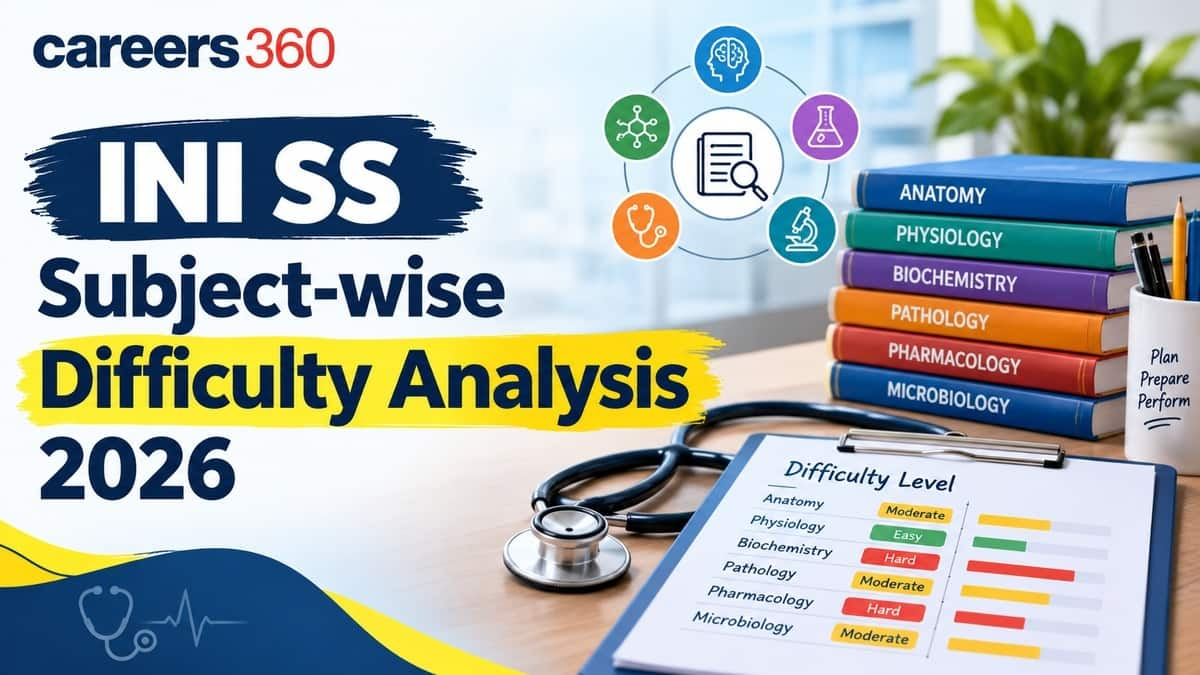
From the initial INI SS Exam analysis, it appears that the difficulty of the test depended on the speciality. There were candidates who considered Urology and Neurosurgery to be difficult, while the feedback about Cardiology was mixed. Plastic Surgery was considered moderate, and some candidates found Surgical Oncology easy. These are just the reactions of some candidates after the test.
Unlike NEET, there is no single list of subjects for all candidates in the case of INI SS. The exam contains a general part and questions from the super-speciality opted by the candidate. Hence, the INI SS subject-wise difficulty analysis 2026 focuses on both the general and speciality parts.
The October 24 examination received mixed reactions from candidates. The following table summarises the initial NEET SS difficulty level analysis for selected specialities.
Speciality | Reported Difficulty Level | Candidate Feedback |
DM Urology | Difficult to very difficult | Some candidates reported challenging speciality questions, including questions related to uro-oncology and recent guidelines. |
MCh Neurosurgery | Difficult | Some candidates described the questions as vague and challenging. |
DM Cardiology | Mixed | Candidates reported a combination of straightforward and very difficult questions. |
MCh Plastic Surgery | Moderate | Some candidates described the paper as moderate, with standard questions. |
MCh Surgical Oncology | Relatively easy | Some candidates reported that the speciality questions were comparatively easy. |
DM Nephrology | Moderate or manageable for some candidates | Some candidates described the paper as manageable, although individual preparation varied. |
Get expert advice on college selection, admission chances, and career path in a personalized counselling session.
Stage I questions come from a general component linked to your parent's postgraduate degree and from a speciality component linked to the DM or MCh you applied for. AIIMS gives no official split. Prep platforms report roughly 40 to 50 percent general and 50 to 60 percent speciality, while one topper described her own paper as about 60 percent speciality and 40 percent general. Treat this as a range.
Component | Main Focus | Factors That May Affect Difficulty |
General component | Knowledge related to the qualifying postgraduate degree | Familiarity with core concepts, clinical reasoning and recall |
Speciality component | Knowledge relevant to the chosen super-speciality | Depth of subject knowledge, clinical application and familiarity with speciality-specific topics |
There is a twist here that makes difficulty personal. Careers360's critical care guide points out that candidates with different feeder degrees, such as MD Medicine and MD Anaesthesiology, can apply for the same seat and still get papers shaped by their own background. So the same question set can feel moderate to one candidate and difficult to another.
If your feeder is Anaesthesiology, expect more perioperative and airway-linked content. If it is Medicine or Chest Medicine, expect more systemic disease and pulmonology. The practical lesson is simple. Do not judge difficulty only by your speciality books. Judge it against your own feeder subject too.
This is where the paper is most likely to separate candidates. INI SS papers lean more towards image-based and case-integrated questions than older ones did. We have used the reported trend below.
Question Type | What It Requires | Potential Challenge |
Direct recall | Remembering established facts and concepts | Accurate recall under time pressure |
Clinical vignettes | Interpreting symptoms, clinical findings and management options | Applying knowledge to a clinical situation |
Image-based questions | Interpreting ECGs, radiology, histopathology slides or clinical photographs, where applicable | Recognising findings and drawing the correct conclusion |
Guidelines and recent advances | Applying relevant clinical recommendations and updated knowledge | Recalling the correct recommendation or evidence |
Scoring and staging systems | Applying established scoring criteria or classification systems | Selecting the correct criteria and interpreting the result |
Estimates run from roughly one in ten questions to nearly three in ten, and none of them is official. So we are not quoting one number as fact. What matters is the direction. Images take longer, and a candidate who skips image practice loses time as well as marks.
Ninety minutes for 80 questions leaves about 67 seconds per question. That sounds workable, but image and vignette questions often need more, and one-liners need less. In many streams, the real difficulty of INI SS is not any single question. It is finishing the paper without panic.
Here is a suggested pacing plan you can try.
First pass (about 60 minutes). Answer what you know quickly and mark long questions for later.
Second pass (about 20 minutes). Go back to the marked questions, starting with the ones where you can remove at least one option.
Final pass (about 10 minutes). Review flagged answers, but do not change one without a clear reason.
Negative marking is minus one-third, so a blind guess breaks even only when your chance of being right is 25 percent. Below that, you lose marks on average. To build speed on images and vignettes before the exam, practise INI SS previous year question papers. These are memory-based and not official AIIMS papers, so use them for practice rather than prediction.
Careers360 reported that when AIIMS declared the January 2026 session result in December 2025, 3,304 candidates qualified, yet no candidate qualified in four super-speciality courses. This does not prove that those papers were harder. Seats, applicant numbers and cutoff rules also matter. What it does show is that outcomes vary a lot by speciality, so a single overall difficulty rating can mislead you.
Also Read:
Frequently Asked Questions (FAQs)
AIIMS does not release official difficulty ratings. The paper is said to be moderate to difficult based on initial feedback from candidates.
There is no reliable way to rank specialities, because each candidate gets a paper built around their own speciality and feeder background. Streams like cardiology, neurology and nephrology are reported to be heavy on images and guidelines, but that is about where the pressure comes from, not which one is harder.
No. AIIMS has not published topic-wise weightage for any INI SS stream. Any percentage you see online is an estimate from a coaching platform or a candidate, and the estimates often disagree with each other.

NEET PG All India & State College Predictor with Admission Process Guide
India’s only private university to be ranked for Graduate Employability | 6000+ Placements | 800+ Recruiters | 75 LPA-Highest Salary
End-to-End NEET PG Admission Guidance | One-to-One Counselling | College Predictors | Regular Updates | E-books
Established in 1993, with a focus on Homoeopathy and Health Sciences | Offers programmes in Homoeopathy and allied health-related disciplines