


NEET PG 2026 Chapter-Wise Weightage: Subject-Wise Questions & Important Topics
NEET PG 2026 Chapter-Wise Weightage: NEET PG 2026 is not going to look like the paper most aspirants have been practising on. The National Board of Examinations in Medical Sciences (NBEMS) released its information bulletin on July 1, 2026. The change that matters most for anyone who is creating a study plan right now is this: the question count has dropped from 200 to 180, split into five timed sections of 36 questions each, worth 720 marks in total instead of 800. The NEET PG exam itself is scheduled for August 30, 2026, in a single shift from 9 am to 12:30 pm. Before getting into which chapters deserve your remaining weeks, it helps to understand exactly how this paper restructuring changes the weightage math, because a subject that used to carry, say, 25 questions out of 200 does not automatically carry the same weightage out of 180.
This Story also Contains
- NEET PG 2026 Chapter-Wise Weightage: What Has Changed This Year
- NEET PG 2026 Subject-Wise Weightage: Pre-Clinical Subjects
- NEET PG 2026 Subject-Wise Weightage: Para-Clinical Subjects
- NEET PG 2026 Subject-Wise Weightage: Clinical Subjects
- Important Topics and Preparation Strategy Based on Chapter-Wise Weightage
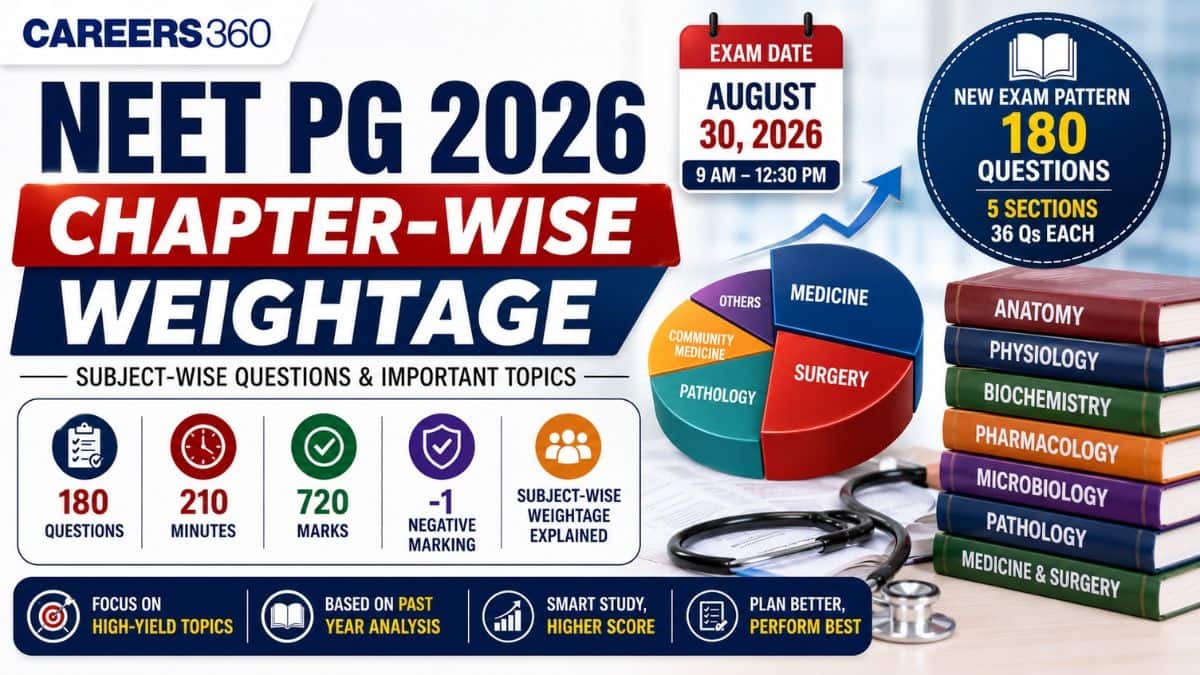
NEET PG 2026 Chapter-Wise Weightage: What Has Changed This Year
For several years, NEET PG followed a fairly predictable subject distribution across its Pre-Clinical, Para-Clinical, and Clinical sections, and most coaching institutes and reference guides built their revision plans around that pattern. With NBEMS confirming a 10 per cent cut in total questions for 2026, along with the new Group A to Group E sectional format where each 42-minute block is sealed once time runs out, two things follow directly.
First, every subject's absolute question count this year will be proportionally lower than what aspirants may have seen in older sample papers, even though the syllabus itself, taken entirely from the MBBS curriculum prescribed by the National Medical Commission (NMC), has not changed.
Second, because you can no longer revisit a section once its 42 minutes end, knowing which subjects are bunched into which part of the paper matters almost as much as knowing how many marks are allotted to each one.
NBEMS has not released an official chapter-by-chapter breakup of the new 180-question paper. So, the estimates in this article are created by applying the confirmed 10 per cent reduction to the subject-wise pattern NEET PG has followed historically. This should be treated as a working guide rather than an exact weightage.
Confused About College Admissions?
Get expert advice on college selection, admission chances, and career path in a personalized counselling session.
NEET PG 2026 Subject-Wise Weightage: Pre-Clinical Subjects
Anatomy, Physiology, and Biochemistry together make up Part A of the syllabus and have traditionally carried a broadly even split among themselves, with Anatomy and Physiology each running slightly ahead of Biochemistry. Within Anatomy, the musculoskeletal system, neuroanatomy, and vascular supply of major organs tend to repeat most often across previous papers. Physiology questions lean heavily on blood and its components, along with endocrine and renal physiology, while Biochemistry favours carbohydrate and lipid metabolism, enzymes, and vitamin-related disorders. Because this pre-clinical section usually appears early in a sectional exam structure, aspirants who keep these three subjects sharp tend to carry momentum into the tougher para-clinical and clinical sections that follow.
NEET PG 2026 Subject-Wise Weightage: Para-Clinical Subjects
Part B, comprising Pathology, Pharmacology, Microbiology, Forensic Medicine, and Social and Preventive Medicine (Community Medicine), has consistently been one of the heavier-weighted zones of the NEET PG paper, with Pathology and Community Medicine historically topping this group. General pathology concepts such as inflammation, neoplasia, and haematology are asked more often than isolated systemic pathology facts. So a good conceptual grasp of these things is useful for all sorts of questions.
Pharmacology tends to favour students who understand the mechanisms and classification of drugs rather than those who memorise brand names, while microbiology draws proportionately more on bacteriology and virology than on mycology or parasitology. Community Medicine is another subject that is often considered as a ‘soft’ subject by many MBBS graduates. However, Community Medicine has been matching Pathology in terms of the number of questions asked on it repeatedly. Questions on Community Medicine usually focus on epidemiology, biostatistics and national health programmes. It is a real high-scoring subject for the time it takes to revise.
NEET PG 2026 Subject-Wise Weightage: Clinical Subjects
Part C is where the most weightage of the paper lies, and General Medicine and General Surgery, each including their allied specialities, have long been the two largest contributors to NEET PG, historically outweighing every other individual subject by a wide margin. Within Medicine, cardiovascular, respiratory, and gastrointestinal conditions, along with dermatology and psychiatry topics folded into the same section, come up frequently.
Surgery draws proportionately from orthopaedics, anaesthesia, and radiodiagnosis alongside core surgical principles. Obstetrics and Gynaecology follows as the next significant contributor, with paediatrics, ENT, and ophthalmology each holding a smaller but still meaningful share. Because Medicine and Surgery combined can account for one-fourth of the entire paper, under-revising either one has a disproportionately large effect on the final score compared with skipping a smaller subject like ophthalmology.
Important Topics and Preparation Strategy Based on Chapter-Wise Weightage
Knowing the weightage only helps if it changes your study schedule and how the remaining study time gets allocated. Given the reduced total question count, every mark now carries slightly more relative value than it did under the 200-question format, which makes accuracy on high-weightage subjects even more important than attempting a wide but shallow spread of topics. A practical approach is to treat Pathology, Community Medicine, General Medicine, and General Surgery as the four subjects that justify the deepest revision, since together they have historically accounted for a large share of the paper, while still keeping Anatomy, Physiology, and Pharmacology on a steady revision cycle rather than leaving them for the final week.
Attempting NEET PG previous year question papers remains one of the more reliable ways to see how these weightage patterns actually translate into real questions, and cross-checking preparation against the complete NEET PG syllabus helps confirm that no high-scoring topic within a heavily weighted subject gets missed.
Since the exam is now split into five sealed, time-bound sections, it is also worth reading through the NEET PG 2026 sectional exam pattern to understand how the 42-minute lock affects pacing within each group of subjects, and reviewing general NEET PG preparation strategy to build a revision schedule around these priorities before August 30.
Frequently Asked Questions (FAQs)
NEET PG 2026 consists of 180 multiple-choice questions, divided into five sections of 36 questions each, carrying a total of 720 marks, as per the NBEMS information bulletin released on July 1, 2026.
General Medicine (including dermatology, venereology, and psychiatry) and General Surgery (including orthopaedics, anaesthesia, and radiodiagnosis) have historically carried the highest weightage in NEET PG, followed by Pathology and Community Medicine.
No. NBEMS has confirmed that only the number of questions and the sectional format have changed for 2026. The syllabus continues to be based on Pre-Clinical, Para-Clinical, and Clinical subjects from the MBBS curriculum.
Yes. Candidates are awarded four marks for every correct answer and lose one mark for every incorrect answer, with no marks deducted for unattempted questions.
No. Once the 42-minute window for a section ends or the section is submitted, candidates cannot revisit or change answers from that section.
Popular Courses and Specializations
List of colleges accepting NEET PG

Browse Medicine Colleges by State
Questions related to NEET PG
On Question asked by student community
Hello, the NEET PG stipend at Parul University depends on the postgraduate course, academic year and applicable university policies.
Hello Student,
If you are looking for information about NEET PG 2025 DNB seat allotment and the fees payable at the allotted college or hospital, DNB seats are allotted through the respective counselling process based on your rank, category, choice of speciality, and seat availability.
For the 2025 session, the
Dear Student, with a NEET PG 2026 rank of 6,600 in the EWS category, your options should be assessed using the relevant counselling year's college-wise closing ranks, category-wise seats and counselling round. Please also confirm whether you are applying through the applicable All India counselling route or another quota. That
Hello, with a NEET PG rank of 11,000, your chances of getting MS ENT at Government Medical College, Thiruvananthapuram depend on your category, state quota, counselling round and previous year’s closing rank. You can check the cutoff details here: https://medicine.careers360.com/articles/kerala-neet-pg-cut-off
Dear Student, with a NEET PG rank of 8,571, you can explore DNB Pediatrics options through the relevant counselling process. If Bangalore is your preferred location, it would be useful to compare the available hospitals on factors such as patient load, paediatric case exposure, teaching environment, stipend, bond conditions and