NEET PG College Predictor
NEET PG All India & State College Predictor with Admission Process Guide


NEET PG case-based questions for 2026 increasingly involve the candidate in using clinical knowledge in linking signs and symptoms with examination and investigation results prior to diagnosis and decision-making. Practising case-based questions will ensure the development of the skills that will help in handling application-based questions.
This Story also Contains
The article below features original case-based questions for NEET PG based on common clinical principles and decision points. The questions are neither the officially published questions nor from any NEET PG paper since NBEMS does not publish the question paper. Cases in the article are followed by questions related to diagnosis, investigation, mechanism, or management of cases.
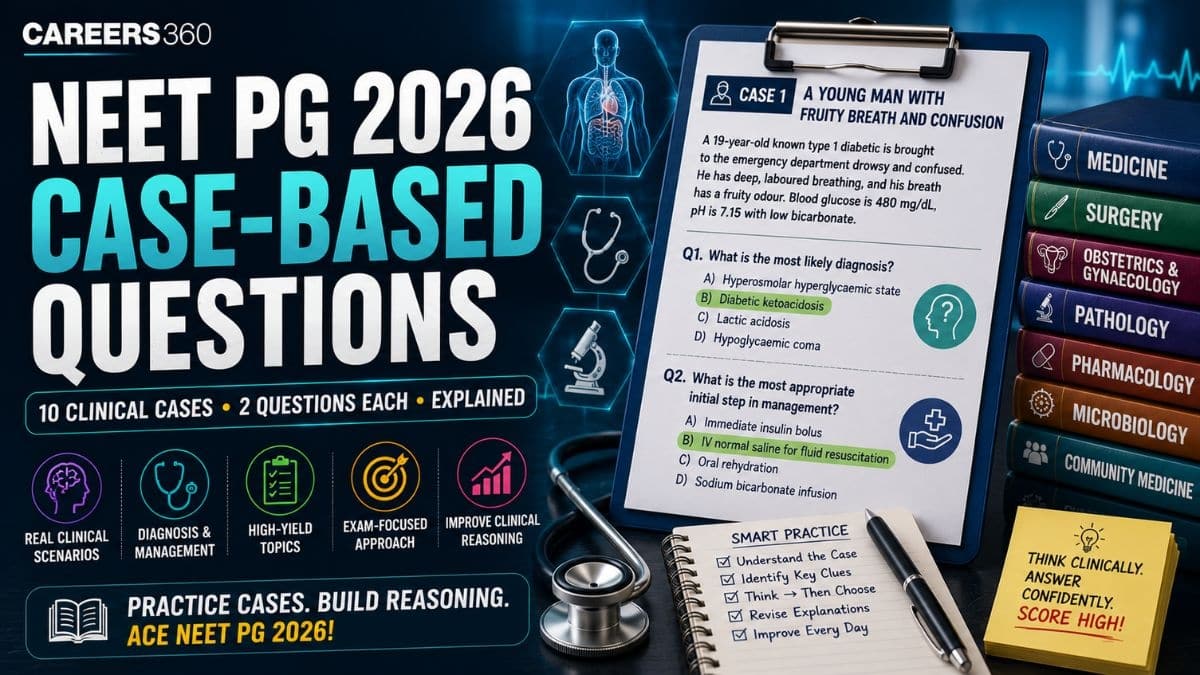
A 19-year-old known type 1 diabetic is brought to the emergency department drowsy and confused. He has deep, laboured breathing, and his breath has a fruity odour. Blood glucose is 480 mg/dL, and arterial blood gas shows a pH of 7.15 with low bicarbonate.
NEET PG case-based question 1: What is the most likely diagnosis?
A) Hyperosmolar hyperglycaemic state
B) Diabetic ketoacidosis
C) Lactic acidosis
D) Hypoglycaemic coma
Answer: B) Diabetic ketoacidosis.
Explanation: Put the pieces together here and DKA is really the only fit — the Kussmaul breathing, the ketone smell on his breath, and a pH this low with bicarbonate this depleted. HHS gets confused with this sometimes, but that usually shows up with glucose readings far higher than this and barely any ketosis to speak of.
NEET PG case-based question 2. What is the most appropriate initial step in management?
A) Immediate insulin bolus
B) IV normal saline for fluid resuscitation
C) Oral rehydration
D) Sodium bicarbonate infusion
Answer: B) IV normal saline.
Explanation: Fluids come before insulin here, not after. This patient is volume-depleted, and starting insulin first, before that's corrected, can actually drop his blood pressure further and, in someone this young, raise the risk of cerebral oedema. Get the fluids running first.
Get expert advice on college selection, admission chances, and career path in a personalized counselling session.
A 60-year-old man presents with sudden onset severe abdominal pain, distension, and absolute constipation. On examination, the abdomen is tympanic, and an X-ray shows dilated bowel loops with multiple air-fluid levels.
NEET PG case-based questions: 3. What is the most likely diagnosis?
A) Acute pancreatitis
B) Intestinal obstruction
C) Perforated peptic ulcer
D) Acute cholecystitis
Answer: B) Intestinal obstruction.
Explanation: Absolute constipation plus a distended, tympanic abdomen plus those air-fluid levels on the film — that's about as textbook an obstruction picture as it gets. If this were a perforation instead, you'd expect free air under the diaphragm, which isn't mentioned here.
NEET PG case-based questions: 4. What is the most appropriate next investigation to identify the level and cause of obstruction?
A) Ultrasound abdomen
B) CT abdomen with contrast
C) Colonoscopy
D) Diagnostic laparoscopy
Answer: B) CT abdomen with contrast.
Explanation: A plain film can suggest obstruction, but it won't tell you where the blockage is or whether the bowel is strangulating. CT does both, which is exactly why it's become the go-to investigation once obstruction is suspected.
A 28-year-old woman with six weeks of amenorrhoea presents with sudden-onset severe lower abdominal pain and light vaginal spotting. She is tachycardic, and her blood pressure is 90/60 mmHg. A urine pregnancy test is positive.
NEET PG case-based question 5. What is the most likely diagnosis?
A) Threatened abortion
B) Ectopic pregnancy
C) Ovarian cyst rupture
D) Pelvic inflammatory disease
Answer: B) Ectopic pregnancy.
Explanation: A positive pregnancy test, sudden pain, spotting, and a blood pressure that's already dropping – treat this as a ruptured ectopic until something rules it out. It's one of those diagnoses where waiting to be sure can cost you.
NEET PG case-based questions 6. What is the most appropriate immediate next step?
A) Outpatient serial beta-hCG monitoring
B) Transvaginal ultrasound and immediate stabilisation
C) Discharge with analgesia
D) Await spontaneous resolution
Answer: B) Transvaginal ultrasound and immediate stabilisation.
Explanation: She's already showing signs of instability, so this isn't a wait-and-watch situation. Stabilise her while confirming the diagnosis on ultrasound, because active bleeding from a ruptured ectopic needs surgery, not observation.
A 3-day-old term newborn is noted to have yellowing of the skin and sclera, first appearing on the face and progressing to the trunk. The baby is otherwise active and feeding well. Total serum bilirubin is 14 mg/dL, predominantly unconjugated.
NEET PG case-based question 7. What is the most likely cause of this presentation?
A) Biliary atresia
B) Physiological jaundice
C) Breast milk jaundice
D) Rh incompatibility
Answer: B) Physiological jaundice.
Explanation: The timing here matters more than people expect. Jaundice showing up after the first day, peaking around day 3 to 5, in a baby who's otherwise doing fine — that's the usual physiological pattern. Rh incompatibility, by contrast, tends to announce itself within the first 24 hours, which rules it out here.
NEET PG case-based question 8. At what bilirubin threshold would phototherapy typically be considered in this term infant?
A) Any bilirubin level above 5 mg/dL
B) Based on age-in-hours specific nomograms, generally above 15 mg/dL at this age
C) Only if bilirubin exceeds 25 mg/dL
D) Phototherapy is never used in physiological jaundice
Answer: B) Age-specific nomogram thresholds.
Explanation: There's no single magic bilirubin number here — the decision runs off hour-specific nomograms. For a term baby around 72 hours old, once you're approaching 15 mg/dL, phototherapy is usually on the table. This exact reasoning shows up a lot in paediatric case questions.
An 8-year-old boy presents with periorbital swelling that is worse in the morning, along with frothy urine. Urinalysis shows heavy proteinuria with a bland sediment, and serum albumin is low.
NEET PG case-based question 9. What is the most likely diagnosis?
A) Acute glomerulonephritis
B) Nephrotic syndrome
C) Acute pyelonephritis
D) Nephrolithiasis
Answer: B) Nephrotic syndrome.
Explanation: Heavy protein loss, low albumin, puffy eyes, and a sediment that's clean rather than full of red cell casts — that combination says nephrotic, not nephritic. At this age, minimal change disease is by far the most likely cause for it.
NEET PG case-based question 10. What is the most appropriate first-line treatment in this age group?
A) ACE inhibitors
B) Oral corticosteroids
C) Immediate renal biopsy
D) IV antibiotics
Answer: B) Oral corticosteroids.
Explanation: Since minimal change disease responds so reliably to steroids in children, most paediatricians will actually start treatment empirically rather than biopsy first. A biopsy only gets pulled in if the child doesn't respond, or something about the presentation looks atypical.
A 35-year-old returning from a rural area presents with cyclical high-grade fever accompanied by chills and rigors, occurring roughly every 48 hours, along with headache and mild jaundice. A peripheral smear shows ring-form trophozoites inside red blood cells.
NEET PG case-based question 11. What is the most likely diagnosis?
A) Typhoid fever
B) Plasmodium vivax malaria
C) Dengue fever
D) Leptospirosis
Answer: B) Plasmodium vivax malaria.
Explanation: A 48-hour fever cycle with ring forms on the smear — that tertian pattern is a strong pointer toward vivax (though falciparum can mimic it too). Questions that connect the fever pattern to the smear finding like this come up a lot, so it's worth having the timing memorised cold.
NEET PG case-based question 12. Which drug is essential in this patient's treatment specifically to prevent relapse, and why?
A) Chloroquine, to clear blood-stage parasites
B) Primaquine, to eliminate hypnozoites in the liver
C) Doxycycline, for its antibacterial cover
D) Artesunate, for severe malaria only
Answer: B) Primaquine.
Chloroquine handles the blood-stage parasites, but it does nothing for the hypnozoites sitting dormant in the liver — that's primaquine's job, and skipping it is exactly why vivax malaria relapses. This pairing gets tested almost every time a vivax question comes up.
Minutes after receiving an intramuscular penicillin injection, a patient develops widespread urticaria, facial swelling, wheeze, and a sudden drop in blood pressure to 70/40 mmHg.
NEET PG case-based question: 13. What is the most likely diagnosis?
A) Vasovagal syncope
B) Anaphylaxis
C) Serum sickness
D) Angioedema alone
Answer: B) Anaphylaxis.
Explanation: Hives, facial swelling, wheeze, and a crashing blood pressure, all within minutes of the injection — there's really no other diagnosis this fits. This is anaphylaxis, and it needs treating immediately, not observed.
NEET PG case-based question 14. What is the most appropriate immediate step in management?
A) IV antihistamines
B) Intramuscular adrenaline
C) Oral corticosteroids
D) Slow IV fluids only
Answer: B) Intramuscular adrenaline.
Explanation: Adrenaline, into the thigh, comes first — full stop. A surprising number of students reach for antihistamines or steroids instead, and examiners know it, which is exactly why this trap keeps showing up in papers.
Within a span of five days, twelve people from the same village present with acute watery diarrhoea and vomiting. All affected individuals had consumed water from the same source.
NEET PG case-based question 15. What type of epidemiological study would be most appropriate to identify the source of this outbreak?
A) Cohort study
B) Case-control study
C) Randomised controlled trial
D) Cross-sectional survey alone
Answer: B) Case-control study.
Explanation: With a small, defined group of cases and a suspected shared exposure, a case-control design lets you compare exposure histories between the sick and the well fairly quickly, which is exactly what's needed to trace an outbreak like this back to its source.
NEET PG case-based question 16. What is the most appropriate immediate public health measure while investigation is ongoing?
A) Wait for laboratory confirmation before any action
B) Chlorination of the suspected water source and oral rehydration for affected individuals
C) Evacuate the entire village
D) Withhold information until the outbreak is confirmed
Answer: B) Chlorination and oral rehydration.
Explanation: You don't sit around waiting for lab confirmation while people keep getting sick. Disinfecting the water source and starting rehydration should happen right away, and this idea, acting early rather than waiting for certainty, comes up again and again in PSM outbreak questions.
A 55-year-old woman presents with sudden severe pain in one eye, blurred vision, and seeing haloes around lights. On examination, the eye is red, the cornea appears hazy, and the pupil is mid-dilated and fixed.
NEET PG case-based question 17. What is the most likely diagnosis?
A) Open-angle glaucoma
B) Acute angle-closure glaucoma
C) Anterior uveitis
D) Conjunctivitis
Answer: B) Acute angle-closure glaucoma.
Explanation: Red, painful eye, hazy cornea, a pupil that's mid-dilated and won't react, haloes around lights — this combination is about as unmistakable as ophthalmology gets, and it's one examiners return to often.
NEET PG case-based question 18. What is the most appropriate immediate step in management?
A) Topical antibiotics
B) IV mannitol and topical agents to lower intraocular pressure
C) Reassurance and review in a week
D) Patching the eye
Answer: B) IV mannitol and IOP-lowering agents.
Explanation: This is an emergency, not a next-appointment problem. The pressure needs to come down fast, using IV mannitol along with topical agents like beta blockers and pilocarpine, and once the acute attack settles, laser iridotomy sorts out the underlying problem for good.
A patient with a recent tibial fracture, now in a cast, develops severe pain out of proportion to the injury, along with tense swelling of the calf and pain on passive stretching of the toes. Pulses are still palpable.
NEET PG case-based question 19. What is the most likely diagnosis?
A) Deep vein thrombosis
B) Compartment syndrome
C) Cellulitis
D) Nerve injury alone
Answer: B) Compartment syndrome.
Explanation: Pain that's way out of proportion to the injury, worse on passive stretch — that's your earliest warning sign, and it shows up before pulses ever disappear. That's actually the trap here: waiting for pulses to go before acting is a mistake that costs limbs.
NEET PG case-based question 20. What is the most appropriate next step in management?
A) Elevate the limb and observe
B) Urgent fasciotomy
C) Start anticoagulation
D) Remove the cast and reassess in 24 hours
Answer: B) Urgent fasciotomy.
Explanation: Once compartment syndrome is on the table clinically, this becomes a surgical emergency. Fasciotomy needs to happen urgently to relieve the pressure — sitting back to observe risks permanent muscle and nerve damage that won't come back.
The two-question structure used with each case throughout this article. It reflects how the NEET PG exam has evolved over the years. Fewer individual recall questions, more scenarios where a candidate has to first figure out what's happening and then decide what to do next. Practising this way builds a different skill than the flashcard-style revision does. It trains the sequence of clinical thinking itself, recognising a pattern, then choosing the correct next action, which is exactly what the exam increasingly rewards.
A useful habit while working through cases like these is to pause after reading the vignette and commit to an answer before checking the options. NEET PG's option sets are often designed to include a logical distractor right next to the correct answer. Reasoning through the case first, rather than working backwards from the choices, tends to build sturdier judgement for exam day.
Consistently apply an approach in answering case-based questions.
Read the case carefully and pick the important clinical hints.
Make a prediction of the probable diagnosis without looking at the options.
Evaluate your options to reinforce your thinking process and choose the right one.
Evaluate the explanation after answering, particularly if you did not know or chose the wrong one.
Review the concept behind the question rather than memorising the answer.
Re-do the question after some time to see if the concept was learned.
Frequently Asked Questions (FAQs)
They are original case scenarios built around clinical presentations and decision points that recur consistently across NEET PG's recent papers. NBEMS does not release an official past paper, so no source can claim to reproduce a verified original exam case.
Case-based questions present one patient scenario followed by two or more connected questions, typically moving from diagnosis to management or investigation, rather than a single standalone question with one answer.
The format is designed to test applied clinical reasoning, whether a candidate can work through a scenario the way they would with an actual patient, rather than testing isolated factual recall.
Reading the full vignette carefully and forming an answer before checking the options helps build the same reasoning sequence the exam tests, rather than pattern-matching keywords to answer choices.
Not necessarily harder, but they require connecting two or more pieces of information at once, so strong topic-wise conceptual clarity matters more than memorising isolated facts.

On Question asked by student community
Hello, the NEET PG stipend at Parul University depends on the postgraduate course, academic year and applicable university policies.
Hello Student,
If you are looking for information about NEET PG 2025 DNB seat allotment and the fees payable at the allotted college or hospital, DNB seats are allotted through the respective counselling process based on your rank, category, choice of speciality, and seat availability.
For the 2025 session, the
Dear Student, with a NEET PG 2026 rank of 6,600 in the EWS category, your options should be assessed using the relevant counselling year's college-wise closing ranks, category-wise seats and counselling round. Please also confirm whether you are applying through the applicable All India counselling route or another quota. That
Hello, with a NEET PG rank of 11,000, your chances of getting MS ENT at Government Medical College, Thiruvananthapuram depend on your category, state quota, counselling round and previous year’s closing rank. You can check the cutoff details here: https://medicine.careers360.com/articles/kerala-neet-pg-cut-off
Dear Student, with a NEET PG rank of 8,571, you can explore DNB Pediatrics options through the relevant counselling process. If Bangalore is your preferred location, it would be useful to compare the available hospitals on factors such as patient load, paediatric case exposure, teaching environment, stipend, bond conditions and

NEET PG All India & State College Predictor with Admission Process Guide
End-to-End NEET PG Admission Guidance | One-to-One Counselling | College Predictors | Regular Updates | E-books