Emversity
Get Job Ready in Healthcare | Employability-Focused Programs


NEET UG is the single largest medical entrance exam conducted by NTA for granting admission in MBBS, BDS and AYUSH courses. The NTA specifies important NEET 2025 dress guidelines for candidates to ensure a smooth and secure process. The NTA has set some NEET footwear restrictions for both male and female candidates to avoid any complications on exam day.
This Story also Contains
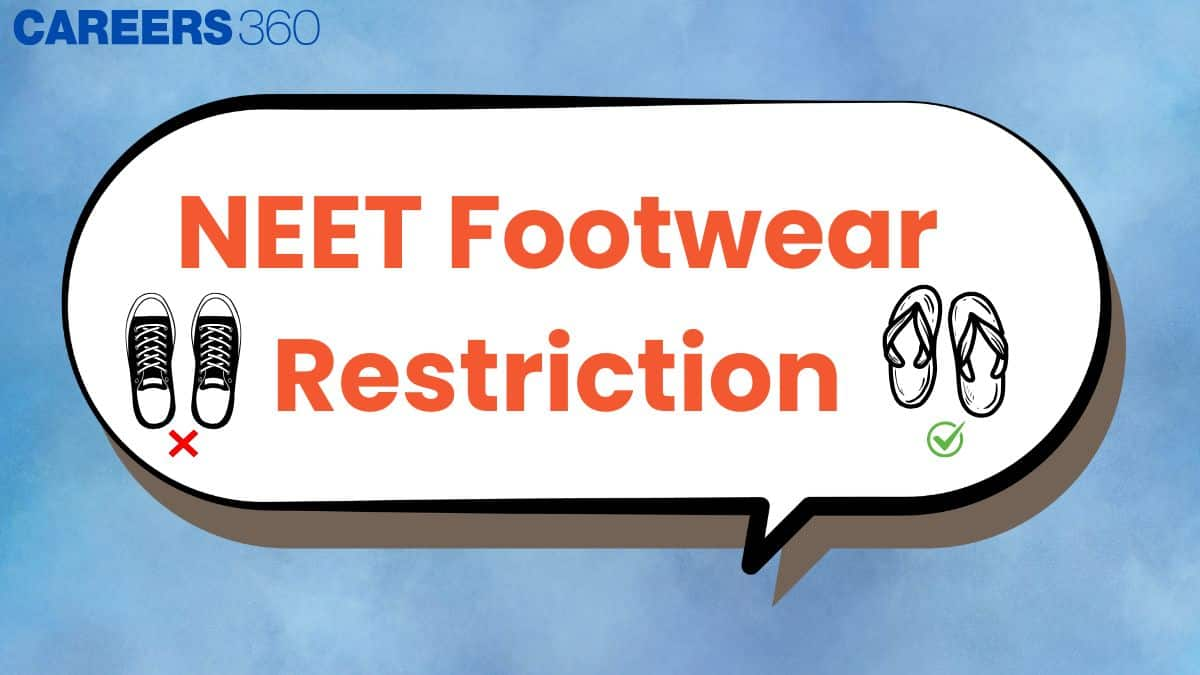
The NEET footwear restrictions has sparked an interesting debate among students. The NTA prohibits shoes, boots and closed footwear in NEET 2025. Hence, it is important to know the NEET exam footwear guidelines and follow all instructions carefully. Read this article to know, NEET footwear policy and footwear restrictions for NEET exam in detail.
The NTA has provided NEET 2025 dress code guidelines for candidates appearing for the entrance exam. The authority has released the dress code for NEET along with the information bulletin. For NEET 2025, candidates are permitted to wear slippers or sandals with low heels. While shoes, boots or closed footwear are strictly prohibited. Additionally, clothes should be simple and plain without any fashion. Candidates must follow the NEET footwear rules to avoid any issue which can lead to disqualification.
Get expert advice on college selection, admission chances, and career path in a personalized counselling session.
Only slippers or sandals with low heels are allowed to wear for the NEET exam. Shoes or closed footwear are prohibited for both male and female candidates in NEET 2025. Aspirants should be mindful of footwear as slippers and open-toed sandals with thin soles are preferred as they provide comfort while visiting the NEET exam centre. Candidates are advised to avoid wearing shoes or boots to avoid any issue.
Slippers or sandals with thin soles are allowed.
Shoes, boots, or closed footwear are prohibited.
Slippers or open-toed sandals with thin soles are permitted.
High heels, shoes, and closed footwear are not allowed
The NTA has outlined strict NEET 2025 dress code guidelines for male and female candidates. The authority has set some strict NEET 2025 attire restrictions to ensure a transparent exam process. Students must adhere to these guidelines to avoid any inconvenience on exam day. The NEET attire restrictions are designed to stop cheating and unfair activities during the NEET exam. Check the NEET 2025 attire restrictions for male and female candidates below.
Jewelry and ornaments: Both male and female candidates are not permitted to wear rings, bracelets, necklaces, earrings, nose pins, or any metallic items.
Hair accessories: Candidates must avoid using hair accessories such as hairbands, rubber bands with metal parts, or elaborate hair accessories. Only simple rubber bands or pins may be used if necessary.
Watches and electronic gadgets: Avoiding electronic devices such as smartwatches, fitness bands, calculators, pen drives and any metallic items are strictly prohibited.
The NEET footwear restrictions has emerged as a crucial topic among the students. The footwear restrictions in NEET exam halls raises important questions about student comfort and unnecessary stress on the aspirants. At times, NEET aspirants are being asked to remove shoes before entering the examination centre and write barefoot. This move has been criticised by both students and educators. However, the rationale behind these footwear restrictions is to ensure uniformity and discipline among the students. With NEET footwear policy, candidates are less distracted and their focus remains on performance and not on personal choices. The plain slippers and sandals with thin soles are only allowed in the NEET exam. The footwear plays an important role in physical comfort and enforcing strict restrictions may affect the performance of students during the exams.
Frequently Asked Questions (FAQs)
No, heels are not allowed in the NEET exam.
Yes, you can wear slippers or sandals with low heels for the NEET exam.
No, you are not allowed to wear socks and shoes for the NEET exam
Only slippers or sandals with low heels are allowed in the NEET 2025 exam.

On Question asked by student community
Hello Savi
Please check the link below:
Hope it helps.
Hello, for AP NEET PG Category C seats, NRI documents are generally required if you are applying under the NRI quota, and eligibility depends on the applicable counselling rules. The fee payment currency and procedure should be confirmed from the current Dr. NTRUHS notification at its official website drntr.uhsap.in.
Hello, the NEET PG stipend at Parul University depends on the postgraduate course, academic year and applicable university policies.
Hello, some B.Sc Nursing colleges may offer admission without NEET, but the admission process depends on the college and its eligibility rules. You can find colleges offering B.Sc Nursing admission without NEET here: https://medicine.careers360.com/articles/bsc-nursing-admission-without-neet
Hello, you can pursue BPT in Kerala without NEET UG. Admission is generally based on the LBS Centre rank list and the applicable admission process. You can check BPT colleges in Kerala and their details here: https://medicine.careers360.com/colleges/list-of-bpt-in-physiotherapy-colleges-in-kerala
the product 'P' will be ,


| Column A | Column B |
| A |
a) Organisation of cellular contents and further cell growth. |
| B |
b) Leads to formation of two daughter cells. |
| C |
c) Cell grows physically and increase volume proteins,organells. |
| D |
d) synthesis and replication of DNA. |
Match the correct option as per the process shown in the
0.16 g of dibasic acid required 25 ml of decinormal solution for complete neutralisation. The modecular weight of the acid will be
32
64
128
256
0xone is

Get Job Ready in Healthcare | Employability-Focused Programs
Ranked #19 by NIRF, NAAC A++ Accredited | Recognized by dental council of India
Ranked among the top Dental Colleges for 7 consecutive years by India Today poll
BCI Approved Programs | AA+ Graded Law School in Tripura (East Zone)