
Search Colleges, Exams, Schools & more


Login
NEET PG Clinical Scenario Questions 2026: Important Case-Based MCQs with Answers
NEET PG clinical scenario questions 2026: NEET PG is conducted by the National Board of Examinations in Medical Sciences (NBEMS) for admission to MD, MS, and PG Diploma courses. It has moved away from plain one-line recall toward short patient scenarios: a history, a set of findings, and a single sharp question asking what's happening or what to do next. This format tests something different from memorised facts. It tests whether a candidate can read a case the way they would on the wards, spot the pattern, and act on it under time pressure, which is exactly what the exam is designed to select for.
This Story also Contains
- Clinical Scenario Questions for NEET PG 2026
- NEET PG 2026 Clinical Scenario Questions with Answers
- How to Use These NEET PG Clinical Scenario Questions
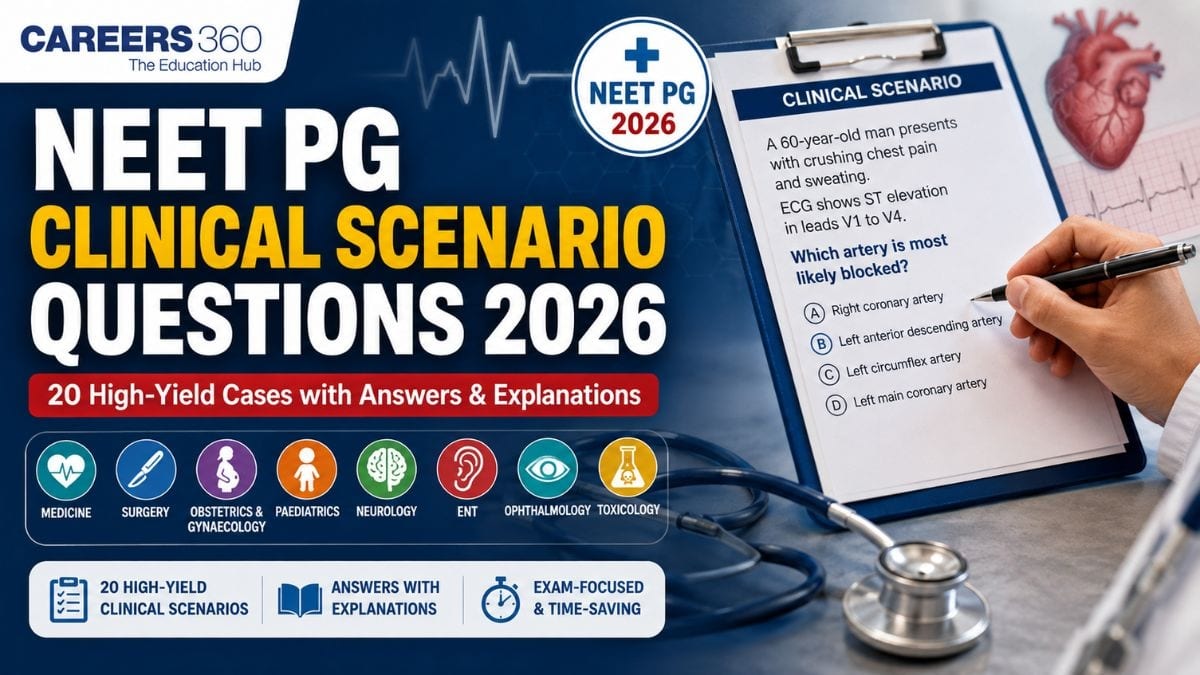
This article covers 20 important clinical scenario questions across Medicine, Surgery, Obstetrics & Gynaecology, Paediatrics, Neurology, and a few high-scoring emergencies from ENT, Ophthalmology, and toxicology. Each question is linked to a short case and provided with the correct answer and a clear explanation. Since NBEMS never releases an official past paper, these questions are built around clinical presentations and decision points that recur consistently across NEET PG's recent trends. The Best books for NEET PG lists subject-wise book recommendations that pair well with scenario-based practice like this.
Clinical Scenario Questions for NEET PG 2026
A plain concept-based question checks whether you remember something. A scenario-based question checks if you can use it. NEET PG increasingly includes the second type of questions, since it reflects real clinical decision-making far better than a one-line recall question ever could.
Practising this format also builds speed. The first time you see a scenario, you are figuring out both the medicine and the format. By the twentieth time, the format is second nature, and all your effort goes into the actual clinical reasoning.
Confused About College Admissions?
Get expert advice on college selection, admission chances, and career path in a personalized counselling session.
Book a Counselling Slot
Select Date
Pick a Slot
NEET PG 2026 Clinical Scenario Questions with Answers
Medicine and Endocrine Emergencies
Q1. A 60-year-old man develops crushing chest pain and sweating. ECG shows ST elevation in leads V1 to V4. Which artery is most likely blocked?
A) Right coronary artery
B) Left anterior descending artery
C) Left circumflex artery
D) Left main coronary artery
Answer: B) Left anterior descending artery. Changes in leads V1 to V4 point to the anterior wall of the heart, which is supplied by the LAD.
Q2. A patient on long-term steroids stops them suddenly and develops low blood pressure, vomiting, and confusion. What is the most likely diagnosis?
A) Addisonian crisis
B) Thyroid storm
C) Diabetic ketoacidosis
D) Cushing syndrome
Answer: A) Addisonian crisis. Sudden steroid withdrawal can trigger acute adrenal insufficiency, since the adrenal glands haven't had time to resume normal cortisol production.
Q3. A patient with known hyperthyroidism develops high fever, a fast heart rate, and confusion after surgery. What is the most likely diagnosis?
A) Thyroid storm
B) Myxedema coma
C) Addisonian crisis
D) Malignant hyperthermia
Answer: A) Thyroid storm. Surgery or infection can trigger this life-threatening spike in thyroid hormone activity in a patient with pre-existing hyperthyroidism.
Q4. An elderly diabetic presents confused, with very high blood glucose, but no significant ketones and a normal blood pH. What is the most likely diagnosis?
A) Diabetic ketoacidosis
B) Hyperosmolar hyperglycaemic state
C) Hypoglycaemic coma
D) Lactic acidosis
Answer: B) Hyperosmolar hyperglycaemic state. This condition is more common in older type 2 diabetics and features very high glucose with little to no ketosis, unlike DKA.
Surgical Emergencies
Q5. A patient with acute pancreatitis develops bluish discolouration around the belly button. What does this finding suggest?
A) Cullen's sign, indicating bleeding around the pancreas
B) Normal finding in pancreatitis
C) Liver failure
D) Bowel perforation
Answer: A) Cullen's sign. This bluish discolouration around the umbilicus suggests bleeding tracking from the pancreas into the tissue beneath the skin.
Q6. A patient with sudden, severe abdominal pain has a rigid, board-like abdomen. X-ray shows free air under the diaphragm. What is the most likely cause?
A) Acute appendicitis
B) Perforated hollow viscus
C) Acute pancreatitis
D) Bowel obstruction
Answer: B) Perforated hollow viscus. Free air under the diaphragm on an erect X-ray is a classic sign that a hollow organ, often the stomach or duodenum, has perforated.
Obstetrics, Gynaecology, and Paediatrics
Q7. A pregnant woman at 34 weeks develops sudden severe abdominal pain, vaginal bleeding, and a tender, hard uterus. What is the most likely diagnosis?
A) Placenta praevia
B) Placental abruption
C) Normal labour
D) Uterine rupture
Answer: B) Placental abruption. A painful, tender, hard uterus with bleeding points to the placenta separating early from the uterine wall, unlike placenta praevia, which usually causes painless bleeding.
Q8. Ultrasound in a pregnant woman shows the placenta growing abnormally into the uterine muscle wall. What is this condition called?
A) Placenta praevia
B) Placenta accreta
C) Vasa praevia
D) Placental abruption
Answer: B) Placenta accreta. In this condition, the placenta attaches too deeply into the uterine wall, raising the risk of severe bleeding at delivery.
Q9. A 2-year-old develops a seizure during a high fever, with no other neurological problem found. What is the most likely diagnosis?
A) Epilepsy
B) Febrile seizure
C) Meningitis
D) Breath-holding spell
Answer: B) Febrile seizure. These seizures happen in young children during a rapid rise in body temperature and usually don't indicate an underlying seizure disorder.
Q10. A 6-month-old has episodes of severe abdominal pain, drawing the knees to the chest, with red, jelly-like stools. What is the most likely diagnosis?
A) Intussusception
B) Pyloric stenosis
C) Volvulus
D) Meckel's diverticulum
Answer: A) Intussusception. One part of the bowel telescopes into another, and red, jelly-like stool is a classic finding in this condition.
Neurology and Psychiatry
Q11. A patient on multiple serotonin-boosting drugs develops fever, tremors, and confusion. What is the most likely diagnosis?
A) Neuroleptic malignant syndrome
B) Serotonin syndrome
C) Malignant hyperthermia
D) Anticholinergic toxicity
Answer: B) Serotonin syndrome. This is caused by too much serotonin activity, often from combining drugs like antidepressants, and needs prompt recognition and treatment.
Q12. A patient develops ascending weakness in both legs a few weeks after a diarrhoeal illness. What is the most likely diagnosis?
A) Guillain-Barre syndrome
B) Myasthenia gravis
C) Multiple sclerosis
D) Stroke
Answer: A) Guillain-Barre syndrome. This condition often follows an infection and causes weakness that spreads upward from the legs, sometimes reaching the breathing muscles.
Q13. A patient starts a new anticonvulsant and develops widespread skin blistering and peeling within two weeks. What is the most likely diagnosis?
A) Stevens-Johnson syndrome
B) Contact dermatitis
C) Erythema multiforme minor
D) Urticaria
Answer: A) Stevens-Johnson syndrome. This is a severe drug reaction affecting the skin and mucous membranes, and it requires stopping the drug immediately and urgent care.
ENT, Ophthalmology, and Emergency Medicine
Q14. A patient with sore throat develops a muffled voice, drooling, and difficulty opening the mouth. What is the most likely diagnosis?
A) Peritonsillar abscess
B) Acute tonsillitis
C) Epiglottitis
D) Pharyngitis
Answer: A) Peritonsillar abscess. Also called quinsy, this collection of pus near the tonsil causes a muffled "hot potato" voice and difficulty opening the mouth fully.
Q15. A patient suddenly loses vision in one eye without pain. Examination shows a pale retina with a bright red spot at the centre. What is the most likely diagnosis?
A) Central retinal artery occlusion
B) Central retinal vein occlusion
C) Retinal detachment
D) Acute angle-closure glaucoma
Answer: A) Central retinal artery occlusion. The blocked artery causes sudden, painless vision loss, and the "cherry red spot" is a classic finding on examination.
Q16. A patient after chest trauma has severe breathlessness, low blood pressure, and no breath sounds on one side, with a shift of the trachea. What is the most likely diagnosis?
A) Simple pneumothorax
B) Tension pneumothorax
C) Haemothorax
D) Flail chest
Answer: B) Tension pneumothorax. Air trapped under pressure in the chest pushes the trachea to the opposite side and needs immediate needle decompression, not investigation first.
Q17. A patient with a long bone fracture develops breathlessness, confusion, and a rash over the chest a day later. What is the most likely diagnosis?
A) Pulmonary embolism
B) Fat embolism syndrome
C) Pneumonia
D) Acute respiratory distress syndrome
Answer: B) Fat embolism syndrome. This classic triad of breathlessness, confusion, and petechial rash typically appears 24 to 72 hours after a long bone fracture.
Infectious Disease and Toxicology
Q18. A patient with dengue fever develops cold extremities, a weak pulse, and a narrowing gap between systolic and diastolic blood pressure. What is the most likely diagnosis?
A) Dengue shock syndrome
B) Simple dengue fever
C) Typhoid fever
D) Septic shock from another cause
Answer: A) Dengue shock syndrome. A narrowing pulse pressure along with cold extremities and a weak pulse signals the shock stage of severe dengue, which needs urgent fluid management.
Q19. A patient who took a large dose of aspirin presents with ringing in the ears, rapid breathing, and confusion. What is the most likely diagnosis?
A) Salicylate poisoning
B) Paracetamol overdose
C) Opioid overdose
D) Benzodiazepine overdose
Answer: A) Salicylate poisoning. Tinnitus (ringing in the ears) combined with rapid breathing is a classic early sign of aspirin toxicity.
Q20. A patient develops severe muscle pain, dark urine, and confirmed muscle breakdown after being trapped under debris for hours. What is the most likely diagnosis?
A) Rhabdomyolysis
B) Acute kidney injury from dehydration
C) Compartment syndrome only
D) Fat embolism syndrome
Answer: A) Rhabdomyolysis. Crushed muscle releases its contents into the bloodstream, and this can seriously damage the kidneys if not treated promptly with fluids.
How to Use These NEET PG Clinical Scenario Questions
Read the whole case first. Don't jump to the options immediately. Try to form your own answer in your head before you even look at the given solutions.
Notice how each scenario gives you two or three clues, not just one. Real exam questions rarely hand you the diagnosis in a single word. They expect you to put small details together like the timing, the trigger, and the exact finding to reach the right answer.
Once you have practised these questions, attempt full previous year papers to see how scenario questions integrate into the rest of a real NEET PG paper. Full-length, timed practice also helps you get used to the current 42-minute, sectioned exam format.
Frequently Asked Questions (FAQs)
Q: Are these real previous year NEET PG clinical scenario questions?
A:
They are original scenarios built around clinical presentations and patterns that repeat consistently across NEET PG's recent years. NBEMS doesn't release an official past paper, so no source can claim to reproduce a verified original exam question.
Q: Why has NEET PG shifted toward clinical scenario questions?
A:
This format tests applied clinical reasoning, whether a candidate can work through a case the way they would with an actual patient, rather than testing isolated one-line facts.
Q: How should I practise for clinical scenario-based questions?
A:
Read the full case and try to reach an answer before checking the options. This builds the same reasoning sequence the exam actually tests, instead of just matching keywords to answer choices.
Articles
Related Stories
|
Certifications By Top Providers
Explore Top Universities Across Globe
Popular Courses and Specializations
List of colleges accepting NEET PG

Browse Medicine Colleges by State
Questions related to NEET PG
On Question asked by student community
Have a question related to NEET PG ?
Hello, the NEET PG stipend at Parul University depends on the postgraduate course, academic year and applicable university policies.
Hello Student,
If you are looking for information about NEET PG 2025 DNB seat allotment and the fees payable at the allotted college or hospital, DNB seats are allotted through the respective counselling process based on your rank, category, choice of speciality, and seat availability.
For the 2025 session, the
Dear Student, with a NEET PG 2026 rank of 6,600 in the EWS category, your options should be assessed using the relevant counselling year's college-wise closing ranks, category-wise seats and counselling round. Please also confirm whether you are applying through the applicable All India counselling route or another quota. That
Hello, with a NEET PG rank of 11,000, your chances of getting MS ENT at Government Medical College, Thiruvananthapuram depend on your category, state quota, counselling round and previous year’s closing rank. You can check the cutoff details here: https://medicine.careers360.com/articles/kerala-neet-pg-cut-off
Dear Student, with a NEET PG rank of 8,571, you can explore DNB Pediatrics options through the relevant counselling process. If Bangalore is your preferred location, it would be useful to compare the available hospitals on factors such as patient load, paediatric case exposure, teaching environment, stipend, bond conditions and

Study Resources, Applications and Opportunities
NEET PG All India & State College Predictor with Admission Process Guide
NEET PG Counseling Guidance
EnquireEnd-to-End NEET PG Admission Guidance | One-to-One Counselling | College Predictors | Regular Updates | E-books
NEET PG Notifications
Never miss NEET PG update
Get timely NEET PG updates directly to your inbox. Stay informed!