SRM Kattankulathur Dental College and Hospital, Kattankulathur
Ranked #19 by NIRF, NAAC A++ Accredited | Recognized by dental council of India


The Reduction Formula for NEET 2026 is a key concept in redox reactions, organic chemistry, and electrochemistry, forming an important part of the NEET Chemistry syllabus. Questions based on reduction reactions, oxidation number changes, and electron transfer are frequently asked in the exam. A clear grasp of reduction processes, formulas, and reaction mechanisms helps students solve both theoretical and numerical questions more effectively.
This Story also Contains
For NEET 2026 preparation, focusing on types of reduction reactions, important reducing agents, and named reactions can significantly improve performance. Concepts such as gain of electrons, addition of hydrogen, and decrease in oxidation state are commonly tested. Regular practice of reduction-based questions and formulas not only strengthens conceptual clarity but also increases speed and accuracy in the NEET exam chemistry section.
Reduction is a chemical process in which a substance either:
Gains electrons
Loses oxygen
Gains hydrogen
Shows a decrease in oxidation number
Ranked #19 by NIRF, NAAC A++ Accredited | Recognized by dental council of India
Special Scholarship for Students from Goa (Get an exclusive scholarship of ₹20,000 if you're a Goa-based student) | Bringing Parul Education Trust's 30-year Education Legacy to Goa
Get expert advice on college selection, admission chances, and career path in a personalized counselling session.
Based on the chemical process involved, there are various ways for the occurrence of Reduction reactions:
1. Removal of Oxygen
Removal of oxygen from any compound leads to the formation of a reduction.
Example:
$\mathrm{FeO}+\mathrm{C} \rightarrow \mathrm{Fe}+\mathrm{CO}_2$
2. Addition of Hydrogen
If hydrogen is added to any substance, then reduction occurs:
Example:
$\mathrm{H}_2+\mathrm{I}_2 \rightarrow 2 \mathrm{HI}$
3. Gain of Electrons
The occurrence of electron transfer among species leads to reduction
Example:
$\mathrm{Cu}^{2+}+2 \mathrm{e}^{-} \rightarrow \mathrm{Cu}$
4. Oxidation Number Method
When the oxidation state of an element decreases during a chemical reaction, then reduction occurs
Refer to the reduction agents given below:
1. Lithium Aluminium Hydride $\left(\mathrm{LiAlH}_4\right)$
Lithium Aluminium hydride is a strong reducing agent. It is used to reduce esters, acids, aldehydes, ketones, and nitriles. $\left(\mathrm{LiAlH}_4\right)$ is highly reactive with water.
2. Sodium Borohydride $\left(\mathrm{NaBH}_4\right)$
Sodium Borohydride is a mild reducing agent. It mainly reduces aldehydes and ketones. It is Safer and more selective than $\left(\mathrm{LiAlH}_4\right)$
Both $\left(\mathrm{LiAlH}_4\right)$ and $\left(\mathrm{NaBH}_4\right)$ reagents are commonly used in organic chemistry mechanisms.
These reactions are frequently asked in NEET exams:
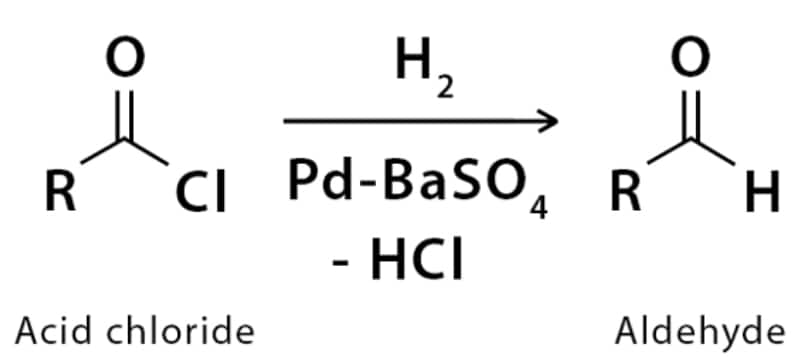
1. Rosenmund Reduction
Rosenmund's reduction is a process in which acyl chlorides are converted to aldehydes in the presence of hydrogen and a catalyst
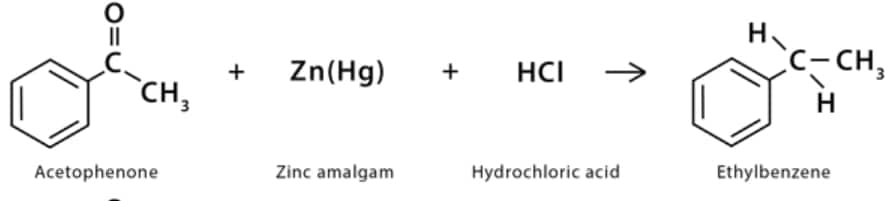
2. Clemmensen Reduction
The process through which aldehydes and ketones are converted into alkanes by using Zn(Hg) and HCl is Clemmensen Reduction.
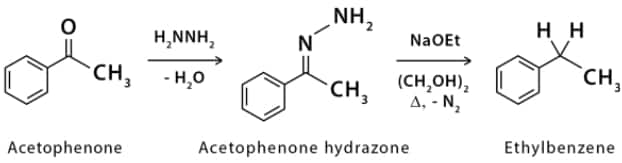
3. Wolff Kishner Reduction
To convert carbonyl compounds into alkanes by using hydrazine Wolff Kisner Reductions process is used.
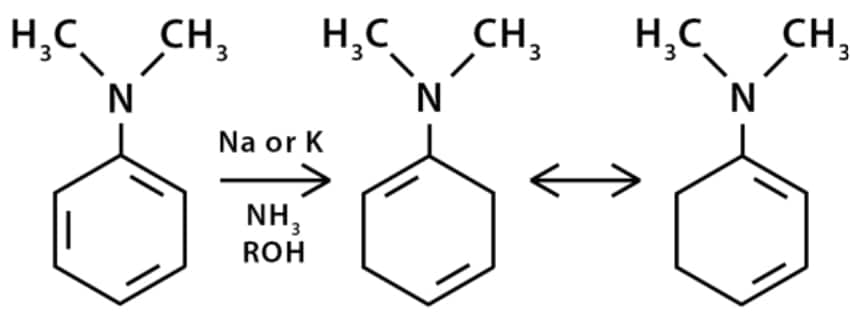
4. Birch Reduction
Birch reduction is the process in which aromatic rings reduce to non-aromatic compounds.
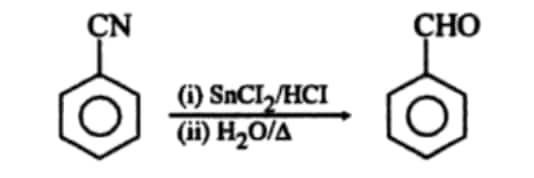
5. Stephen Reduction
Conversion of nitriles into aldehydes is carried out through the Stephen Reduction
Reduction reactions are frequently used in various questions:
Questions from the balancing of redox reactions are widely asked in the NEET Exam, and the reduction reaction is the basis behind it.
Reduction reaction is widely used in solving electrochemistry numericals.
Reduction reaction is widely used in organic reaction mechanisms
Questions involving identifying reducing agents, calculating oxidation states, or completing half-reactions are widely asked in exams.
To master the reduction formula and reactions for NEET 2026, candidates need a clear conceptual understanding along with consistent practice. A strategic approach to revision and problem-solving can significantly improve accuracy and confidence in this topic.
Revise NCERT definitions and examples thoroughly
Practice redox balancing questions regularly
Memorise important reducing agents and reactions
Focus on named reactions and mechanisms
Solve previous year NEET questions (PYQs)
Ranked among the top Dental Colleges for 7 consecutive years by India Today poll
Following these preparation tips will help you strengthen your concepts and perform better in the NEET Chemistry section.
Frequently Asked Questions (FAQs)
Reduction refers to the gain of electrons, loss of oxygen, gain of hydrogen, or decrease in oxidation number.
Lithium Aluminium Hydride (LiAlH₄) and Sodium Borohydride (NaBH₄) are the most important reducing agents.
Yes, reactions like Clemmensen, Wolff–Kishner, and Birch reduction are frequently asked.

On Question asked by student community
Hello Students,
For the NEET UG 2026 Question Paper PDF with Answer Key and Solutions, refer to the article below:
https://medicine.careers360.com/articles/neet-previous-year-question-paper-with-solution
Hello Student,
You can check the resource provided below:
Download NEET Previous 10 Years Question Papers with Solutions PDF
You can also check the NEET 2026 question paper with solutions
Hope this helps!
Hello Chetan,
Here are the links you asked for. I hope they serve your purpose.
Hello Suma,
Here are the links you asked for. I hope they serve your purpose.
Hello Bhanuday,
Here are the links you requested. I hope you find them helpful.
the product 'P' will be ,


| Column A | Column B |
| A |
a) Organisation of cellular contents and further cell growth. |
| B |
b) Leads to formation of two daughter cells. |
| C |
c) Cell grows physically and increase volume proteins,organells. |
| D |
d) synthesis and replication of DNA. |
Match the correct option as per the process shown in the
0.16 g of dibasic acid required 25 ml of decinormal solution for complete neutralisation. The modecular weight of the acid will be
32
64
128
256
0xone is

Ranked #19 by NIRF, NAAC A++ Accredited | Recognized by dental council of India
Special Scholarship for Students from Goa (Get an exclusive scholarship of ₹20,000 if you're a Goa-based student) | Bringing Parul Education Trust's 30-year Education Legacy to Goa
Ranked among the top Dental Colleges for 7 consecutive years by India Today poll