NEET PG College Predictor
NEET PG All India & State College Predictor with Admission Process Guide


Preparing for the Top 100 Topics of NEET PG 2026 will enable candidates to prioritise their high-yield topics while preparing from the exhaustive syllabus of MBBS. The latest NEET PG pattern includes 200 questions that are to be solved within 3.5 hours, making the process of topic prioritisation a necessity for time management during the revisions. Considering that the NEET PG 2026 exam date is August 30, 2026, this list of the top 100 topics of NEET PG 2026 will be based on previous years' papers, memory-based recall and recent exam trends.
This Story also Contains
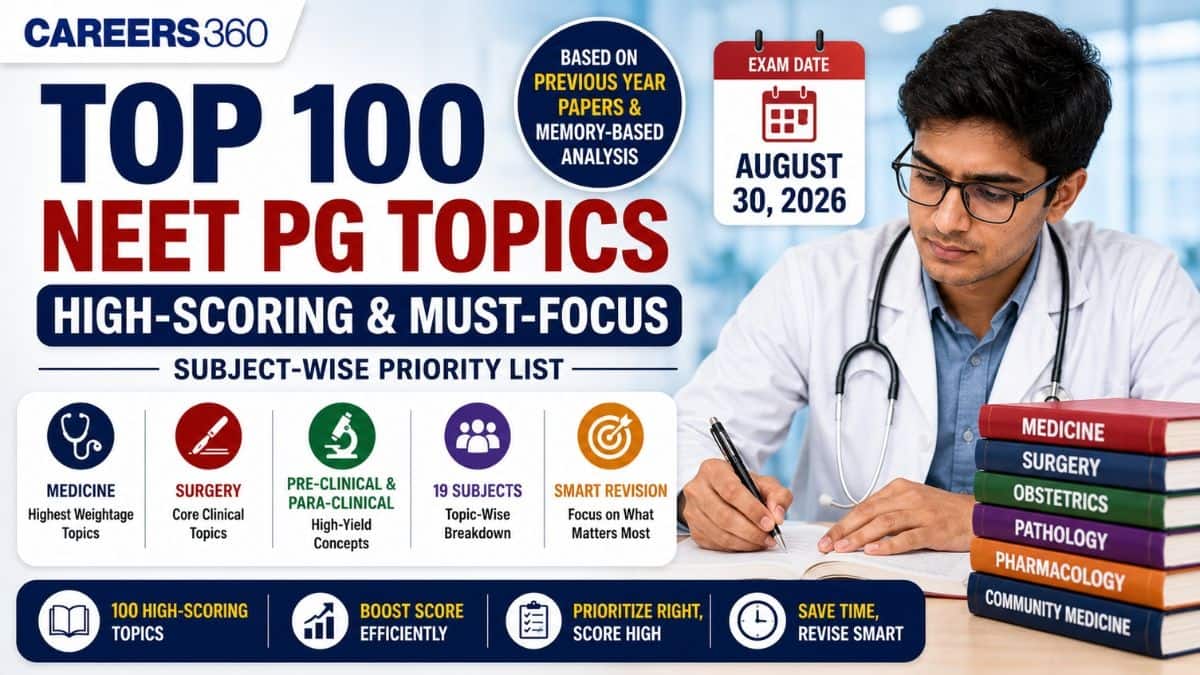
As the syllabus of the NEET PG exam consists of subjects of MBBS syllabus and the candidates do not have enough time to study each topic with equal effort in the last days of preparation, it becomes imperative to prepare from clinically and examination-wise frequent topics. However, this list will only serve the purpose of guiding candidates to prioritise revision and not an official topic-wise weightage list by NBEMS.
The Top 100 Topics of NEET PG 2026 in the following article will be compiled after analysing the trends in previous year questions, memory-based recalls and the NEET PG 2026 exam. Along with the list, the candidates must prepare themselves from NEET PG previous year questions, clinical/case-based questions, standard textbooks, and mock tests.
NEET PG is based on the entire syllabus of an MBBS course, unlike undergraduate entrance exams, which have a fixed, narrow syllabus, and it is not possible for any candidate to revise all topics from all subjects in equal depth in the weeks before the exam. Subjects also do not contribute equally to the paper. Clinical subjects such as Medicine and Surgery are tested far more frequently than subjects like Forensic Medicine or Ophthalmology, and even within a single subject, some topics recur across years while others rarely appear at all. Prioritising by weightage and recurrence, rather than moving through the syllabus in whatever order a textbook happens to present it, is what allows a candidate to cover the highest-value material first and leave lower-yield areas for whatever time remains.
Get expert advice on college selection, admission chances, and career path in a personalized counselling session.
As the NBEMS does not give an official weightage to topics for NEET PG, this list is prepared by referring to previous years' question papers, recollections from past years' NEET PG examination, recent analyses and high-yield topics. The most recent year's NEET PG question paper for analysis is that of 2025, while the NEET PG exam for the year 2026 is on August 30, 2026.
However, apart from taking into consideration the official subject syllabus and frequency of the topics, this list has taken into consideration the number of times the concepts were asked in the past examinations. The list has to be taken only as a guide and not as an official weightage list from NBEMS.
Subject | high-scoring Topics |
General Medicine | Cardiac arrhythmias and ECG interpretation; Acute coronary syndrome; Chronic kidney disease and dialysis; Diabetes mellitus complications; Thyroid disorders; Tuberculosis and NTEP regimen; HIV/AIDS and opportunistic infections; Anaemia classification and peripheral smear; Liver cirrhosis and complications; Stroke and neurological localisation; Rheumatoid arthritis and connective tissue disorders; Electrolyte imbalances; COPD; Acid-base disorders (ABG interpretation); Snake bite and poisoning |
General Surgery (incl. Ortho, Anaesthesia, Radiology) | Acute abdomen; Breast cancer staging; Thyroid nodules and surgical indications; Long bone fracture classification; Burns assessment and fluid management; Hernia types and repair; Urinary tract stones; Head injury and GCS; Peripheral vascular disease; Local anaesthetic agents and toxicity; Shock: types and management; GI malignancies; Spinal cord injury; Trauma imaging findings; Wound healing and surgical site infection |
Obstetrics & Gynaecology | Antenatal care and high-risk pregnancy; Postpartum haemorrhage; Pre-eclampsia and eclampsia; Normal labour and partograph; Ectopic pregnancy; Abnormal uterine bleeding; Ovarian cysts and tumours; Contraception methods; Cervical cancer screening and staging; Infertility evaluation |
Social & Preventive Medicine | National health programmes (NTEP, NVBDCP); Epidemiology of communicable disease; Biostatistics fundamentals; National Immunization Schedule; Maternal and child health indicators; Sensitivity and specificity of screening tests; Nutritional deficiency disorders; Environmental and occupational health |
Pathology | Neoplasia and tumour markers; Acute and chronic inflammation; Leukaemia and lymphoma; Glomerulonephritis; Cell injury and adaptation; Coagulation disorders; Genetic disorders and karyotyping; Breast and cervical pathology |
Pharmacology | Antimicrobial classification and mechanism; Anti-tubercular drugs and adverse effects; Cardiovascular drugs; Anticancer drug mechanisms; Drug interactions and adverse reactions; Autonomic nervous system pharmacology; Analgesics and anti-inflammatory drugs |
Microbiology | Bacterial classification and culture; Viral hepatitis markers; Sexually transmitted infections; Vaccines: types and composition; Fungal infections and diagnosis; Nosocomial infections and antibiotic resistance; Malaria diagnosis |
Anatomy | Brachial plexus and upper limb nerve injuries; Cranial nerves and clinical correlation; Coronary blood supply; Development of the heart and congenital anomalies; Pelvic anatomy relevant to obstetrics; Cross-sectional anatomy for imaging |
Physiology | Cardiac cycle and cardiac output regulation; Renal physiology and GFR; Endocrine feedback mechanisms (HPA, HPT axis); Nerve conduction and synaptic transmission; Respiratory physiology and gas exchange; Reproductive physiology and menstrual cycle |
Biochemistry | Carbohydrate metabolism and diabetes biochemistry; Lipid metabolism and dyslipidaemia; Enzyme kinetics and clinical enzymology; Vitamin deficiency disorders; DNA replication and mutations |
Paediatrics | Neonatal jaundice; Developmental milestones; Childhood immunisation; Common paediatric nutritional deficiencies |
Forensic Medicine | Medico-legal aspects of injuries; Asphyxial deaths; Forensic toxicology |
ENT | Otitis media and complications; Nasal polyps and sinusitis; Laryngeal carcinoma |
Ophthalmology | Cataract types and management; Glaucoma classification; Diabetic retinopathy |
The Top 100 NEET PG Topics should be used as a guide for prioritising revision rather than a list to be ticked off. Go through the high-yield topics multiple times, leaving longer and longer intervals between each revision, and solve relevant questions after each revision session to enhance retention and clinical understanding.
Go through all the high-priority topics multiple times in your preparation phase, i.e., 2–3 times per topic.
Practice previous year NEET PG and memory-based questions regarding the topic.
Try focusing on clinical or case-based questions instead of factual ones.
Analyse your mistakes and revise difficult concepts.
Keep in view the recent recall trends to revise accordingly.
One may use Careers360 NEET PG previous year question papers and NEET PG mock tests along with the above topic-wise revision technique. Candidates may also refer to the best books for NEET PG.
Frequently Asked Questions (FAQs)
No. NBEMS does not publish an official topic-wise or subject-wise weightage for NEET PG. This list is compiled from patterns across previous year papers, memory-based recall sets, and review book emphasis.
Each subject's share was based on its approximate historical weightage in the exam, so subjects like Medicine and Surgery, which carry more questions, were allotted more topics than subjects like ENT or Ophthalmology.
No. These topics are meant to guide prioritisation within a revision plan, not replace coverage of the full syllabus. NEET PG can and does ask questions outside any fixed high-scoring list.
The topic list is based on subject content and historical trends rather than the exam's question count or sectional structure, so it should remain broadly stable even if the format changes again, though periodic review is still advisable.
Ideally after each exam cycle, once new memory-based papers and trend data become available, to check whether the relative emphasis across subjects and topics has shifted.

On Question asked by student community
Hello, the NEET PG stipend at Parul University depends on the postgraduate course, academic year and applicable university policies.
Hello Student,
If you are looking for information about NEET PG 2025 DNB seat allotment and the fees payable at the allotted college or hospital, DNB seats are allotted through the respective counselling process based on your rank, category, choice of speciality, and seat availability.
For the 2025 session, the
Dear Student, with a NEET PG 2026 rank of 6,600 in the EWS category, your options should be assessed using the relevant counselling year's college-wise closing ranks, category-wise seats and counselling round. Please also confirm whether you are applying through the applicable All India counselling route or another quota. That
Hello, with a NEET PG rank of 11,000, your chances of getting MS ENT at Government Medical College, Thiruvananthapuram depend on your category, state quota, counselling round and previous year’s closing rank. You can check the cutoff details here: https://medicine.careers360.com/articles/kerala-neet-pg-cut-off
Dear Student, with a NEET PG rank of 8,571, you can explore DNB Pediatrics options through the relevant counselling process. If Bangalore is your preferred location, it would be useful to compare the available hospitals on factors such as patient load, paediatric case exposure, teaching environment, stipend, bond conditions and

NEET PG All India & State College Predictor with Admission Process Guide
End-to-End NEET PG Admission Guidance | One-to-One Counselling | College Predictors | Regular Updates | E-books