Emversity Allied Health Programs
Get Job Ready in Healthcare | Employability-Focused Programs


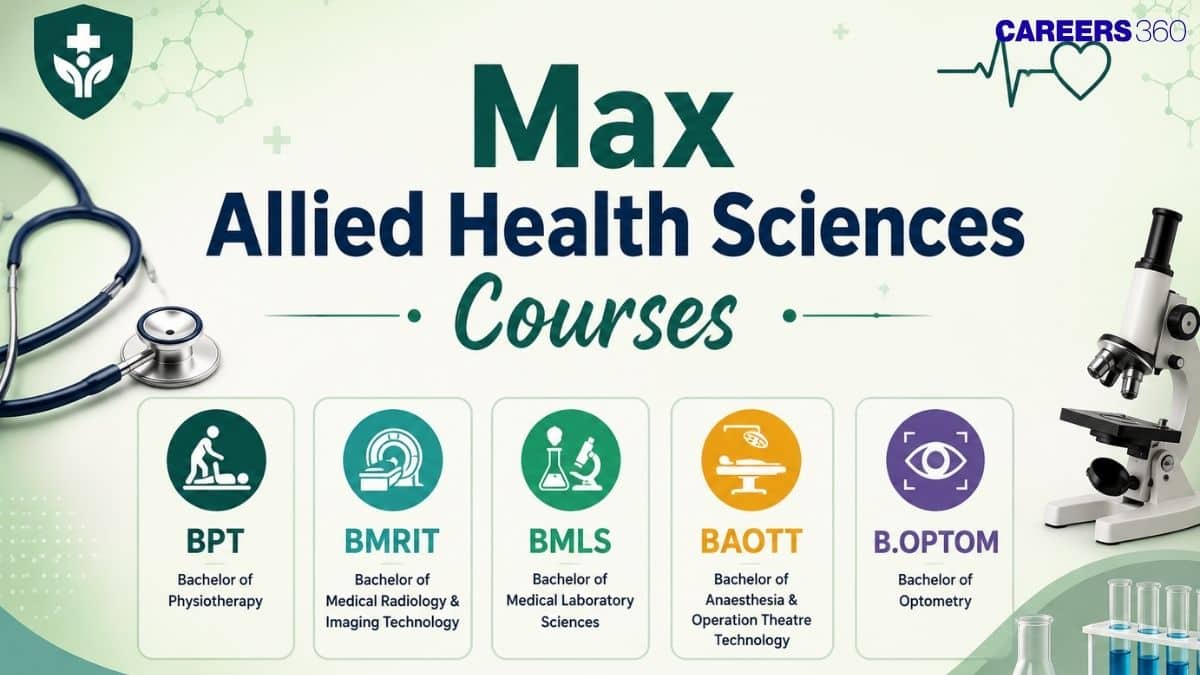
Picking a healthcare career does not always mean clearing NEET or spending six years on an MBBS. If you are someone who wants to start working in a hospital environment sooner, allied health is where a lot of students end up landing and Max Healthcare has built a full lineup of courses around exactly that. Through its Institute of Allied and Paramedical Education, Max trains students for roles like lab technicians, radiology assistants, OT staff, dialysis technicians, and optometrists, with actual hospital floors to practice on instead of just textbooks. Here's what the 2026 course list looks like:
This Story also Contains
Course levels: Bachelor's (B.Sc.), Diploma, and Certificate programmes.
Number of Allied Health Sciences Courses: 15 Courses
Duration: 3 years for Bachelor degree except Bachelors of Optometry which is a 4-year allied health sciences program.
Eligibility: Class 12 pass out students with PCB or PCM subjects.
Placement support: Max claims 100% placement assistance for eligible students.
Campuses: Vaishali, Rohini, and South Delhi, and Lucknow.
Course Name | Duration | Eligibility | Degree/Certificate Awarded |
B.Sc. Medical Laboratory Technology (BSc MLT) | 3 Years | 12th pass with PCB/PCM | B.Sc. (MLT) |
B.Sc. Medical Radiology & Imaging Technology (BSc MRIT) | 3 Years | 12th pass with PCB/PCM | B.Sc. (Radiology) |
B.Sc. Operation Theatre Technology (BSc OTT) | 3 Years | 12th pass with PCB/PCM | B.Sc. (OTT) |
B.Sc. Cardiovascular Technology (Cath Lab) (BSc CVT) | 3 Years | 12th pass with PCB/PCM, min. age 17 | B.Sc. (Cardiovascular Tech) |
B.Sc. Dialysis Therapy Technology (BSc DDT) | 3 Years | 12th pass with PCB/PCM | B.Sc. (Dialysis Therapy) |
B.Sc. Clinical Psychology | 3 Years | 12th pass | B.Sc. (Clinical Psychology) |
B.Sc. Respiratory Technology (BSc RT) | 3 Years | 12th pass with PCB/PCM | B.Sc. (Respiratory Tech) |
Bachelor of Optometry (B.Optom) | 4 Years | 12th pass with PCB/PCM | B.Optometry |
Diploma in Medical Laboratory Technology | 2 Years | 12th pass (PCB/PCM 40% or other stream 50%) | Diploma (DMLT) |
Diploma in Radiology Technician | 2 Years | 12th pass (PCB/PCM 40% or other stream 50%) | Diploma |
Diploma in Operation Theatre Technician | 2 Years | 12th pass (PCB/PCM 40% or other stream 50%) | Diploma |
Diploma in Dialysis Technician | 2 Years | 12th pass (PCB/PCM 40% or other stream 50%) | Diploma |
Diploma in Cardiac Care Technology | 2 Years | 12th pass (PCB/PCM 40% or other stream 50%) | Diploma |
Diploma in Vision Technician | Not specified | Not specified on site | Diploma |
Certificate in Billing Excellence & Patient Experience | Not specified | Not specified on site | Certificate |
Get expert advice on college selection, admission chances, and career path in a personalized counselling session.
1- B.Sc. Medical Laboratory Technology (BMLT): This course trains in handling lab equipment, and carrying out laboratory tests. Bachelor of Science in MLT is ideal for candidates who are interested in diagnostic centres or hospital labs.
2- B.Sc. Medical Radiology & Imaging Technology: This course will train in imaging technologies like MRI, X-ray, ultrasound and CT scan. Graduates support doctors with imaging reports that are critical for almost every treatment plan.
3- B.Sc. Operation Theatre Technology: Ever wondered who keeps the OT running smoothly behind the scenes? That's this course. You will learn sterilisation, equipment handling, and how to assist surgeons and anaesthetists mid-procedure. If watching a surgery sounds exciting rather than nerve-wracking, this could be your track.
4- B.Sc. Cardiovascular Technology (Cath Lab): Heart-related work, basically. The course gets into cardiac catheterisation, ECG, echocardiography, and hemodynamics, a lot of technical ground, but it pays off once you are standing next to a cardiologist during an angioplasty. Not many undergrad courses put you that close to the actual procedure.
5- B.Sc. Dialysis Therapy Technology: This is about learning to operate dialysis machines and care for patients going through renal failure. It sounds niche, but kidney disease numbers in India aren't slowing down, so demand for trained dialysis staff keeps growing right along with it.
6- B.Sc. Clinical Psychology: This allied health sciences program involves human behaviour and mental health study. Graduates can work as a counselor, and clinical assistant.
7- B.Sc. Respiratory Technology: Pulmonary function testing and respiratory equipment are the core of this one. Most graduates work in ICUs or critical care units, helping patients who need support just to breathe. It's intense work, but always in demand.
8- Bachelors of Optometry: The longest programme on this list, four years instead of three. You will cover eye examination, vision testing, and corrective devices, but optometry today goes beyond glasses. A routine eye check can actually catch early signs of diabetes, which says a lot about how far the field has come.
9- Diploma courses (MLT, Radiology, OT, Dialysis, Cardiac Care): These are shorter, 2-year, skill-focused versions of the bachelor's programmes above, a quicker route into hospital support roles.
10- Diploma in Vision Technician: Trains students to assist ophthalmologists and optometrists with eye examination and optical instruments in clinics and eye hospitals.
Allied health graduates from Max are trained for hands-on hospital roles, and the job scope is fairly wide:
Lab technology graduates can work as lab technicians, pathology assistants, or in blood banks and diagnostic centres.
Radiology graduates usually go into hospitals or imaging centres, working with X-ray, CT, and MRI equipment.
If OT technology's your track, you're looking at roles as an operation theatre technician or a surgical assistant.
Cardiovascular and respiratory course students often work in cath labs, ICUs, or cardiac care units.
Dialysis graduates have a few directions to go- hospital dialysis units, nephrology departments, or one of the many standalone dialysis centres that have opened up in recent years.
Optometry and vision technician graduates can work in eye hospitals, optical retail chains, and vision clinics.
Clinical psychology graduates can move into counselling support roles or pursue further study in mental health.
Certificate-course graduates (billing, TPA, medical records, transcription) find work in hospital administration, insurance companies, and health-tech firms.
Since Max Healthcare runs 21+ hospital facilities, students also get a direct pathway to clinical postings and, in many cases, placement support within the Max network itself.
Frequently Asked Questions (FAQs)
Max offers various B.Sc. and diploma programmes in lab technology, radiology, OT technology, cardiovascular technology, dialysis therapy, respiratory technology, optometry, and clinical psychology. On top of that, Max also offers a short certificate course i.e. Certificate in Billing Excellence and Patient Experience for people looking to upskill quickly.
Passing Class 12 (usually with PCB or PCM) covers most bachelor's and diploma programmes.
Three years, for the most bachelor degree courses. Optometry breaks that pattern a little as it takes four years.
Yes, Max diploma in allied health sciences courses are of 2 years while Max B.Sc. courses in allied health sciences are of 3 years.
Max states it offers 100% placement assistance, along with clinical postings at its hospital facilities during the course.

On Question asked by student community
Hello, some B.Sc Nursing colleges may offer admission without NEET, but the admission process depends on the college and its eligibility rules. You can find colleges offering B.Sc Nursing admission without NEET here: https://medicine.careers360.com/articles/bsc-nursing-admission-without-neet
Hello, you can pursue BPT in Kerala without NEET UG. Admission is generally based on the LBS Centre rank list and the applicable admission process. You can check BPT colleges in Kerala and their details here: https://medicine.careers360.com/colleges/list-of-bpt-in-physiotherapy-colleges-in-kerala
Hello Student,
If you are looking for information about NEET PG 2025 DNB seat allotment and the fees payable at the allotted college or hospital, DNB seats are allotted through the respective counselling process based on your rank, category, choice of speciality, and seat availability.
For the 2025 session, the
Dear Student, with a NEET PG 2026 rank of 6,600 in the EWS category, your options should be assessed using the relevant counselling year's college-wise closing ranks, category-wise seats and counselling round. Please also confirm whether you are applying through the applicable All India counselling route or another quota. That
Hello
If you mean whether a school/college will be strict about attendance when you are preparing for NEET UG, it depends on the institution’s rules. NEET preparation itself is generally not a reason to ignore regular attendance.
For example, CBSE requires 75% attendance for board-exam eligibility, with limited relaxation for
the product 'P' will be ,


| Column A | Column B |
| A |
a) Organisation of cellular contents and further cell growth. |
| B |
b) Leads to formation of two daughter cells. |
| C |
c) Cell grows physically and increase volume proteins,organells. |
| D |
d) synthesis and replication of DNA. |
Match the correct option as per the process shown in the
0.16 g of dibasic acid required 25 ml of decinormal solution for complete neutralisation. The modecular weight of the acid will be
32
64
128
256
0xone is

Know possible Govt/Private MBBS/BDS Colleges based on your NEET rank
College Predictors Webinars One to One Counselling Regular Updates Medical Almanac
Highest Package: ₹32 LPA | Placement Rate: 90% students placed | 5000+ Students Placed 900+ Placements Recruiters | Scholarships Available
33.5 LPA-Highest Package | Up to 100% scholarship worth 30 CR
Get Job Ready in Healthcare | Employability-Focused Programs
Get Started With Your Healthcare Career. 2026 Admissions open.