Emversity Allied Health Programs
Get Job Ready in Healthcare | Employability-Focused Programs


NEET 2027 High-Weightage Chapters in Biology: Biology decides the NEET result more than any other subject. It carries 360 out of 720 marks. 50% of the paper is spread across 90 questions from Botany and Zoology combined, which makes it the single biggest section in the NEET exam. The biology syllabus is enormous, and not every chapter pulls its weight equally at exam time. Some chapters have shown up in nearly every NEET paper in the last six years. Other chapters appear rarely. Knowing chapter-wise weightage helps you plan your preparation.
This Story also Contains
This article breaks down NEET 2027 Biology by actual chapter-wise weightage, built from a six-year analysis (2021–2026) of previous NEET papers. The NTA does not publish an official weightage list for any subject, so every "important chapters" list is derived from question-count patterns across past papers. This analysis is built on the current rationalised NEET syllabus. Note that NTA has not yet released the official NEET 2027 syllabus. So treat this as a preparation-planning guide to be cross-checked once the official notification is out.
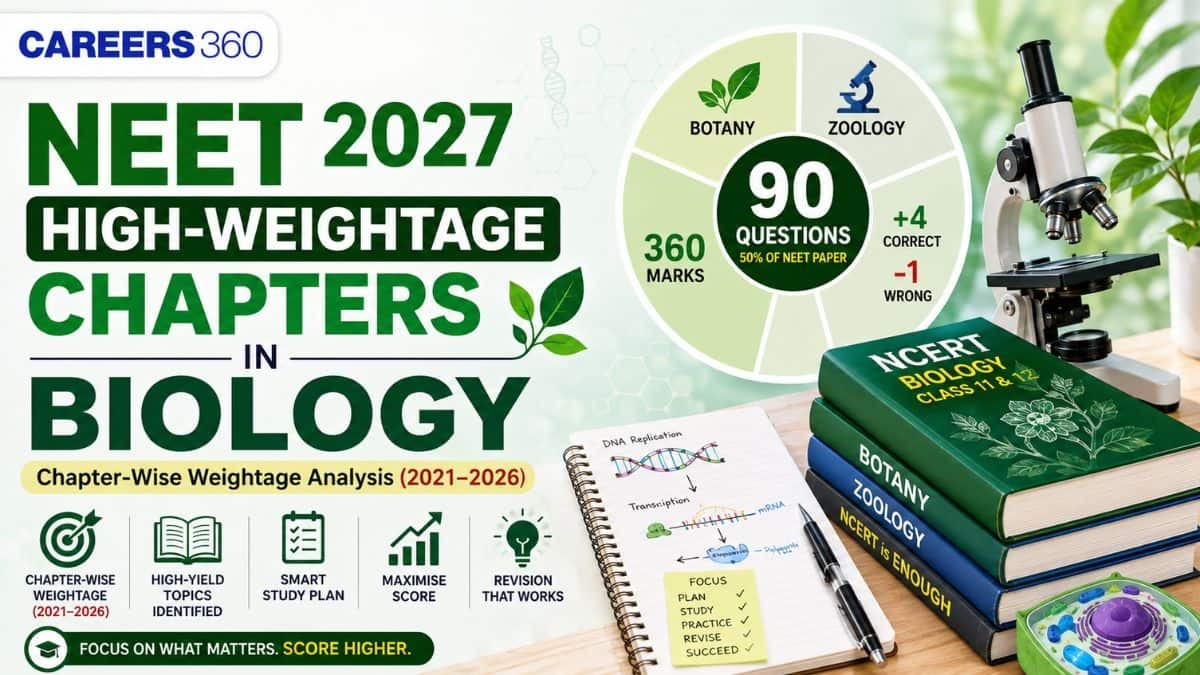
Biology contributes 90 questions out of 180 total NEET questions — 50% of the paper. Biology carries 360 marks out of 720 total marks. Each correct answer scores +4; each incorrect answer deducts 1 mark; unattempted questions score zero. Biology is split into Botany and Zoology, drawn from the Class 11 and Class 12 NCERT syllabus
Get expert advice on college selection, admission chances, and career path in a personalized counselling session.
The table below shows how many questions each chapter contributed across the last six NEET papers, including the 2026 paper. Use this for chapter prioritisation. Chapters at the top deserve repeated revision cycles, while chapters near the bottom need only a single careful pass.
Chapter | 2021 | 2022 | 2023 | 2024 | 2025 | 2026 | Weightage |
Molecular Basis of Inheritance | 11 | 9 | 7 | 6 | 7 | 4 | 8.07% |
Biotechnology: Principles & Processes | 8 | 6 | 5 | 7 | 4 | 6 | 6.61% |
Animal Kingdom | 5 | 4 | 4 | 6 | 6 | 4 | 5.32% |
Sexual Reproduction in Flowering Plants | 8 | 6 | 3 | 2 | 3 | 4 | 4.77% |
Principles of Inheritance & Variation | 2 | 4 | 5 | 6 | 5 | 4 | 4.77% |
Human Health and Disease | 4 | 4 | 4 | 4 | 7 | 2 | 4.59% |
Biomolecules | 3 | 3 | 3 | 5 | 6 | 5 | 4.59% |
Cell Cycle and Cell Division | 5 | 6 | 6 | 5 | 0 | 2 | 4.40% |
Human Reproduction | 3 | 4 | 3 | 4 | 7 | 3 | 4.40% |
Structural Organisation in Animals | 5 | 4 | 5 | 2 | 3 | 3 | 4.04% |
Cell: The Unit of Life | 3 | 3 | 2 | 4 | 3 | 4 | 3.49% |
Morphology of Flowering Plants | 4 | 1 | 3 | 5 | 3 | 2 | 3.30% |
Ecosystem | 3 | 4 | 2 | 1 | 5 | 3 | 3.30% |
Anatomy of Flowering Plants | 3 | 3 | 3 | 4 | 2 | 3 | 3.30% |
Organisms & Populations | 4 | 3 | 4 | 2 | 2 | 3 | 3.30% |
Biotechnology & Its Application | 3 | 4 | 2 | 2 | 3 | 3 | 3.12% |
Evolution | 3 | 2 | 2 | 4 | 1 | 5 | 3.12% |
Photosynthesis in Higher Plants | 2 | 2 | 3 | 3 | 2 | 3 | 2.75% |
Chemical Coordination and Integration | 1 | 0 | 2 | 4 | 6 | 1 | 2.57% |
Plant Kingdom | 0 | 3 | 3 | 1 | 6 | 1 | 2.57% |
Biodiversity and Conservation | 0 | 0 | 2 | 5 | 2 | 5 | 2.57% |
Reproductive Health | 4 | 2 | 2 | 2 | 0 | 2 | 2.20% |
Microbes in Human Welfare | 2 | 2 | 1 | 1 | 4 | 2 | 2.20% |
Breathing and Exchange of Gases | 3 | 3 | 1 | 2 | 0 | 3 | 2.20% |
Plant Growth and Development | 1 | 2 | 2 | 2 | 1 | 3 | 2.02% |
Locomotion and Movement | 1 | 3 | 2 | 2 | 0 | 1 | 1.65% |
Biological Classification | 2 | 2 | 0 | 2 | 1 | 1 | 1.47% |
Respiration in Plants | 1 | 1 | 2 | 2 | 0 | 1 | 1.28% |
Excretory Products and Elimination | 0 | 0 | 2 | 2 | 1 | 2 | 1.28% |
Body Fluids & Circulation | 0 | 2 | 1 | 2 | 0 | 2 | 1.28% |
Environmental Issues | 1 | 1 | 4 | 0 | 0 | 0 | 1.10% |
Neural Control and Coordination | 0 | 0 | 2 | 1 | 0 | 2 | 0.92% |
Reproduction in Organisms | 0 | 1 | 0 | 0 | 0 | 0 | 0.18% |
The Living World appeared as a separately-tagged chapter for the first time in the 2026 analysis (1 question), distinct from Biological Classification — too new a data point to weight reliably yet, so it's tracked separately here rather than folded into the six-year average above.
Molecular Basis of Inheritance sits at the top of this list for a reason. It has consistently produced the most questions of any single chapter across all six years analysed, 2026 included. DNA replication, transcription, translation, and gene regulation (the lac operon in particular) are tested repeatedly and reward deep conceptual understanding over surface memorisation.
Biotechnology: Principles and Processes is the second-highest contributor and also one of the most scoring, since its content — restriction enzymes, PCR, recombinant DNA technology, and vectors — is precise and fact-based rather than conceptually murky. Its 2026 count (6 questions) was its highest in the entire six-year window, reinforcing rather than breaking the trend.
Animal Kingdom anchors the zoology-diversity portion of the paper and has stayed remarkably consistent every year, including 2026. Classification criteria, phylum-level distinguishing features, and examples are the recurring question format here.
Sexual Reproduction in Flowering Plants and Principles of Inheritance and Variation now sit just above Human Health and Disease once 2026 is factored in — both held steady with 4 questions in 2026. Genetics questions in particular tend to be problem-based (Mendelian crosses, pedigree analysis) rather than pure recall, so this pair benefits from practice with numerical and diagrammatic questions, not just reading.
Human Health and Disease and Biomolecules are effectively tied for the next spot. Human Health and Disease dipped in 2026 (2 questions, its lowest in the window) while Biomolecules had a strong year (5 questions) — worth watching both closely rather than assuming last year's pattern repeats.
Cell Cycle and Cell Division, Human Reproduction, and Structural Organisation in Animals round out the top tier and have all stayed reliably in the 3–4 question range for multiple years running, including 2026.
Broadly, the high-weightage chapters are spread across both years rather than concentrated in one:
Class 11: Animal Kingdom, Plant Kingdom, Structural Organisation in Animals, Cell: The Unit of Life, Cell Cycle and Cell Division, Biomolecules, Morphology and Anatomy of Flowering Plants
Class 12: Molecular Basis of Inheritance, Principles of Inheritance and Variation, Biotechnology (both chapters), Human Reproduction, Sexual Reproduction in Flowering Plants, Human Health and Disease, Ecosystem, Organisms and Populations
If you're starting NEET 2027 preparation early, from Class 11, don't push genetics and biotechnology to "later" simply because they're Class 12 topics. Their weightage is too high to leave for a quick final revision. If Biology feels overwhelming on its own, subject-specific NEET biology preparation tips can help you sequence this alongside Class 11 and 12 coursework rather than treating exam prep as a separate track.
Biology decides half the paper, but Physics and Chemistry still carry 360 marks between them. Once the Biology list is under control, work through the equivalent high-weightage Physics chapters for NEET and high-weightage Chemistry chapters for NEET, or see all three subjects mapped together in one place via the combined NEET high-weightage chapters list.
Don't treat every chapter in the table the same way. Chapters above roughly 4% weightage need multiple revision cycles and question practice across the full preparation timeline. Chapters with the 2–4% weightage need one solid study pass plus revision closer to the exam. Chapters below 2% weightage still need coverage. NEET occasionally surprises candidates by framing questions from a normally low-yield chapter, which is why even the lower-weightage chapters in the do-or-die chapters for NEET list must be studied.
Once your chapter priorities are set, include the right NEET study material and previous year NEET question papers. So, you're not just memorising a weightage list but seeing exactly how these chapters get tested in practice.
Also Read:
Frequently Asked Questions (FAQs)
Based on six-year trend analysis (2021–2026, including the 2026 paper), Molecular Basis of Inheritance has produced the most consistent question count of any single chapter, followed closely by Biotechnology: Principles and Processes and Animal Kingdom.
NTA has not released the official NEET 2027 syllabus at the time of writing. The analysis in this article is based on the current rationalised NCERT syllabus, which already excludes chapters like Transport in Plants, Mineral Nutrition, Digestion and Absorption, and Strategies for Enhancement in Food Production.
No. Low-weightage chapters (below roughly 2%) still need to be studied at least once, since NEET occasionally draws more questions than usual from a normally minor chapter. The weightage data should guide how much revision time each chapter gets, not whether you study it at all.

On Question asked by student community
Hello, you can pursue BPT in Kerala without NEET UG. Admission is generally based on the LBS Centre rank list and the applicable admission process. You can check BPT colleges in Kerala and their details here: https://medicine.careers360.com/colleges/list-of-bpt-in-physiotherapy-colleges-in-kerala
Hello Student,
If you are looking for information about NEET PG 2025 DNB seat allotment and the fees payable at the allotted college or hospital, DNB seats are allotted through the respective counselling process based on your rank, category, choice of speciality, and seat availability.
For the 2025 session, the
Dear Student, with a NEET PG 2026 rank of 6,600 in the EWS category, your options should be assessed using the relevant counselling year's college-wise closing ranks, category-wise seats and counselling round. Please also confirm whether you are applying through the applicable All India counselling route or another quota. That
Hello
If you mean whether a school/college will be strict about attendance when you are preparing for NEET UG, it depends on the institution’s rules. NEET preparation itself is generally not a reason to ignore regular attendance.
For example, CBSE requires 75% attendance for board-exam eligibility, with limited relaxation for
Hello Student,
Aapke NEET marks 372 aur AIR 3,51,532 hain. Lekin 3rd round mein MBBS seat ke liye counselling karani chahiye ya nahi, iska sahi answer dene ke liye mujhe aapki category, domicile state, aur aap AIQ se counselling kar rahe hain ya state quota se—ye details chahiye.
In details
the product 'P' will be ,


| Column A | Column B |
| A |
a) Organisation of cellular contents and further cell growth. |
| B |
b) Leads to formation of two daughter cells. |
| C |
c) Cell grows physically and increase volume proteins,organells. |
| D |
d) synthesis and replication of DNA. |
Match the correct option as per the process shown in the
0.16 g of dibasic acid required 25 ml of decinormal solution for complete neutralisation. The modecular weight of the acid will be
32
64
128
256
0xone is

Know possible Govt/Private MBBS/BDS Colleges based on your NEET rank
College Predictors Webinars One to One Counselling Regular Updates Medical Almanac
Highest Package: ₹32 LPA | Placement Rate: 90% students placed | 5000+ Students Placed 900+ Placements Recruiters | Scholarships Available
33.5 LPA-Highest Package | Up to 100% scholarship worth 30 CR
Get Job Ready in Healthcare | Employability-Focused Programs
Get Started With Your Healthcare Career. 2026 Admissions open.