Emversity Allied Health Programs
Get Job Ready in Healthcare | Employability-Focused Programs


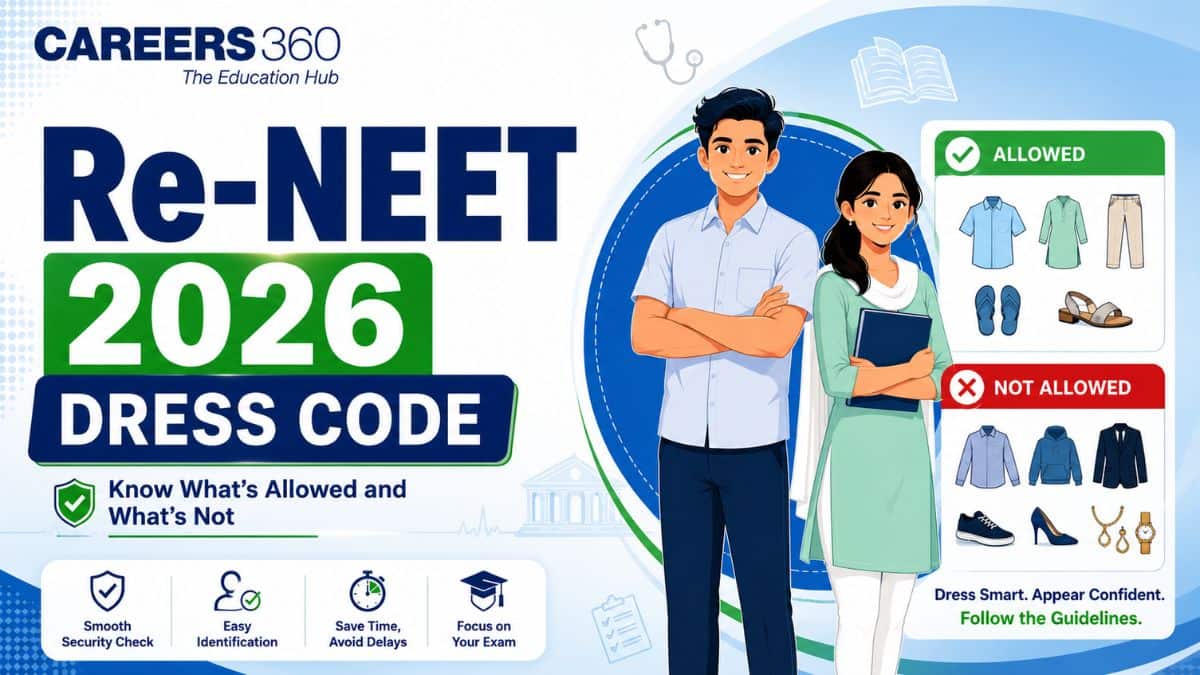
The National Testing Agency (NTA) has prescribed a specific Re NEET Dress Code 2026 for all candidates appearing in the examination on June 21, 2026. Students must follow the official dress code to ensure smooth entry into the examination centre and avoid any inconvenience during the security check process. The Re NEET 2026 dress code for male candidates and female candidates includes guidelines regarding clothing, footwear, accessories, and prohibited items. Candidates are advised to carefully check the dress code instructions before leaving for the exam centre.
This Story also Contains
Particulars | Details |
Exam name | |
Conducting body | National Testing Agency (NTA) |
Exam date | June 21, 2026 |
Dress code applicable | Yes |
Footwear allowed | Slippers and low-heeled sandals |
Shoes allowed | No |
Metal accessories allowed | No |
Get expert advice on college selection, admission chances, and career path in a personalized counselling session.
Male candidates appearing for the Re NEET 2026 examination must wear simple and comfortable clothes. The Re NEET 2026 dress code for male candidates is as follows.
Half-sleeve shirts or T-shirts: Candidates should wear simple half-sleeve shirts or T-shirts to make the security checking process quicker and hassle-free.
Simple trousers or pants: Plain trousers or pants without extra designs, chains, or accessories are allowed inside the examination centre.
Light-coloured clothes: Wearing light-coloured clothing is recommended as it helps in easy identification during security checks and verification.
Slippers or low-heeled sandals: Candidates can wear slippers or simple low-heeled sandals, as they are comfortable and comply with exam dress code guidelines.
Clothing without large pockets: Clothes should not have large or multiple pockets to avoid delays during frisking and security screening.
Full-sleeve shirts: Full-sleeve shirts are generally not allowed because they can make the security checking process more time-consuming.
Jackets and blazers: Candidates should avoid wearing jackets or blazers, as these extra layers are restricted at examination centres.
Hoodies: Hoodies are prohibited because they can conceal items and may lead to additional checking by security personnel.
Shoes and boots: Closed footwear such as shoes and boots is not permitted. Candidates should wear slippers or sandals instead.
Sunglasses: Sunglasses are not allowed inside the examination hall and should be removed before entering the centre.
Caps and hats: Caps, hats, and similar headwear are prohibited unless allowed for specific religious or medical reasons.
Metallic accessories: Items such as chains, bracelets, rings, watches, and other metallic accessories should not be worn during the examination.
Female candidates should wear simple clothing that does not create difficulties during frisking and security checks. The Re NEET 2026 dress code for female candidates is as follows.
Half-sleeve tops: Candidates can wear simple half-sleeve tops, as they are comfortable and help security personnel complete verification quickly.
Simple kurtis: Plain and simple kurtis without heavy embroidery, decorative work, or extra layers are generally permitted at exam centres.
Salwar and leggings: Salwar suits with simple leggings are allowed, provided they do not have unnecessary pockets or metallic attachments.
Light-weight clothing: Light-weight and comfortable clothing is recommended to ensure smooth security checks and a hassle-free examination experience.
Slippers or low-heeled sandals: Girls can wear slippers or low-heeled sandals, as they are permitted under most examination dress code guidelines.
Heavy embroidered dresses: Dresses with heavy embroidery, decorative work, sequins, or multiple layers should be avoided during the examination.
Long sleeves: Full-sleeve or long-sleeve outfits are generally not allowed because they can delay the frisking and verification process.
High heels: High-heeled footwear is prohibited at examination centres. Candidates should choose simple and comfortable alternatives instead.
Shoes and boots: Closed footwear such as shoes and boots is not permitted and may create issues during security checks.
Jewellery and ornaments: Candidates should avoid wearing earrings, necklaces, bangles, rings, and other ornaments inside the examination centre.
Hair clips containing metal: Hair accessories made of metal, including clips and pins, should not be worn on exam day.
Watches and electronic accessories: Watches, smartwatches, fitness bands, earphones, and other electronic devices are strictly prohibited inside the examination hall.
Candidates must follow the dress code guidelines issued by NTA on the examination day.
Allowed Items | Prohibited Items |
Admit Card | Mobile Phones |
Valid ID Proof | Smart Watches |
Passport Size Photograph | Bluetooth Devices |
Transparent Water Bottle (if permitted) | Calculators |
PwD Certificate (if applicable) | Electronic Gadgets |
Low-Heeled Sandals | Jewellery |
Candidates are advised to wear simple footwear while reporting to the examination centre.
Slippers: Candidates are allowed to wear simple slippers, as they are comfortable and help speed up security checks at the examination centre.
Open sandals with low heels: Open sandals with low heels are permitted because they are easy to inspect during the frisking process.
Shoes: Closed shoes are generally prohibited at examination centres as they may require additional security checking before entry.
Sports shoes: Sports shoes are not allowed because they are considered closed footwear and can delay the verification process.
Boots: Boots of any type are prohibited inside the examination centre due to strict security and dress code regulations.
High heels: Candidates should avoid wearing high heels, as they are not permitted under the prescribed exam day guidelines.
Platform heels: Platform heels are also prohibited and candidates are advised to choose simple, low-heeled footwear instead.
Candidates should follow these important instructions on the examination day:
Reach the exam centre before the reporting time.
Carry the admit card and valid ID proof.
Follow the prescribed Re NEET dress code 2026.
Avoid carrying prohibited items.
Cooperate with security personnel during frisking.
Check all instructions mentioned on the admit card.

On Question asked by student community
Hello, you can pursue BPT in Kerala without NEET UG. Admission is generally based on the LBS Centre rank list and the applicable admission process. You can check BPT colleges in Kerala and their details here: https://medicine.careers360.com/colleges/list-of-bpt-in-physiotherapy-colleges-in-kerala
Hello Student,
If you are looking for information about NEET PG 2025 DNB seat allotment and the fees payable at the allotted college or hospital, DNB seats are allotted through the respective counselling process based on your rank, category, choice of speciality, and seat availability.
For the 2025 session, the
Dear Student, with a NEET PG 2026 rank of 6,600 in the EWS category, your options should be assessed using the relevant counselling year's college-wise closing ranks, category-wise seats and counselling round. Please also confirm whether you are applying through the applicable All India counselling route or another quota. That
Hello
If you mean whether a school/college will be strict about attendance when you are preparing for NEET UG, it depends on the institution’s rules. NEET preparation itself is generally not a reason to ignore regular attendance.
For example, CBSE requires 75% attendance for board-exam eligibility, with limited relaxation for
Hello Student,
Aapke NEET marks 372 aur AIR 3,51,532 hain. Lekin 3rd round mein MBBS seat ke liye counselling karani chahiye ya nahi, iska sahi answer dene ke liye mujhe aapki category, domicile state, aur aap AIQ se counselling kar rahe hain ya state quota se—ye details chahiye.
In details
the product 'P' will be ,


| Column A | Column B |
| A |
a) Organisation of cellular contents and further cell growth. |
| B |
b) Leads to formation of two daughter cells. |
| C |
c) Cell grows physically and increase volume proteins,organells. |
| D |
d) synthesis and replication of DNA. |
Match the correct option as per the process shown in the
0.16 g of dibasic acid required 25 ml of decinormal solution for complete neutralisation. The modecular weight of the acid will be
32
64
128
256
0xone is

Know possible Govt/Private MBBS/BDS Colleges based on your NEET rank
College Predictors Webinars One to One Counselling Regular Updates Medical Almanac
Highest Package: ₹32 LPA | Placement Rate: 90% students placed | 5000+ Students Placed 900+ Placements Recruiters | Scholarships Available
33.5 LPA-Highest Package | Up to 100% scholarship worth 30 CR
Get Job Ready in Healthcare | Employability-Focused Programs
Get Started With Your Healthcare Career. 2026 Admissions open.