SRM Kattankulathur Dental College and Hospital, Kattankulathur
Ranked #19 by NIRF, NAAC A++ Accredited | Recognized by dental council of India


Building a NEET CBT-Ready Test Routine: NEET 2027 is moving to Computer-Based Test (CBT) mode, and that changes more than just how you fill in answers. It changes how you should practise, too. Most NEET aspirants already know they need mock tests. But if every single mock test you take is on paper, you're only preparing for half the exam. NEET UG 2027 will run fully on computers, so your practice routine needs a digital test calendar, not just a study timetable. This guide gives you a simple, week-by-week test plan built around screen-based mock tests, so CBT mode feels normal by the time exam day actually arrives.
This Story also Contains
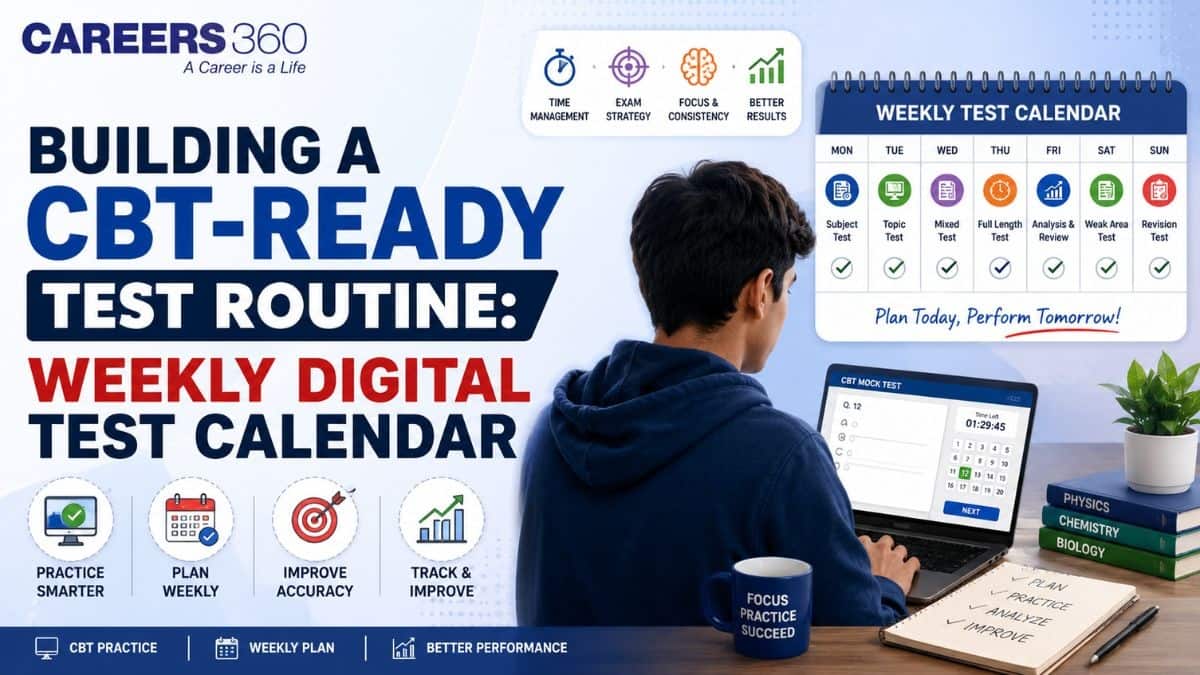
A weekly digital test calendar is not the same as a study plan. A study plan tells you what to read. A test calendar tells you when to test yourself, on what topic or chapter, and for how long. All of this on a screen, the same way you will sit for the real NEET 2027 CBT mode exam. This is important for every NEET aspirant, but it matters even more for repeaters who have spent months, sometimes years, practising only with pen and OMR sheets. Below is a complete weekly test calendar, built for both fresh aspirants and droppers, that you can start using right away.
Reading and testing are two different skills. You can know a topic well and still lose marks if you're not used to the actual exam format. This is exactly why a fixed weekly test routine matters for NEET 2027 CBT mode preparation.
A good test calendar does three things:
Builds comfort with the computer screen, mouse, and digital timer.
Tracks your progress week by week, not just once a month.
Turns CBT mode from something new and scary into something routine.
Get expert advice on college selection, admission chances, and career path in a personalized counselling session.
Here is a simple 7-day structure. Adjust the subjects based on your own weak areas, but try to keep the format screen-based, timed, and reviewed.
Day | Focus | Test Type | Duration |
Monday | Physics | Subject-wise online mock test | 45–60 minutes |
Tuesday | Chemistry | Subject-wise online mock test | 45–60 minutes |
Wednesday | Biology (Botany + Zoology) | Subject-wise online mock test | 45–60 minutes |
Thursday | Weak topics from Mon–Wed | Chapter-wise online quiz | 30–45 minutes |
Friday | Previous year questions | Timed practice, screen-based | 45–60 minutes |
Saturday | Full syllabus | Full-length CBT-style mock test | 3 hours |
Sunday | Review + rest | Score analysis, no new test | 30–45 minutes |
This is not a fixed rule. It's a starting frame. Some students may want two full-length tests a week instead of one. Others may need more revision days. What matters is that most of your testing happens on a screen, not on paper.
You don't need ten different platforms. A few good resources are enough if you use them consistently.
For Monday to Wednesday's subject-wise tests, use the NEET mock test series, which also has separate practice sets for Physics, Chemistry, and Biology.
For Friday's previous year practice, use the NEET previous year question papers. Solve them on a screen, not printouts, with a timer running.
For Saturday's full-length test, use the free NEET mock tests and study resources page, which includes complete syllabus tests built on the latest exam pattern.
For extra practice on any day, NEET sample papers work well as a backup option.
Sunday is not a rest day from testing. It's a review day, and most students skip this step or rush through it. Don't.
Here's a simple way to do it:
Open your Saturday full-length test score report.
Note down which subject had the lowest accuracy.
Write down 3 to 5 specific mistakes, not just topics — the actual questions you got wrong.
Plan next week's weak-topic session (Thursday) around these mistakes.
Do not attempt any new test on Sunday. Just review.
This step is what actually improves your score over time. Taking tests without reviewing them is like running on a treadmill without checking your speed.
If you're a dropper, your test calendar should be more intense than a first-time aspirant's. You already know the basics. Your job now is speed, accuracy, and screen comfort. The NEET preparation tips for droppers page has more detail on building a full-year routine, but for the weekly test calendar specifically, try adding a second full-length mock test, maybe on Wednesday evening, in addition to Saturday's.
Repeaters carry a habit that fresh aspirants don't have: months of pure OMR practice. That habit doesn't disappear on its own. It needs active, repeated screen-based testing to fade out the old one.
Skipping subject-wise tests and only doing full-length ones. This misses out on focused practice for weak chapters.
Never reviewing wrong answers. Taking a test without reviewing it wastes half its value.
Sticking only to paper mocks. This defeats the entire purpose of preparing for CBT mode.
No fixed time slot. Testing whenever there is time usually means it doesn't happen at all. Fix a time, same as a class timetable.
Ignoring the syllabus while focusing only on tests. Testing without a strong base in NCERT-based topics doesn't help much either.
NEET Free Mock Test PDF with Solutions — good for your Saturday full-length slot.
Most Scoring Concepts for NEET – Free PDF — use this to decide which chapters need extra weak-topic sessions.
NEET Previous 10 Years' Question Papers with Solutions — a solid bank for Friday's PYQ practice.
Also Read:
Frequently Asked Questions (FAQs)
One full-length test and three to four subject-wise or chapter-wise tests each week is a good balance for most students.
Most of them should be. A few paper tests are fine early on, but as exam day gets closer, shift almost entirely to screen-based testing.
Start with a half-length test, around 90 minutes, and build up gradually. Some practice on a screen is better than none.
No. Review is where the actual improvement happens. Skipping it means repeating the same mistakes in the next test.

On Question asked by student community
Hello Chetan,
Here are the links you asked for. I hope they serve your purpose.
Hello Suma,
Here are the links you asked for. I hope they serve your purpose.
Hello Bhanuday,
Here are the links you requested. I hope you find them helpful.
Hello Savi
Please check the link below:
Hope it helps.
Hello, for AP NEET PG Category C seats, NRI documents are generally required if you are applying under the NRI quota, and eligibility depends on the applicable counselling rules. The fee payment currency and procedure should be confirmed from the current Dr. NTRUHS notification at its official website drntr.uhsap.in.
the product 'P' will be ,


| Column A | Column B |
| A |
a) Organisation of cellular contents and further cell growth. |
| B |
b) Leads to formation of two daughter cells. |
| C |
c) Cell grows physically and increase volume proteins,organells. |
| D |
d) synthesis and replication of DNA. |
Match the correct option as per the process shown in the
0.16 g of dibasic acid required 25 ml of decinormal solution for complete neutralisation. The modecular weight of the acid will be
32
64
128
256
0xone is

Ranked #19 by NIRF, NAAC A++ Accredited | Recognized by dental council of India
Ranked among the top Dental Colleges for 7 consecutive years by India Today poll