SRM Kattankulathur Dental College and Hospital, Kattankulathur
Ranked #19 by NIRF, NAAC A++ Accredited | Recognized by dental council of India


NEET CBT vs OMR: NEET is about to change in a way no aspirant has dealt with before. From 2027, NEET-UG will move from OMR to a fully Computer-Based Test (CBT) mode, permanently replacing the pen-and-paper format. The announcement came from the Union Education Minister on May 15, 2026, in the aftermath of the NEET-UG 2026 paper leak and the re-examination that followed it. The goal is straightforward to remove the security risks tied to printing, transporting, and storing physical question papers and replace them with a standardised digital exam similar to JEE Main and CUET. The article compares CBT vs OMR and provides 10 exam habits NEET aspirants must unlearn before 2027.
This Story also Contains
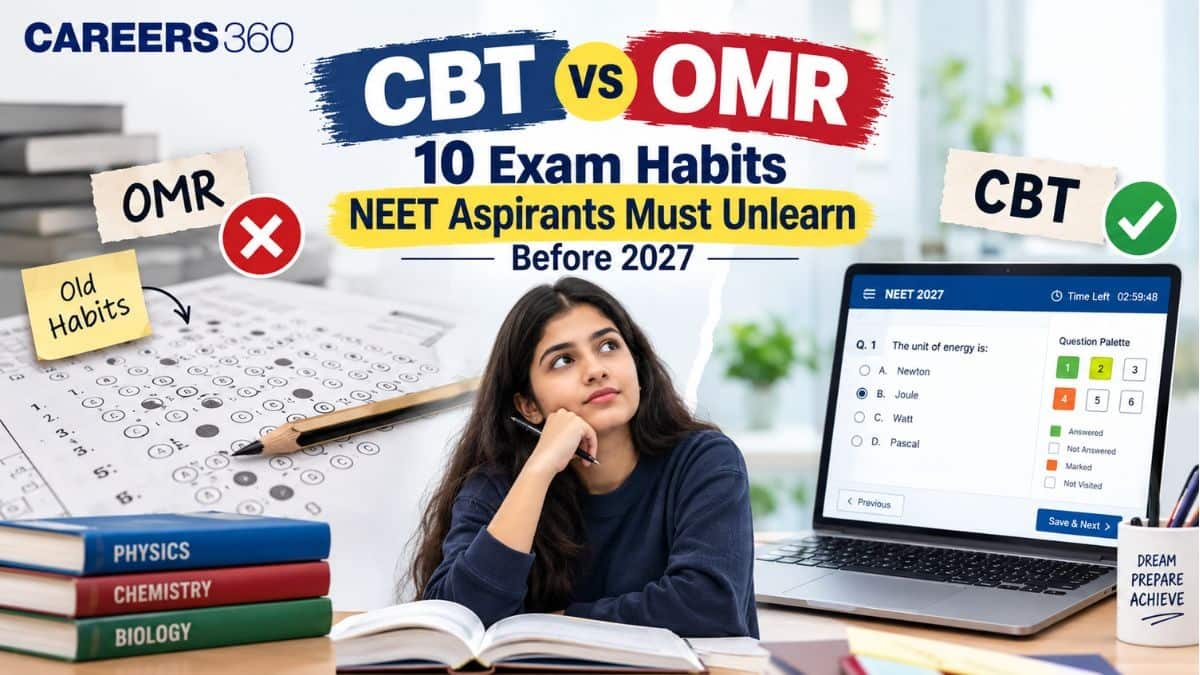
For lakhs of aspirants, the natural question is: will this make NEET harder? According to the detailed breakdown of what changes and what stays the same in NEET UG 2027 CBT mode, the syllabus, the 720-mark structure, and the negative marking scheme are all expected to stay the same. What actually changes is how you take the exam. And that's exactly where years of OMR-trained habits can start working against you instead of for you.
Here are the 10 habits every NEET aspirant, and especially every repeater, needs to unlearn before 2027.
On an OMR sheet, many students develop a habit of marking an answer quickly and coming back to verify later, because shading a bubble feels low-commitment. On a CBT interface, clicking an option is just as reversible, but the interaction itself is different. There is no physical erase-and-redo option to slow you down and force a second look. Build the habit of pausing to confirm before you click, not after.
Every NEET aspirant does this. During the test, they flip back a few pages to double-check a Biology diagram or re-read a Physics question. There is no page-flipping on a computer screen. CBT interfaces use a question palette and navigation buttons instead, and unfamiliarity with that layout under time pressure can cost you far more than a few seconds.
OMR-based exams let you do calculations directly in the question booklet's margins, right next to the question. In CBT mode, rough work happens on a separate sheet provided at the centre, physically apart from your screen. That means constantly shifting your eyes between screen and paper — a skill that has to be practiced, not assumed.
On paper, students often circle or dog-ear a skipped question to return to it later. CBT systems replace this with a digital "mark for review" flag. If you're used to relying on memory or physical cues to track skipped questions, you need to build a new, disciplined habit of tagging and revisiting questions through the software itself.
Many paper-exam strategies budget time at the end to transfer rough-work answers onto the OMR sheet in one block. CBT has no such transfer phase — every click is the final submission in real time. Any pacing strategy built around a "transfer buffer" at the end of the exam needs to be redesigned from scratch.
Some students unconsciously calculate their progress by how much of the physical booklet or OMR sheet is left. On a screen, that visual cue disappears, and pacing depends entirely on the on-screen countdown timer and question counter. This sounds minor, but under exam pressure, losing a familiar cue can throw off your rhythm.
Three hours of continuous bubble-filling builds a specific kind of physical stamina — wrist fatigue, posture adjustments, and a rhythm your body has learned. Screen-based exams introduce a different kind of fatigue: eye strain, glare, and the mental load of constant on-screen navigation. If you've only ever built stamina for paper, screen fatigue can catch you off guard midway through the exam.
A common OMR-era habit is crossing out wrong options directly next to the printed question to narrow down an answer. In CBT mode, the question itself can't be marked up — all elimination logic has to move to your separate rough sheet, which takes deliberate practice to do quickly and cleanly.
Near the end of a paper exam, some students fill in remaining bubbles with a best guess, regardless of the negative marking risk. The scoring logic in CBT mode won't change, but the physical, almost automatic "fill something in" reflex doesn't translate directly to a screen — you have to consciously decide, click by click, whether guessing is worth it for each question.
This is the biggest habit to unlearn, because it undermines all the others. If your mock test practice has been entirely paper-based, you haven't actually built the specific skills CBT will test: screen navigation, digital pacing, on-screen review, and rough-work management on a separate sheet. Working through the full NEET mock test series in a screen-based, timed setting is a far more reliable simulation of exam day than paper mocks alone.
Get expert advice on college selection, admission chances, and career path in a personalized counselling session.
If you have spent an entire drop year drilling on paper, you're carrying the deepest OMR muscle memory of any aspirant group — and now you have an extra adjustment to make alongside your academic revision. That's not a reason to panic. It is a reason to start CBT-specific practice early, rather than assuming your existing prep will transfer automatically. The NEET preparation tips for droppers are a good starting point for building a recalibration plan well before exam day, built entirely around screen-based, full-length mock attempts.
The syllabus stays the same, based on NCERT Class 11 and 12 content; the exam still carries 720 total marks, and the negative marking scheme is expected to remain unchanged. This is not a harder exam. It is the same exam, delivered through an unfamiliar interface. The students who adapt fastest to that interface will have a real edge over those who don't.
You don't need to wait for NTA's final information bulletin to begin adjusting. Start with short, screen-based timed sessions and build up to full three-hour CBT-style mock attempts. Solving NEET previous year question papers and NEET sample papers on-screen, rather than on printouts, is one of the simplest ways to start building the right habits today. Get comfortable navigating a question palette, marking questions for review digitally, and managing rough work on paper separate from your screen. The sooner these become instinctive, the less exam day will feel like a completely new experience layered on top of an already high-stakes test.
Also Read:
Frequently Asked Questions (FAQs)
Yes. The Union Education Minister announced the move to CBT mode on May 15, 2026. However, the exact rollout details, including shift timings and city-wise arrangements, are still awaited in NTA's official information bulletin.
No. The syllabus, subject weightage, and marking scheme are expected to remain the same.
Not academically. The difficulty lies in adapting to a new interface, pacing method, and rough-work process — all of which can be practiced well in advance.
Begin taking full-length mock tests in a screen-based, timed format instead of relying only on paper-based practice. Get familiar with digital navigation tools like the question palette and the "mark for review" option.

On Question asked by student community
Hello Chetan,
Here are the links you asked for. I hope they serve your purpose.
Hello Suma,
Here are the links you asked for. I hope they serve your purpose.
Hello Bhanuday,
Here are the links you requested. I hope you find them helpful.
Hello Savi
Please check the link below:
Hope it helps.
Hello, for AP NEET PG Category C seats, NRI documents are generally required if you are applying under the NRI quota, and eligibility depends on the applicable counselling rules. The fee payment currency and procedure should be confirmed from the current Dr. NTRUHS notification at its official website drntr.uhsap.in.
the product 'P' will be ,


| Column A | Column B |
| A |
a) Organisation of cellular contents and further cell growth. |
| B |
b) Leads to formation of two daughter cells. |
| C |
c) Cell grows physically and increase volume proteins,organells. |
| D |
d) synthesis and replication of DNA. |
Match the correct option as per the process shown in the
0.16 g of dibasic acid required 25 ml of decinormal solution for complete neutralisation. The modecular weight of the acid will be
32
64
128
256
0xone is

Ranked #19 by NIRF, NAAC A++ Accredited | Recognized by dental council of India
Ranked among the top Dental Colleges for 7 consecutive years by India Today poll