Pursue MD/MS in USA
Want to study abroad? Plan your Journey


The FMGE June 2026 difficulty level was reported to be moderate to difficult by candidates, with several aspirants describing the paper as challenging due to more clinical reasoning, integrated concepts and application-based questions. The FMGE exam was conducted by the National Board of Examinations in Medical Sciences (NBEMS) on June 28, 2026.
This Story also Contains
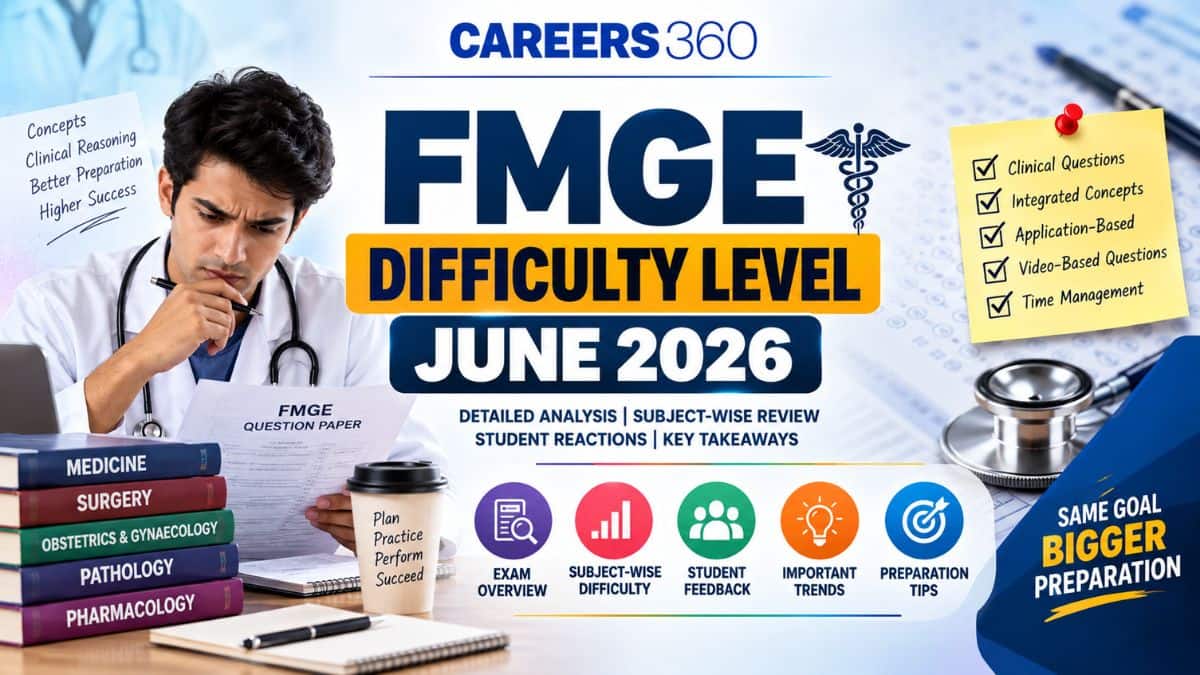
According to candidate feedback and early expert reviews, the FMGE June 2026 question paper included clinically oriented questions, closely framed answer options and questions that required more than simple factual recall. The introduction of video-based questions was also discussed by candidates after the exam. This article provides a detailed analysis of the FMGE June 2026 difficulty level, subject-wise paper review, question trends and important takeaways for candidates preparing for the upcoming FMGE October 2026 session.
The FMGE June 2026 exam was conducted in two computer-based papers on June 28, 2026. Based on the initial response from candidates and faculty analysis, the overall difficulty level of the examination was rated difficult, with a noticeable increase in concept-based and clinical reasoning questions. Unlike examinations that rely heavily on factual recall, the FMGE June 2026 paper required candidates to apply medical concepts across multiple subjects, interpret clinical scenarios, and select the most appropriate management approach.
Many candidates reported that the exam demanded strong conceptual clarity, careful interpretation of lengthy questions, and efficient time management. Paper 2, which covered clinical subjects, was generally perceived as more challenging because of longer clinical case-based questions and integrated concepts. Overall, candidates who had thoroughly revised standard textbooks, practised extensive MCQs, and developed sound clinical reasoning found the paper comparatively manageable.
Get expert advice on college selection, admission chances, and career path in a personalized counselling session.
Parameter | FMGE June 2026 |
Overall Difficulty | Difficult |
Paper Type | Concept-based |
Clinical Orientation | Very High |
Case-based Questions | High |
Direct Recall Questions | Limited |
Multi-concept Questions | High |
Time Management | Challenging |
Clinical Subjects | Tougher than pre-clinical subjects |
The June 2026 session continued the recent trend of assessing candidates through application-oriented and integrated medical concepts rather than isolated theoretical facts. Candidates consistently reported that understanding clinical reasoning was more important than memorising textbook lines.
The overall FMGE June 2026 difficulty level was reported to be difficult by a large section of candidates who appeared for the examination. Although the paper remained within the official FMGE syllabus prescribed by NBEMS, the nature of FMGE questions demanded conceptual clarity, sound clinical reasoning and the ability to apply knowledge across multiple disciplines.
Unlike examinations that rely heavily on factual recall, the FMGE June 2026 paper tested candidates through integrated clinical scenarios, application-based MCQs and closely related answer choices. Aspirants with regular question-bank practice and strong conceptual preparation generally found the paper manageable, whereas candidates who relied primarily on memorisation experienced greater difficulty. Overall, the examination maintained FMGE's reputation as a competency-based licensing examination designed to assess the practical application of medical knowledge rather than textbook recall.
Read now: FMGE June 2026 Exam Analysis
The FMGE June 2026 paper largely followed the recent examination pattern, with a clear emphasis on concept-driven and clinically oriented questions. Based on candidate feedback, the examination contained a higher proportion of application-based questions than direct factual questions, requiring candidates to analyse clinical situations before selecting the most appropriate answer.
Key observations from the June 2026 paper include:
Majority of questions were based on clinical scenarios and practical decision-making.
Multi-concept questions were frequently asked across different subjects.
Direct one-line factual questions were comparatively fewer.
Closely framed answer choices required careful interpretation.
Effective time management was essential, particularly during Paper 2 covering clinical subjects.
Overall, the question pattern aligned with FMGE's objective of evaluating whether foreign medical graduates possess the clinical competence required for medical practice in India.
The FMGE June 2026 subject-wise difficulty level varied across pre-clinical, para-clinical and clinical disciplines. Based on early candidate feedback and expert analysis, pre-clinical subjects were generally moderate in difficulty, whereas most clinical subjects required deeper conceptual understanding, clinical reasoning and interpretation of lengthy case-based questions. The table below summarises the overall difficulty trend observed in the June 2026 session.
Subject Category | Subjects | Difficulty Level | Nature of Questions |
Pre-Clinical | Anatomy | Moderate | Concept-based |
Physiology | Moderate | Application-oriented | |
Biochemistry | Moderate to High | Integration-focused | |
Para-Clinical | Pathology | Moderate to High | Conceptual + clinical |
Pharmacology | Moderate to High | Applied and mechanism-based | |
Microbiology | Moderate | Knowledge-based | |
Forensic Medicine | Moderate | Direct and conceptual | |
Clinical | Medicine | High | Clinically demanding |
Surgery | High | Case-based | |
Obstetrics & Gynaecology | High | Clinical decision-focused | |
Pediatrics | Moderate | Concept + clinical | |
Community Medicine | Moderate | Program- and guideline-based |
Many foreign medical graduates perceive the FMGE to be challenging because the examination evaluates competencies expected in the Indian healthcare system. Besides testing core medical concepts, the paper frequently includes questions related to Indian clinical practice, national health programmes, preventive medicine and standard treatment protocols.
Candidates trained outside India often require additional preparation in these areas. As a result, the difficulty usually stems from differences in curriculum and clinical exposure rather than the overall standard of the examination itself.
Candidates appearing for FMGE for the first time often find the examination more challenging because of its vast syllabus and clinically integrated question pattern. Many first-time test takers underestimate the importance of repeated revision, solving high-quality MCQs and practising full-length FMGE practice tests.
A structured preparation strategy focusing on conceptual understanding, regular revision and time-bound practice significantly improves the chances of clearing FMGE in the first attempt.
Candidates appearing for FMGE after a previous attempt generally have a better understanding of the examination pattern, question style and time management requirements. This familiarity often reduces the perceived difficulty level.
However, merely repeating the examination without modifying the preparation strategy may not improve performance. Successful repeat candidates usually strengthen weak subjects, increase MCQ practice and focus on conceptual revision rather than memorising isolated facts.
Several factors contributed to the overall difficulty level of the FMGE June 2026 examination:
Extensive syllabus covering all nineteen FMGE subjects.
Greater emphasis on clinical reasoning instead of factual recall.
Integration of concepts from multiple medical disciplines.
Closely related answer choices requiring careful interpretation.
Fixed qualifying score of 150 out of 300 marks without relative grading.
These factors collectively made the examination challenging while ensuring that successful candidates demonstrated the competencies expected for safe medical practice in India.
According to many candidates, the FMGE June 2026 exam difficulty level was moderate to difficult. The feedback received after the exam focused on clinical reasoning and questions based on concepts.
The preparation tips for the candidates appearing in the FMGE October 2026 exam should include concepts along with clinical cases in MCQs and mock test preparations.
Parameter | Analysis |
Overall Difficulty | Difficult |
Conceptual Level | High |
Clinical Orientation | Very High |
Clinical Questions | High |
Direct Recall | Limited |
Multi-concept Questions | High |
Time Management | Challenging |
To handle the FMGE 2026 difficulty level, candidates should do the following:
Build strong conceptual understanding instead of relying on rote memorisation.
Solve previous years’ FMGE question Papers to understand the examination pattern.
Practise high-quality MCQs and full-length mock tests under timed conditions.
Revise clinical subjects repeatedly while strengthening weaker pre-clinical and para-clinical areas.
Improve time management by attempting complete mock examinations before the next FMGE session.
Also Read:
Frequently Asked Questions (FAQs)
FMGE 2026 is expected to be moderately to highly difficult, but average students with consistent, concept-based preparation can manage the exam effectively.
Clinical subjects such as Medicine, Surgery, and Obstetrics & Gynaecology usually have higher weightage and contribute more to the FMGE 2026 exam difficulty.
Yes. Focused revision, strong clinical concepts, and familiarity with FMGE-style questions significantly reduce the perceived FMGE 2026 toughness level.

On Question asked by student community
If you completed your MBBS from Russia but have not cleared FMGE, you generally cannot register and practise as a doctor in India until you meet the applicable medical-registration requirements. You should therefore avoid assuming that you can work in India as an MBBS doctor without qualifying the required screening/licensing
Hello,
Yes, FMGE-qualified candidates who have completed the required internship and fulfil the National Medical Commission (NMC) and Maharashtra CET Cell eligibility criteria can participate in Maharashtra PG medical admissions.
Admission to MD/MS courses is based on NEET PG qualification, counselling rules, and other eligibility requirements. FMGE qualification alone does
Hey there,
If your Class 11 marksheet is slightly damaged or stained but all details, marks, school seal, and signatures are clearly visible, it is generally accepted during document verification. However, the final decision rests with the verifying authority. If the damage is significant, obtain a duplicate marksheet from your
If you're a Foreign Medical Graduate (FMG) and have not yet passed the FMGE , you cannot obtain medical registration to practice clinical medicine in India . This means you cannot legally work as a licensed doctor, prescribe medications, or enroll in most clinical postgraduate medical programs in India.
However,
Hello Dear Student,
You cannot appear for NEET PG 2026. The examination is scheduled for August 30, 2026, and the official internship completion deadline for candidates is September 30, 2026. Since your internship concludes on December 14, 2026, you will not meet the eligibility cutoff to sit for this specific

Check your expected admission chances in MD/MS/Diploma courses based on your NEET PG Score
Your one-stop NEET PG counseling package with complete hand-holding throughout the admission journey
Highest Package: ₹32 LPA | Placement Rate: 90% students placed | 5000+ Students Placed 900+ Placements Recruiters | Scholarships Available
Ranked #18 by NIRF, NAAC A++ Accredited | Unmatched clinical exposure with over 7 lakh patients yearly
Predict admission chances in AIIMS, JIPMER, PGIMER & NIMHANS Campuses
Want to study abroad? Plan your Journey