Emversity Allied Health Programs
Get Job Ready in Healthcare | Employability-Focused Programs


NEET 2027 High-Weightage Chapters in Physics: Physics is the subject that decides how close you get to a top NEET rank. It contributes 45 of the 180 questions and 180 of the 720 total marks — 25% of the paper. However, candidates consistently rate it the hardest section, since nearly every question is numerical or concept-application rather than direct one-line theory-based questions. Physics is usually where the real score gap between toppers and everyone else opens up. Once you finish planning for the NEET exam around Biology and Chemistry, focusing on Physics becomes important.
This Story also Contains
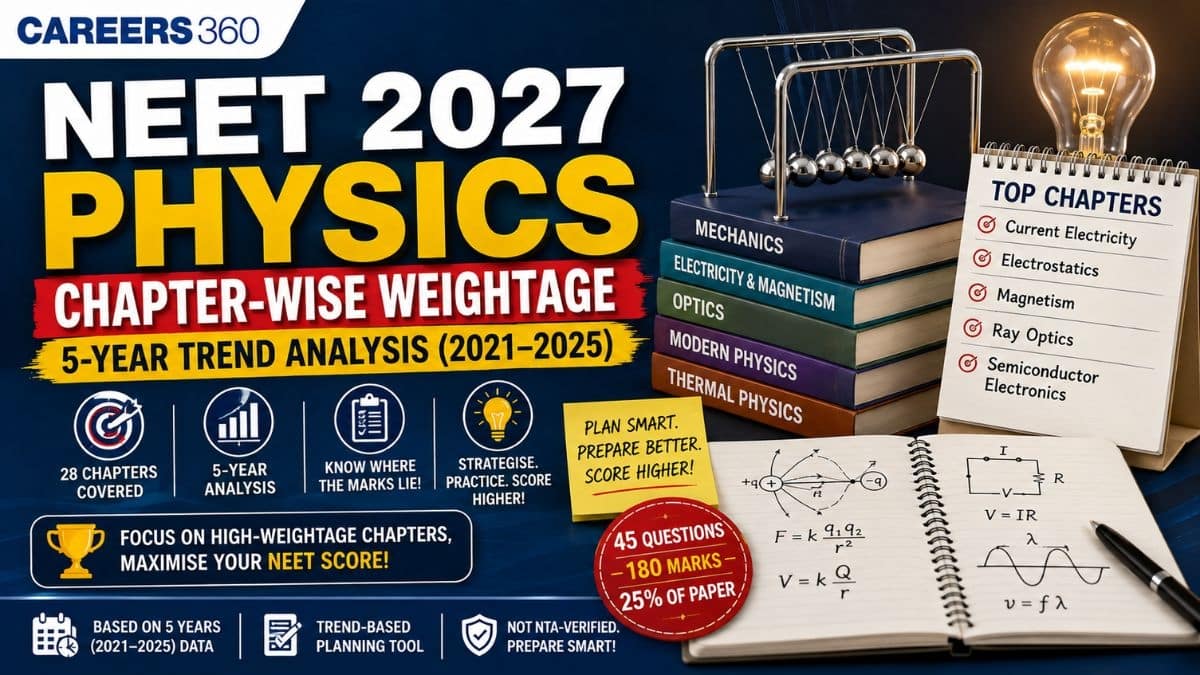
This article breaks down NEET 2027 Physics by chapter-wise weightage, built primarily from Careers360's five-year analysis (2021–2025) of previous NEET papers, with 2026 chapter-tagging data layered in separately where the categories genuinely match. The NTA does not publish an official weightage list, so this is trend-based planning, not an NTA-verified figure. It's built on the current rationalised NEET syllabus covering 28 Physics chapters across Class 11 and Class 12. Note that NTA hasn't released the NEET 2027 syllabus or exam date yet, so treat this as a preparation-planning resource to be cross-checked once the official notification is out.
These figures come from the official NEET exam pattern:
Physics contributes 45 questions out of 180 total NEET questions — 25% of the paper
Physics carries 180 marks out of 720 total marks
Each correct answer scores +4; each incorrect answer deducts 1 mark; unattempted questions score zero
Physics spans 28 chapters across the Class 11 and Class 12 NCERT syllabus, split roughly evenly between mechanics/thermal topics (Class 11) and electricity, magnetism, optics, and modern physics (Class 12)
Get expert advice on college selection, admission chances, and career path in a personalized counselling session.
The table below shows how many questions each chapter contributed across the last six NEET papers, including the 2026 paper, along with its overall six-year weightage percentage. A few 2026 figures were tagged under combined categories rather than exact NCERT chapters (marked with *) — see the note below the table for exactly how each was allocated.
Chapter | 2021 | 2022 | 2023 | 2024 | 2025 | 2026 | Weightage |
Current Electricity | 4 | 4 | 4 | 4 | 3 | 5 | 8.28% |
Ray Optics and Optical Instruments | 4 | 4 | 3 | 2 | 1 | 4* | 6.21% |
Semiconductor Electronics | 3 | 3 | 3 | 3 | 2 | 3 | 5.86% |
Electrostatic Potential and Capacitance | 3 | 5 | 1 | 4 | 2 | 1 | 5.52% |
Gravitation | 3 | 3 | 3 | 2 | 3 | 1 | 5.17% |
Moving Charges and Magnetism | 3 | 3 | 3 | 2 | 2 | 2* | 5.17% |
Oscillations | 2 | 3 | 2 | 4 | 2 | 1 | 4.83% |
Units and Measurements | 3 | 3 | 2 | 3 | 1 | 2 | 4.83% |
Electric Charges and Fields | 4 | 3 | 3 | 1 | 1 | 2 | 4.83% |
Alternating Current | 2 | 3 | 3 | 2 | 2 | 0* | 4.14% |
Electromagnetic Waves | 2 | 2 | 1 | 2 | 2 | 1 | 3.45% |
Work, Energy and Power | 1 | 1 | 2 | 2 | 3 | 1 | 3.45% |
Motion in a Straight Line | 1 | 1 | 2 | 2 | 2 | 2 | 3.45% |
Laws of Motion | 2 | 2 | 2 | 0 | 2 | 2 | 3.45% |
Electromagnetic Induction | 2 | 1 | 2 | 1 | 1 | 3* | 3.45% |
Thermodynamics | 1 | 1 | 1 | 3 | 2 | 1 | 3.10% |
System of Particles and Rotational Motion | 2 | 0 | 2 | 2 | 1 | 2 | 3.10% |
Nuclei | 3 | 3 | 1 | 1 | 0 | 0* | 2.76% |
Dual Nature of Matter and Radiation | 1 | 2 | 0 | 1 | 2 | 2 | 2.76% |
Atoms | 0 | 0 | 2 | 2 | 1 | 3* | 2.76% |
Mechanical Properties of Fluids | 1 | 1 | 2 | 0 | 2 | 1 | 2.41% |
Wave Optics | 0 | 0 | 1 | 2 | 3 | 0* | 2.07% |
Magnetism and Matter | 0 | 0 | 0 | 3 | 2 | 0* | 1.72% |
Kinetic Theory | 1 | 1 | 1 | 0 | 1 | 1 | 1.72% |
Motion in a Plane | 1 | 1 | 2 | 0 | 0 | 1 | 1.72% |
Waves | 1 | 0 | 0 | 0 | 1 | 3* | 1.72% |
Mechanical Properties of Solids | 0 | 0 | 1 | 2 | 0 | 1 | 1.38% |
Thermal Properties of Matter | 0 | 0 | 1 | 0 | 1 | 0 | 0.69% |
How the combined 2026 tags were allocated: Careers360's 2026 chapter-tagging data used a few broader labels rather than exact NCERT chapters.
"Optics" (4 questions) is shown against Ray Optics, with Wave Optics carrying 0 for 2026.
"Atoms And Nuclei" (3 questions) is shown against Atoms, with Nuclei carrying 0.
"Electromagnetic Induction and alternating Currents" (3 questions) is shown against Electromagnetic Induction, with Alternating Current carrying 0.
"Magnetic Effects of Current and Magnetism" (2 questions) is shown against Moving Charges and Magnetism, with Magnetism and Matter carrying 0.
"Oscillations and Waves" (2 questions) plus a separate
"Waves" tag (1 question) are combined and shown against Waves (3 total).
If you're revising chapter-by-chapter, treat these pairs as a single study block rather than assuming the untagged chapter in each pair had zero real presence in the 2026 paper.
Current Electricity is the single highest-weightage Physics chapter by a clear margin, appearing in every one of the last five papers with remarkable consistency. Kirchhoff's laws, Wheatstone bridge, and meter bridge problems are the recurring numerical formats.
Electrostatic Potential and Capacitance sits second, and it's a chapter where conceptual clarity on potential energy and capacitor combinations matters more than raw formula memorisation.
Four chapters are tied at 5.86% — Magnetism and Matter, Semiconductor Electronics, Gravitation, and Ray Optics and Optical Instruments. This is a useful cluster to study together where possible: Magnetism and Matter pairs naturally with Moving Charges and Magnetism, Semiconductor Electronics rewards diagram-based practice (p-n junction, logic gates), Gravitation is short and formula-driven, and Ray Optics needs consistent numerical practice with lens and mirror formulae.
Moving Charges and Magnetism and Oscillations follow closely at 5.44%, and Alternating Current, Units and Measurements, and Electric Charges and Fields round out the top tier at 5.02% each. Electric Charges and Fields in particular is foundational — weak preparation here tends to show up as errors in Electrostatic Potential and Capacitance questions too, since the two chapters build directly on each other.
Class 11: Gravitation, Oscillations, Units and Measurements, Work Energy and Power, Motion in a Straight Line, Laws of Motion, Thermodynamics
Class 12: Current Electricity, Electrostatic Potential and Capacitance, Magnetism and Matter, Semiconductor Electronics, Ray Optics and Optical Instruments, Moving Charges and Magnetism, Alternating Current, Electric Charges and Fields
Class 12 chapters dominate the top of this list, which matters for sequencing — if you're preparing from Class 11 onward, don't leave electricity, magnetism, and optics for a rushed final few months. They carry more combined weightage than almost anything from Class 11.
Careers360's internal 2026 chapter-tagging data (45 questions total, matching the exam pattern) confirms most of this trend held, though the 2026 tagging uses some broader combined categories rather than exact NCERT chapter splits, so it can't be merged cleanly into the five-year percentage table above. Worth flagging directly: Current Electricity was tagged 5 times in 2026 — its strongest single-year count in this entire window — while Optics (Ray and Wave optics combined) and Electromagnetic Induction with Alternating Current (combined) also stayed among the most-tagged categories, and Atoms and Nuclei (combined) held steady too. This broadly reinforces rather than contradicts the five-year ranking above, even without an exact chapter-level split for 2026.
Physics carries less weightage than Biology but demands more per-question time due to numericals, so a balanced NEET 2027 strategy matters. Once this list is under control, revisit the high-weightage Biology chapters for NEET and high-weightage Chemistry chapters for NEET, or see all three subjects mapped together via the combined NEET high-weightage chapters list.
Chapters above roughly 5% weightage need repeated numerical practice across your full preparation timeline, not just concept reading. Chapters in the 2–5% band need one thorough pass plus targeted revision, and chapters below 2% still deserve coverage since NEET occasionally draws more heavily from a normally low-yield chapter — check the do-or-die chapters for NEET list for the lower-weightage chapters that still shouldn't be skipped entirely.
Back this list with solid NEET study material and pair it with previous year NEET question papers, since Physics rewards seeing how a chapter's numericals are actually framed far more than memorising a weightage list on its own.
Also Read:
Frequently Asked Questions (FAQs)
Based on five-year trend analysis (2021–2025), Current Electricity has produced the most consistent question count of any single Physics chapter, followed by Electrostatic Potential and Capacitance.
Physics carries only 25% of the paper against Biology's 50%, but most candidates find it more time-consuming per question because it's numerical and application-based rather than recall-based. Many aspirants find prioritising high-weightage Physics chapters more valuable per hour invested than doing the same for Biology.
Use it as a starting priority map, not a complete strategy. Weightage data should guide how many revision cycles a chapter gets, but every chapter in the current syllabus still needs at least one solid pass, since NEET occasionally departs from its usual pattern in a given year.

On Question asked by student community
Hello, you can pursue BPT in Kerala without NEET UG. Admission is generally based on the LBS Centre rank list and the applicable admission process. You can check BPT colleges in Kerala and their details here: https://medicine.careers360.com/colleges/list-of-bpt-in-physiotherapy-colleges-in-kerala
Hello Student,
If you are looking for information about NEET PG 2025 DNB seat allotment and the fees payable at the allotted college or hospital, DNB seats are allotted through the respective counselling process based on your rank, category, choice of speciality, and seat availability.
For the 2025 session, the
Dear Student, with a NEET PG 2026 rank of 6,600 in the EWS category, your options should be assessed using the relevant counselling year's college-wise closing ranks, category-wise seats and counselling round. Please also confirm whether you are applying through the applicable All India counselling route or another quota. That
Hello
If you mean whether a school/college will be strict about attendance when you are preparing for NEET UG, it depends on the institution’s rules. NEET preparation itself is generally not a reason to ignore regular attendance.
For example, CBSE requires 75% attendance for board-exam eligibility, with limited relaxation for
Hello Student,
Aapke NEET marks 372 aur AIR 3,51,532 hain. Lekin 3rd round mein MBBS seat ke liye counselling karani chahiye ya nahi, iska sahi answer dene ke liye mujhe aapki category, domicile state, aur aap AIQ se counselling kar rahe hain ya state quota se—ye details chahiye.
In details
the product 'P' will be ,


| Column A | Column B |
| A |
a) Organisation of cellular contents and further cell growth. |
| B |
b) Leads to formation of two daughter cells. |
| C |
c) Cell grows physically and increase volume proteins,organells. |
| D |
d) synthesis and replication of DNA. |
Match the correct option as per the process shown in the
0.16 g of dibasic acid required 25 ml of decinormal solution for complete neutralisation. The modecular weight of the acid will be
32
64
128
256
0xone is

Know possible Govt/Private MBBS/BDS Colleges based on your NEET rank
College Predictors Webinars One to One Counselling Regular Updates Medical Almanac
Highest Package: ₹32 LPA | Placement Rate: 90% students placed | 5000+ Students Placed 900+ Placements Recruiters | Scholarships Available
33.5 LPA-Highest Package | Up to 100% scholarship worth 30 CR
Get Job Ready in Healthcare | Employability-Focused Programs
Get Started With Your Healthcare Career. 2026 Admissions open.